 FinCrime Intelligence

Suspicious activity reporting is one of the most consequential outputs of a financial crime compliance programme. A SAR, suspicious transaction report or suspicious matter report is not merely an administrative record of an alert. It is a regulatory disclosure that should explain what happened, why the activity is suspicious, who is involved, how funds moved and what information may help a financial intelligence unit or law-enforcement agency.
Investigators nevertheless spend substantial time extracting data from fragmented systems, reconstructing timelines, calculating totals and translating case notes into concise narratives. Generative artificial intelligence creates a credible opportunity to reduce this burden. Properly designed, it can assemble verified facts, organise them chronologically, identify gaps and produce a reviewable first draft.
The strategic boundary is critical. AI can support the expression of suspicion, but it should not manufacture suspicion, invent evidence or assume the accountable reporting decision. The most defensible model is a governed co-pilot in which technology accelerates evidence assembly and drafting while trained investigators retain responsibility for judgement, accuracy and submission.
Listen the podcast
Watch the video
Why AI-driven SAR drafting matters now
Reporting volumes demonstrate the operational challenge. FinCEN recorded approximately 4.8 million SARs in the United States during fiscal year 2025, up from 4.3 million in 2022. In the United Kingdom, the UK Financial Intelligence Unit receives more than 850,000 SARs annually and holds over 4.5 million reports in its central database. These filings support criminal investigations and strategic intelligence.
Volume alone does not create intelligence value. A poorly structured report can contain many transactions while failing to explain the underlying suspicion. FinCEN’s guidance states that a complete narrative should address who, what, when, where and why, together with how the activity occurred. It recommends a concise, chronological structure comprising an introduction, body and conclusion.
This creates a recurring tension. Investigators must manage alert volumes, filing deadlines and consistent reporting standards, but relevant information may sit across monitoring platforms, customer files, payment systems, device tools, communications and previous investigations. Drafting can therefore become the final bottleneck in an otherwise technology-enabled workflow.
AI is arriving as the wider sector is increasing adoption. A 2024 Bank of England and FCA survey found that 75% of responding firms used AI and another 10% planned to adopt it within three years. Foundation models represented 17% of AI use cases, while one third of implementations involved third parties. These figures do not prove widespread live use for SAR drafting, but they show that the infrastructure and governance questions are already entering regulated firms.
What AI-assisted SAR drafting actually does
The most useful systems do not begin with an open prompt asking a general-purpose model to “write a SAR”. They begin with controlled evidence assembly.
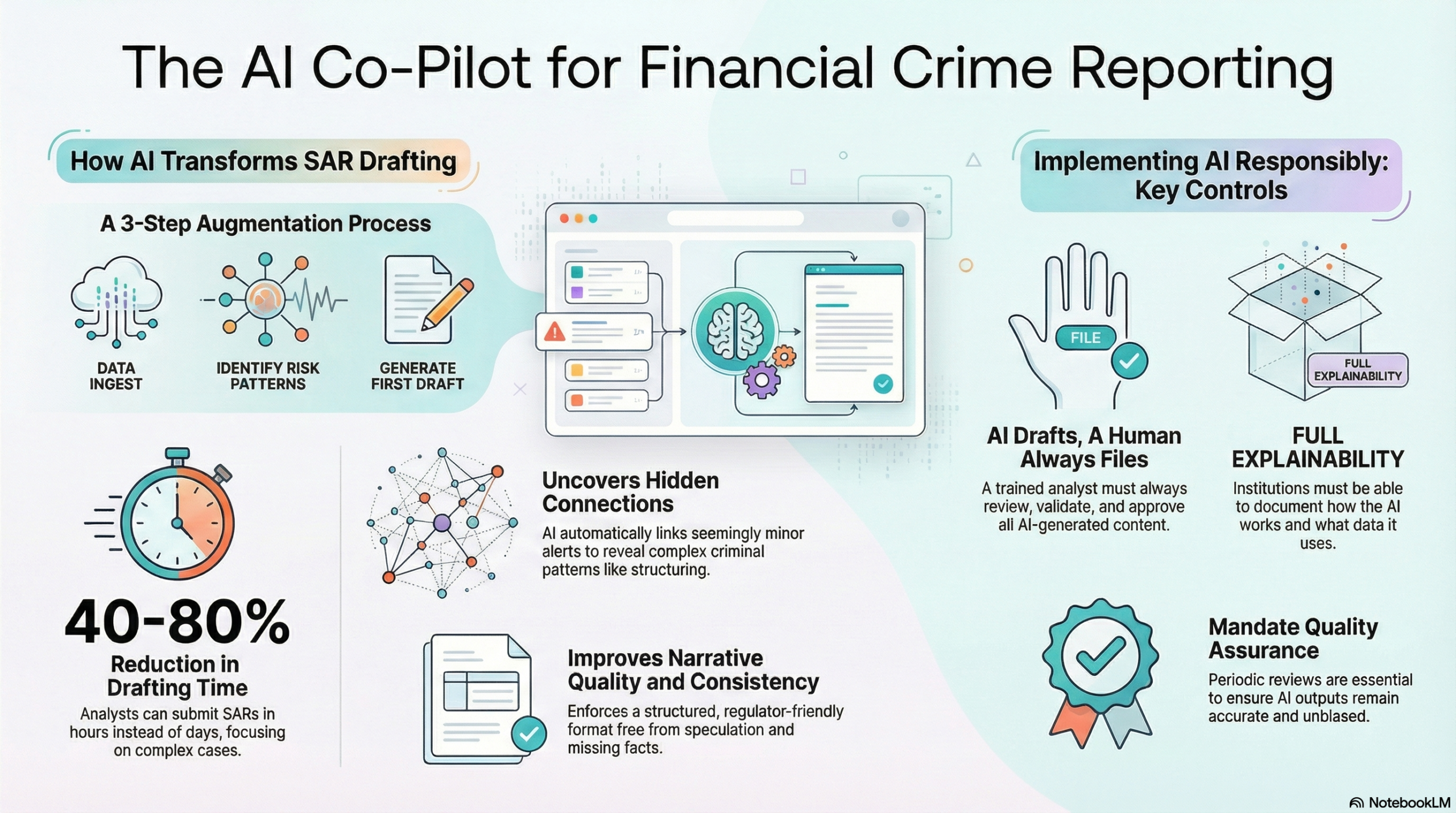
A drafting tool can retrieve customer identifiers, expected activity, risk ratings, transactions, counterparties, alert reasons, investigator notes and relevant intelligence. It can normalise dates and currencies, remove duplicates, calculate totals and build a chronology. The model can then convert that structured case package into a narrative aligned with the institution’s template and jurisdictional requirements.
Retrieval-augmented generation is particularly relevant. Rather than relying on general training data, the institution supplies an approved case-specific source set and controlled guidance such as typology definitions, reporting instructions and glossary codes. Each generated statement should be linked to its source record, reducing the space in which the model can improvise and making review more efficient.
AI can also operate as a quality-control layer. It can check whether the draft includes the relevant parties, period, amounts, jurisdictions, instruments, suspicion rationale and relationship disposition. It can flag unsupported conclusions, inconsistent totals, missing identifiers or a narrative that describes activity without explaining why it is unusual.
The technology should remain downstream of the investigative decision. A human determines whether the facts meet the institution’s suspicion threshold and whether reporting is required. AI helps communicate that decision; it does not replace the judgement that created it.
Where the real possibilities are emerging
Public disclosures currently describe drafting prototypes and investigator-assistance architectures more frequently than autonomous regulatory filing. This distinction matters because solution demonstrations and vendor claims should not be presented as evidence that regulated institutions have delegated reporting decisions to generative AI.
Practical architectures are, however, becoming visible. In 2025, AWS published a reference solution showing how foundation models could generate a draft suspicious transaction report from account information, transaction data, correspondence summaries and a knowledge base of fraudulent entities. It is a technical blueprint rather than proof of autonomous filing, but it demonstrates that the required components can be integrated into a controlled workflow.
The immediate use cases are narrower and more defensible. AI can summarise an investigation, convert raw transactions into a chronological flow-of-funds description, draft an opening synopsis, prepare a continuing-activity update and compare a report against a quality checklist. It can adapt presentation for different regimes while preserving the same verified evidential core.
More advanced systems could support network reporting. Combined with graph analytics, AI can explain relationships among customers, shell companies, counterparties and payment routes, identify central nodes and summarise movement across several generations.
The value is not simply faster writing. It is the opportunity to redirect investigator time from formatting towards testing explanations, reviewing linked entities, identifying typologies and deciding what intelligence is most useful.
Why AI drafting can fail
The principal risk is factual confabulation. A fluent narrative may introduce an unproven relationship, infer criminal purpose beyond the evidence, merge counterparties, alter a date or present an estimate as fact. Because the prose sounds authoritative, the error may be difficult to detect.
Omission is equally serious. A model may produce a coherent account while excluding a transaction, prior report, jurisdiction, customer explanation or contradictory fact that changes the case. The objective cannot be linguistic quality alone. It must be evidential completeness and faithful representation of uncertainty.
Automation bias can weaken review. Investigators under time pressure may accept polished text too readily, especially after repeated good performance. Over time, teams may become skilled at editing prose but less capable of independently reconstructing activity, turning human approval into a ceremonial control.
Sensitive-data exposure is another concern. SAR cases can contain identity records, transactions, communications, law-enforcement requests and information about people not accused of wrongdoing. External models without adequate contractual, technical and access controls can create confidentiality, data-protection and cross-border risks. The ICO stresses that AI may exacerbate existing security risks and that data minimisation must reflect the nature and purpose of processing.
AI may also standardise weak reasoning. If historical reports contain defensive filing, vague suspicion rationales or bias, a model trained or prompted from those examples can reproduce the same deficiencies at scale. Faster drafting is not progress if it produces more low-value intelligence.
What a resilient control stack looks like
The first layer is a restricted evidence boundary. The model should draft only from approved case data and controlled guidance. Calculations, dates and identifiers should be generated or verified by deterministic systems rather than probabilistic text generation.
The second layer is source-level traceability. Investigators should be able to select a sentence and see the transaction, document or note supporting it. Unsupported claims should be blocked or visibly marked. The case file should preserve the source package, model version, workflow, generated draft, edits and approver.
The third layer is mandatory human accountability. A trained investigator must confirm the suspicion rationale, factual accuracy, material completeness and jurisdictional requirements. Reports involving terrorist financing, sanctions evasion, human trafficking, insiders or urgent restraint may require enhanced specialist review.
The fourth layer is independent validation and monitoring. Testing should cover factual errors, omissions, numerical accuracy, typology performance, consistency across customer groups and resilience to unusual inputs. The Wolfsberg Group’s innovation framework emphasises transition and validation, balancing model risk against financial crime risk, and explainability. Current OCC guidance similarly highlights development, testing, validation, monitoring, governance and third-party controls.
The fifth layer is privacy and security engineering. Institutions should minimise data supplied to the model, segregate environments, control retention, encrypt information, restrict access and prevent case data from being reused for external training. Vendor due diligence should cover hosting, subcontractors, incident response, data location, model changes and access to audit evidence.
Clear failure procedures are also necessary. Investigators must know when to disregard generated text, revert to manual drafting, escalate anomalous behaviour or suspend the system after a material error.
How institutions should implement AI drafting
The safest implementation begins in shadow mode. The system produces drafts alongside the existing process while investigators continue to prepare the official narrative independently. Outputs can then be compared against a benchmark set covering different products, typologies, languages, customer segments and levels of complexity.
Deployment can then move to low-complexity assistance with mandatory line-by-line review. Functions such as automatic chronology creation, network summaries and continuing-activity reports should be added only when data lineage and validation are mature.
Success measures should extend beyond handling time. Institutions should track factual corrections, material omissions, rejected drafts, overrides, quality-assurance findings, resubmissions and regulatory or law-enforcement feedback. A tool that saves time but increases omissions is not effective.
Quality teams should classify whether errors arose from source data, retrieval, calculation, generation or human approval and use those findings to strengthen controls. Models should not learn indiscriminately from every edit because investigator changes may themselves be inconsistent.
FATF recognises that technology can improve AML/CFT efficiency and help institutions analyse structured and unstructured data, while stressing responsible adoption and respect for privacy frameworks. The FCA likewise applies existing outcome-focused governance and senior accountability expectations to AI rather than treating it as outside the regulatory perimeter.
What this means for financial crime leaders
AI-driven SAR drafting should be treated as a reporting-control transformation, not a writing application. It changes how evidence is assembled, judgement is documented, quality is measured and sensitive data moves through the institution.
The strongest business case is not headcount reduction. It is better consistency, faster escalation, stronger traceability and more investigator capacity for complex analysis. Those benefits require reliable data and a mature reporting process. AI cannot repair weak investigations or unclear suspicion standards simply by producing better prose.
Leaders should ask whether every generated statement can be traced to evidence, whether investigators remain capable of challenging the output, whether model changes are controlled and whether performance is measured against intelligence value rather than speed.
Suspicious activity reporting is likely to become increasingly AI-assisted. But the report remains an accountable statement by the institution. The winning model will not be the one that writes fastest. It will be the one that converts verified evidence into clear and useful intelligence without weakening judgement, confidentiality or regulatory responsibility.
What Financial Institutions Should Consider
- Maintain Mandatory Human Review and Approval
- Establish Clear AI Governance and Accountability
- Protect Sensitive SAR and Customer Data
- Validate AI-Generated Facts Against Source Evidence
- Prevent Hallucination and Unsupported Conclusions
- Implement Robust Quality Assurance Controls
- Maintain Complete Audit Trails and Version Histories
- Monitor Model Performance and Output Consistency
- Control Prompts, Data Sources and Model Access
- Integrate AI Securely With Case Management Systems
- Train Investigators to Review AI-Generated Narratives
- Define Appropriate Use Cases and Escalation Thresholds
- Measure Improvements in Quality, Accuracy and Efficiency
- Prepare for AI-Enabled End-to-End Case Intelligence



AI-driven SAR drafting represents a significant opportunity to improve the efficiency, consistency and analytical value of suspicious activity reporting. By helping investigators assemble evidence, reconstruct transaction timelines, summarise complex activity and identify gaps, AI can reduce administrative burden and allow more time to be directed towards investigative judgement.
However, the value of these systems depends entirely on how they are governed. A fluent narrative is not necessarily an accurate one, and a faster process is not automatically a better process. Every statement must remain grounded in verified case evidence, material uncertainty must be preserved, and investigators must retain clear responsibility for the suspicion decision and the final regulatory submission.
The most resilient model is therefore not autonomous reporting, but controlled augmentation. This requires restricted data boundaries, source-level traceability, deterministic validation of key facts, mandatory human review and ongoing monitoring for factual errors, omissions, bias and automation dependency.
Financial institutions should assess success through the quality and usefulness of the intelligence produced, not only through time saved. AI should strengthen the connection between evidence, judgement and reporting—not weaken it.
Ultimately, the future of suspicious activity reporting will likely be increasingly AI-assisted, but accountability will remain human and institutional. The strongest programmes will be those that use technology to enhance investigative clarity while preserving accuracy, confidentiality and regulatory integrity.