 FinCrime Intelligence

Digital advertising has become a critical component of modern commerce. Businesses can open advertising accounts, fund campaigns, purchase media across jurisdictions and measure customer engagement almost immediately. Agencies, resellers, publishers, ad exchanges, payment processors and affiliate networks may all participate in the delivery and settlement of a single campaign.
The same scale and flexibility create opportunities for abuse. Criminal actors can use fictitious advertising services to explain large commercial payments, generate fraudulent advertising revenue through automated traffic, fund campaigns with stolen payment instruments or route value through agencies and publishers under their control. Advertising may also support the predicate offence by directing potential victims towards fraudulent investments, counterfeit goods, phishing sites or other scams.
“Ad money laundering” is best understood as an analytical umbrella rather than a universally defined regulatory typology. Not every suspicious advertising payment constitutes money laundering, and not every form of advertising fraud involves criminal proceeds being concealed. The financial-crime risk emerges when advertising expenditure, revenue, refunds, commissions or agency settlements are used to disguise the source, ownership, destination or economic purpose of illicit value.
Key Takeaways
- Advertising Payments Can Conceal Illicit Value
- Ad Money Laundering Is Broader Than Advertising Fraud
- Fictitious Marketing Services Can Facilitate Value Transfer
- Fraudulent Ad Inventory Can Generate Apparently Legitimate Revenue
- Affiliate Networks Can Obscure Related-Party Transactions
- Stolen Payment Instruments Can Fund Wider Criminal Activity
- Refunds, Rebates and Credits Can Create Additional Layers
- Agencies and Resellers Can Distance Payers From Beneficiaries
- Advertising Supply Chains Create Significant Data Fragmentation
- Economic Purpose Is More Important Than Payment Size Alone
Listen the podcast
Watch the video
Why advertising payments matter now
The digital advertising market operates through a complex and highly automated supply chain. A campaign may involve an advertiser, media agency, demand-side platform, advertising exchange, supply-side platform, publisher and several specialist intermediaries. Payments and performance data may be distributed across those participants, while the advertiser’s bank sees only a transfer or card payment described as a marketing expense.
The UK Competition and Markets Authority has identified significant transparency problems within programmatic advertising, including limited visibility over intermediary fees, auction processes, ad verification and attribution. The UK government has similarly described online advertising as a vast, complex, often opaque and automated ecosystem in which advertisements are delivered at speed and scale. These characteristics do not make the sector inherently criminal, but they can make it difficult to establish who purchased an advertisement, where it appeared, who ultimately received the revenue and whether the underlying commercial activity was genuine.
Advertising also sits close to several financial-crime threat chainshttps://fincrimeintelligence.com/glossary/fraud-detection/. Fraudsters use paid search, social-media advertising and sponsored content to acquire victims for investment scams, fake shops, impersonation schemes and fraudulent services. FATF has identified social-media advertising and fake websites as tools used to perpetrate cyber-enabled fraud remotely and at scale. Europol investigations continue to show victims being directed towards apparently legitimate online investment platforms through deceptive advertisements. In those cases, the advertising payment facilitates the predicate offence; the laundering usually occurs when victim funds are moved through mule accounts, payment companies or virtual-asset channels.
The distinction is operationally important. Financial institutions should not classify every payment to an advertising platform as laundering. They should assess whether the expenditure is commercially plausible, whether the payer and beneficiary relationships make sense and whether advertising activity forms part of a wider flow of illicit funds.
How advertising can conceal or transform criminal value
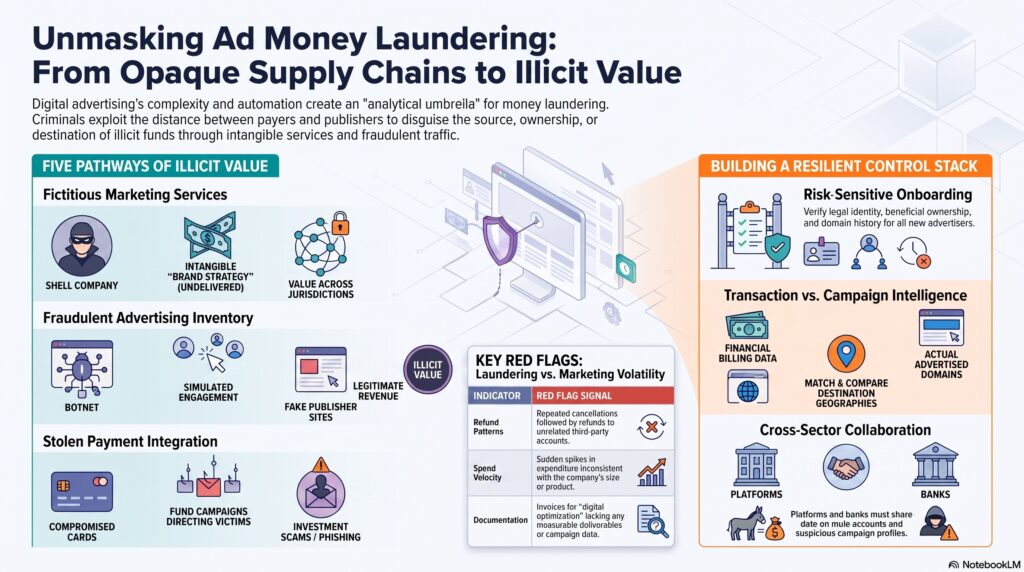
One pathway involves fictitious advertising or marketing services. A shell company may pay an agency, consultant, influencer network or media reseller for campaigns that were never delivered or were materially overstated. The recipient can retain a commission and return the remaining value through another company, jurisdiction or payment method.
Because marketing services are intangible, their value can be difficult to verify. An invoice may refer to campaign management, brand strategy, customer acquisition or digital optimisation without identifying measurable deliverables. Large fluctuations in expenditure can also appear commercially plausible where a business claims to be launching a product, entering a market or acquiring customers.
This resembles service-based trade laundering: apparently legitimate commercial documentation is used to justify a transfer whose real purpose is moving value between connected parties. FinCEN identifies inconsistent business activity, payments lacking a clear purpose and multiple high-value transfers between shell companies without an apparent legitimate rationale as relevant money-laundering indicators.
A second pathway involves fraudulent advertising inventory. Criminals can create fake publishers, spoof legitimate domains or operate websites designed primarily to display advertisements. Bots, malware-infected devices or data-centre servers then simulate human views, clicks and video engagement. Advertisers pay for activity that never involved genuine customers, and the operator receives apparently legitimate advertising revenue.
The US Department of Justice’s prosecution of the 3ve digital-advertising schemes demonstrates the scale of this model. One network allegedly used more than 1,900 servers, spoofed over 5,000 domains and falsified billions of advertising views. A related botnet accessed more than 1.7 million infected computers. Together, the schemes allegedly caused businesses to pay tens of millions of dollars for advertisements that were never viewed by genuine users. The defendants faced fraud, identity-theft, computer-intrusion and money-laundering charges, and one operator was subsequently convicted in relation to more than $7 million in losses.
Here, advertising is both the fraud mechanism and the revenue source. The laundering risk arises when fraudulent advertising proceeds are moved through companies, processors and accounts designed to make them appear to be ordinary publisher or technology income.
A third pathway involves affiliate and lead-generation networks. Businesses routinely pay commissions for clicks, leads, registrations or completed sales. Criminal actors can exploit this model by generating fake users, stolen identities or fabricated transactions, or by controlling both the advertiser and the affiliate receiving the commission.
Related entities may circulate payments while presenting them as customer-acquisition costs and performance revenue. The same network can use bots to create traffic, shell merchants to record sales and payment accounts to receive commissions. The apparent commercial activity obscures the fact that no independent customer demand exists.
A fourth pathway involves stolen or third-party payment instruments. Criminals may fund advertising with compromised cards, unauthorised bank accounts or payment credentials obtained through account takeover. They may use the campaigns to promote fraudulent businesses, sell prohibited goods or direct victims to phishing and investment sites.
The advertising purchase itself is initially a payment-fraud event rather than necessarily money laundering. It becomes part of a laundering structure where the criminal network converts stolen payment capacity into revenue, leads, digital assets or sales controlled elsewhere in the operation. Payment processors servicing internet merchants have long been recognised as vulnerable to fraud, identity theft, illicit transactions and money laundering, particularly where high chargeback levels, complaints or redundant banking relationships are present.
A fifth pathway can involve advertising balances, credits, rebates and refunds. Depending on the platform and contractual arrangement, advertisers may pre-fund accounts, receive agency rebates or recover unspent balances. Abuse can occur where funds are loaded without a credible campaign purpose, repeatedly moved among accounts or returned through a channel that reduces transparency around their original source.
This typology should be assessed carefully because refund practices differ materially across platforms and payment methods. A refund is not suspicious simply because it follows a large advertising payment. The stronger indicators are circularity, mismatched funding and refund instruments, repeated campaign cancellations, unrelated third-party recipients or patterns that lack a reasonable marketing explanation.
Finally, advertising agencies and resellers can create additional distance between the payer and the platform. A bank may see payments to a legitimate agency, while the platform identifies a different advertiser, domain or beneficial owner. Criminal clients may use multiple agencies, white-label accounts or cross-border resellers to replace accounts that have been suspended and obscure who controls the campaigns.
Why the activity is difficult to detect
The first challenge is commercial variability. Advertising expenditure can change rapidly based on seasonality, product launches, acquisition targets or market conditions. High spending is not inherently unusual for a growing digital business, and smaller companies can legitimately spend more on advertising than their current revenue might suggest.
The second challenge is data fragmentation. Banks see account and payment information. Platforms see advertisers, campaign content, landing pages, devices and billing profiles. Agencies see contracts and media plans. Publishers and ad exchanges see inventory and traffic. No participant necessarily sees the full commercial and financial chain.
The third challenge is the speed and volume of programmatic activity. Advertising impressions may be bought and sold in real time, with revenue divided among several intermediaries. That complexity can allow fraudulent inventory, misrepresented domains and controlled counterparties to blend into legitimate transactions.
Industry standards such as ads.txt, sellers.json and the SupplyChain object seek to improve transparency by identifying authorised sellers and intermediaries. These tools can make counterfeit inventory and domain misrepresentation more difficult, but they are not substitutes for customer due diligence, payment monitoring or investigation of beneficial ownership.
The fourth challenge is regulatory fragmentation. Banks, card issuers and regulated payment providers generally operate established financial-crime controls, while other participants may be governed primarily through advertising, consumer-protection, platform-safety or commercial rules. Responsibilities can therefore become distributed across sectors with different data, incentives and escalation processes.
What an evidence-led investigation looks like
The investigation should begin by establishing the economic purpose of the advertising expenditure. Analysts should understand what the customer sells, its target market, typical customer-acquisition cost, expected campaign volumes and relationships with agencies or publishers.
Invoices alone are insufficient. Investigators may need media plans, campaign identifiers, platform statements, contracts, landing pages, performance reports and evidence of genuine customer conversions. The objective is not to second-guess marketing strategy but to determine whether the claimed activity exists and is broadly consistent with the payments.
The second step is reconstructing the flow of funds. Analysts should identify who funded the advertising account, which entity owned the campaign, where advertisements directed users, which publishers or affiliates received revenue and whether refunds or rebates returned to the original payer. Related-party payments and changes of jurisdiction should be examined against beneficial ownership and commercial rationale.
The third step is examining digital infrastructure. Shared devices, IP addresses, domains, analytics identifiers, payment instruments and administrator accounts can reveal apparently separate advertisers or publishers operating as one network. Recently registered domains, copied content, non-functional websites and campaigns unrelated to the customer’s declared business may strengthen suspicion.
The fourth step is distinguishing the underlying offence. The case may involve payment fraud, fraudulent advertising inventory, transaction laundering, scam facilitation, sanctions exposure or laundering of proceeds from another predicate offence. Correct classification determines what evidence should be gathered, which teams should be involved and how suspicious activity should be reported.
What a resilient control stack looks like
The first layer is risk-sensitive onboarding. Advertising platforms, agencies, payment providers and financial institutions should verify legal identity, beneficial ownership, business activity, domains and expected payment methods. Greater scrutiny may be appropriate for newly formed companies claiming substantial advertising budgets, complex agency structures or high-risk products.
Advertiser-verification programmes can increase transparency by connecting advertisements to verified organisations and public disclosures. Google, for example, states that its verification programme may examine identity, business operations and suspicious advertising behaviour, with verified information appearing in ad disclosures and its transparency centre. These measures strengthen attribution but do not guarantee that every verified advertiser or campaign is legitimate.
The second layer is transaction and billing analytics. Controls should consider unusual increases in advertising spend, multiple accounts funded by the same instrument, frequent payment-method changes, high chargebacks, repetitive refunds and expenditure inconsistent with the customer’s size or product.
The third layer is campaign-level intelligence. Payments should be connected, where legally and operationally possible, with the advertised domain, campaign purpose, destination geography and advertiser identity. A company claiming to promote domestic professional services should not generate unexplained campaigns for unrelated investment products across multiple jurisdictions.
The fourth layer is network analysis. Shared payment cards, bank accounts, devices, administrators, domains, agencies and publishers can identify connected structures that account-by-account monitoring will miss. Confirmed fraud or laundering cases should be used to search retrospectively for related advertisers and beneficiaries.
The fifth layer is cross-sector collaboration. Platforms should be able to provide actionable campaign and account information when regulated firms investigate suspicious payments. Financial institutions can contribute transaction patterns, mule-account intelligence and chargeback data. The UK’s policy work on online advertising has emphasised shared responsibility across advertisers, platforms, intermediaries and publishers rather than placing the entire burden on one participant
What this means for financial crime leaders
Ad money laundering should not be reduced to a rule for “large payments to advertising platforms”. The underlying risk is the mismatch between the apparent commercial purpose and the real movement of value.
The strongest programmes will connect financial transactions with business activity, campaign data, digital infrastructure and counterparty relationships. They will distinguish ordinary marketing expenditure from fictitious services, advertising fraud, stolen-payment activity and the laundering of criminal proceeds.
Leaders should ask whether teams can identify who ultimately funded and benefited from a campaign, whether agency and reseller relationships are transparent and whether refunds, commissions and publisher revenue can be traced across the full chain.
Advertising is designed to attract attention. Its financial infrastructure can nevertheless conceal activity behind ordinary-looking business payments, automated settlement and multiple intermediaries. Recognising that advertising expenditure and revenue can form part of a laundering architecture is the first step towards exposing the value flows that remain hidden behind the campaign.
What Financial Institutions Should Consider
- Verify the Economic Purpose of Advertising Expenditure
- Strengthen Due Diligence on Advertisers and Agencies
- Connect Payments With Campaign-Level Intelligence
- Monitor Unusual Advertising Spend and Payment Changes
- Analyse Refunds, Rebates and Circular Fund Flows
- Review Beneficial Ownership and Related-Party Relationships
- Detect Shared Devices, Domains and Payment Instruments
- Apply Network Analytics Across Advertisers and Publishers
- Distinguish Advertising Fraud From Money Laundering
- Investigate High Chargebacks and Unusual Billing Patterns
- Strengthen Cross-Sector Intelligence Sharing
- Link Transaction Monitoring With Digital Infrastructure
- Perform Retrospective Searches After Confirmed Cases
- Focus on the Ultimate Economic Beneficiary
Download the briefing
Ad Money Laundering: Exploiting the Digital Advertising Frontier



Ad money laundering is not defined by advertising expenditure alone, but by the misuse of advertising-related payments, revenues, commissions, refunds and agency relationships to disguise the true source, ownership or destination of illicit value.
The complexity of the digital advertising ecosystem makes this risk difficult to detect. Legitimate campaigns often involve multiple intermediaries, intangible services, cross-border settlements and rapidly changing expenditure. Those same features can be exploited through fictitious marketing services, fraudulent traffic, related-party transactions, compromised payment instruments and opaque reseller arrangements.
Effective detection therefore requires more than monitoring for unusually large payments to advertising platforms. Financial institutions, payment providers and advertising businesses need to connect financial activity with beneficial ownership, campaign purpose, digital infrastructure, customer behaviour and the identity of the ultimate economic beneficiary.
The strongest control frameworks will distinguish clearly between advertising fraud, scam facilitation, payment abuse and money laundering while recognising that these activities can converge within the same criminal network. They will also convert confirmed cases into shared intelligence across platforms, banks, agencies and law enforcement.
Ultimately, the central question is whether the advertising activity reflects genuine commercial demand or merely provides a credible explanation for moving value. Institutions capable of testing that economic reality will be better positioned to identify illicit flows hidden behind apparently ordinary marketing transactions.