Executive Summary
Financial crime is entering a more adaptive phase. Criminals are no longer limited to static phishing templates, fixed malware signatures, reusable fake documents or predictable laundering patterns. Artificial intelligence is enabling a new generation of polymorphic attacks: campaigns that can modify their content, infrastructure, social engineering scripts, identity artefacts, transaction behaviour and evasion tactics in near real time.
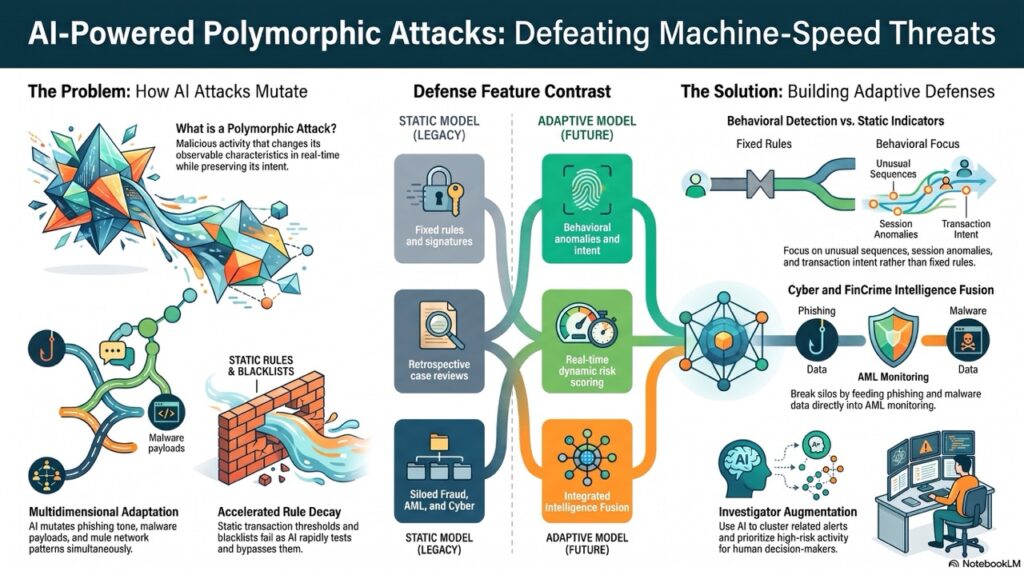
In cybersecurity, the term “polymorphic” has historically described malware that changes its code or appearance to avoid signature-based detection. In financial crime, the same principle is now expanding beyond malware. Fraud attempts, synthetic identities, mule networks, phishing campaigns, scam journeys and laundering routes can now be continuously adjusted based on what works, what fails and what controls are encountered.
This matters because many financial crime controls still rely on static rules, fixed scenarios, known indicators, historical typologies and periodic model tuning. These controls remain necessary, but they are no longer sufficient on their own. Adaptive criminal campaigns can test controls, identify weaknesses and mutate faster than traditional detection frameworks can respond.
For banks, payment firms, fintechs, cryptoasset service providers and other regulated financial institutions, AI-powered polymorphic attacks create a convergence problem. Cybersecurity, fraud prevention, AML, KYC, sanctions compliance, transaction monitoring and customer protection can no longer operate as separate defensive disciplines. The same attack may begin with cyber reconnaissance, continue through social engineering, result in authorised push payment fraud, move through mule accounts, and ultimately generate laundering indicators that require financial crime investigation.
The institutions best positioned to respond will be those that move from static detection to adaptive defence. That means stronger behavioural analytics, dynamic typology management, cyber-fraud-AML intelligence fusion, real-time risk scoring, better mule network detection, stronger identity controls, investigator feedback loops, and board-level governance over AI-enabled financial crime risk.
The central question is no longer whether criminals will use AI. They already are. The strategic question is whether financial institutions can adapt faster than the campaigns targeting them.
Listen the podcast
Watch the video
Key Takeaways
AI-powered polymorphic attacks are not simply “AI phishing” or “deepfake fraud.” They represent a broader shift towards adaptive financial crime campaigns that can change form, channel, timing, content and transaction behaviour during execution.
Traditional financial crime controls are vulnerable when they depend too heavily on fixed rules, known typologies, static red flags or delayed control refresh cycles.
The greatest risk sits at the intersection of cybercrime, fraud and AML. A single AI-enabled attack chain may include credential compromise, account takeover, authorised payment manipulation, mule account activity, synthetic identity abuse and laundering behaviour.
Financial institutions should prioritise behavioural detection over appearance-based detection. The question is not only whether a document, email, device or transaction looks suspicious in isolation, but whether the behaviour surrounding it is consistent with legitimate customer activity.
Boards and senior management should treat AI-enabled financial crime as a strategic risk, not only a technology issue. The response requires governance, investment, cross-functional coordination and measurable control adaptation.
Why This Matters Now
Financial crime has always evolved in response to controls. When banks improved card fraud detection, criminals shifted towards social engineering and authorised push payment fraud. When customer due diligence improved, criminals invested in synthetic identities, mule recruitment and document manipulation. When malware signatures became more effective, malware became polymorphic. The pattern is clear: criminal capability adapts to defensive pressure.
AI accelerates this cycle.
A scam campaign that previously required manual scripting, translation, document editing, impersonation and testing can now be generated, localised and varied at scale. A phishing kit can produce multiple versions of the same message. A fake onboarding journey can be supported by AI-generated identity material. A romance scam can maintain personalised conversations across multiple victims. A business email compromise attempt can be tailored to the writing style, role and transaction context of a specific employee. A fraudster can test different scripts, landing pages, sender names, payment instructions and urgency triggers, then rapidly shift to the version that works best.
The result is not just more fraud. It is faster fraud, more targeted fraud and more adaptive fraud.
For financial institutions, this creates a control mismatch. Many financial crime frameworks are designed around known patterns: a set of red flags, a transaction rule, a typology update, a suspicious activity report theme, a model threshold, a watchlist screen, a manual escalation procedure. These controls are still important, but they often assume that criminal behaviour changes gradually enough for compliance teams to observe it, analyse it and update controls.
AI-powered polymorphic attacks challenge that assumption.
The risk is especially acute because financial crime controls often operate in silos. Cybersecurity may detect credential harvesting. Fraud teams may detect unusual payment behaviour. AML teams may detect mule flows or layering. KYC teams may identify document anomalies. Sanctions teams may monitor counterparties and jurisdictions. But the criminal campaign itself does not respect these organisational boundaries.
An adaptive attack may look like a cyber event at the beginning, a fraud event in the middle and an AML event at the end. Institutions that investigate each phase separately may miss the full pattern.
What Are AI-Powered Polymorphic Attacks?
An AI-powered polymorphic attack is a campaign that uses artificial intelligence to alter its characteristics in order to increase success and reduce detection.
In financial crime, the “polymorphic” element can apply to multiple parts of the attack, including:
- The wording, tone and language of phishing messages.
- The visual design of fake websites or customer portals.
- The appearance of identity documents, selfies, videos or voice recordings.
- The sequence of account activity before a fraudulent payment.
- The timing, size and routing of transactions.
- The choice of mule accounts or withdrawal channels.
- The infrastructure used to host, deliver or support the campaign.
- The social engineering narrative used with victims or employees.
- The method used to bypass authentication or customer verification.
This is broader than traditional cyber polymorphism. A malicious file changing its signature is only one example. In financial crime, the attack may mutate across human behaviour, digital identity, communications, payment flows and laundering typologies.
For example, a criminal group running investment scams may use AI to create multiple versions of fake broker websites, generate convincing market commentary, produce professional-looking onboarding documents, automate victim conversations, alter scripts when victims become suspicious, and route payments through different mule networks depending on bank response. The core criminal objective remains the same, but the campaign continuously changes its visible form.
This adaptive quality makes detection more difficult. A rule designed to identify one version of the scam may fail when the language changes. A document fraud control trained on known templates may struggle with newly generated variations. A mule detection scenario based on previous flow patterns may miss a modified transaction sequence. A manual investigator may see isolated anomalies but not the underlying adaptive campaign.
AI does not need to make criminals perfect. It only needs to make them faster, cheaper and more scalable.
From Automation to Adaptation
Financial institutions are already familiar with automated attacks. Credential stuffing, bot-driven account opening, scripted phishing, mass spam campaigns and rule-based laundering structures are not new. The difference now is the move from automation to adaptation.
Automation repeats a process at scale.
Adaptation changes the process based on feedback.
A traditional automated phishing campaign may send the same email to thousands of recipients. An adaptive AI-assisted campaign can generate different versions of the message based on region, language, employer, role, financial behaviour or previous victim response. If one version underperforms, the campaign can shift to another. If a domain is blocked, another can be generated. If a bank detects one transaction pattern, the criminal group can experiment with a different payment sequence.
The same distinction applies to mule activity. A basic mule network may reuse known accounts, similar transaction sizes and predictable cash-out methods. An adaptive network can vary payment amounts, split transactions, delay onward movement, rotate devices, diversify receiving accounts, use staged account-warming activity and adjust cash-out behaviour depending on detection pressure.
This creates a machine-speed learning loop for criminals:
- Launch multiple variations of an attack.
- Observe which versions pass controls or generate victim response.
- Discard weak versions.
- Amplify successful versions.
- Modify indicators when detection increases.
- Repeat the cycle.
Financial institutions have their own learning loops, but they are often slower. A new typology may be identified by investigators, escalated to compliance, reviewed by model governance, translated into rules, tested, approved and deployed. That process can take weeks or months. Criminals may adapt in hours or days.
The strategic challenge is therefore one of speed and feedback. Institutions need detection and governance models that can learn from emerging behaviour quickly, without compromising explainability, fairness, regulatory accountability or operational control.
The Adaptive Financial Crime Attack Chain
AI-powered polymorphic attacks should be understood as an attack chain, not as a single event. The following model illustrates how an adaptive campaign may unfold across cyber, fraud and AML domains.
1. Target Selection and Reconnaissance
The campaign begins with intelligence gathering. Criminals collect information from public sources, data breaches, social media, corporate websites, professional networks and previous scam interactions. AI can help organise this information, identify high-value targets, infer relationships, draft personalised messages and select the most plausible attack narrative.
For retail customers, the target may be selected based on age, vulnerability, recent life events, online behaviour or previous fraud exposure. For businesses, the target may be a finance employee, executive assistant, accounts payable team, legal department or treasury function. For financial institutions, the target may be customer onboarding, payment operations, contact centre staff or relationship managers.
2. Personalised Social Engineering
The attacker then deploys AI-generated social engineering. This may include phishing emails, SMS messages, instant messages, fake customer support chats, voice cloning, deepfake video, fake invoices, investment materials, romance scam scripts, recruitment messages or impersonation of trusted parties.
The attack is polymorphic because the content can change quickly. Tone, urgency, language, sender identity, branding and payment instructions can be adapted to the victim and channel.
A customer may receive a message that appears to come from their bank. A company employee may receive a payment instruction appearing to come from a senior executive. A job seeker may receive a fake recruitment message requesting identity documents or bank details. A victim of an investment scam may be shown AI-generated market commentary, fake account balances and professional-looking onboarding material.
3. Credential Capture, Authentication Manipulation or Authorised Payment Inducement
The next stage depends on the objective. Some campaigns aim to capture credentials. Others manipulate the victim into authorising a payment. Some seek identity documents for synthetic identity creation. Others attempt to bypass authentication or exploit account recovery processes.
AI can support this stage by generating convincing fake login pages, automating helpdesk-style conversations, creating plausible explanations for urgent payments, or coaching criminals through victim interaction.
In authorised push payment fraud, the customer may technically approve the transaction, but the approval is the result of manipulation. In account takeover, the criminal may gain direct access and attempt to change profile details, add payees, suppress alerts or initiate payments.
4. Account Behaviour Manipulation
Once access or influence is obtained, the attacker may alter behaviour to avoid detection. This can include changing device fingerprints, using residential proxies, modifying contact details, adding new beneficiaries gradually, testing small transactions, splitting larger payments, delaying cash-out or using account-warming techniques.
This is where polymorphism becomes especially important for financial institutions. A static rule may detect a large first payment to a new beneficiary. But what if the attacker first changes contact details, waits, makes a small payment, waits again, then initiates several moderate payments? What if the mule account has been warmed with legitimate-looking activity? What if the fraudster adapts timing to avoid known monitoring windows?
5. Payment Execution
The fraudulent value transfer may occur through bank transfer, card payment, instant payment, cryptoasset purchase, remittance, merchant transaction, loan disbursement, insurance claim, trade payment or other financial channel.
AI-enabled campaigns can vary payment narratives. One victim is told to move money to a “safe account.” Another is told to pay tax on investment returns. Another is told to settle an invoice. Another is instructed to purchase cryptoassets. Another is manipulated into sending funds to an account controlled by a mule.
The payment may be structured to avoid thresholds, mimic expected customer behaviour or exploit known weaknesses in confirmation and reimbursement processes.
6. Mule Account Movement
Mule accounts remain central to many financial crime attack chains. Funds may move through personal accounts, business accounts, newly opened accounts, compromised accounts, student accounts, gig-worker accounts, synthetic identities or accounts controlled by organised criminal groups.
AI may assist mule recruitment through fake job adverts, social media outreach, romance scams or coercive narratives. It can also support account application fraud by generating synthetic identity material, fake employment information, false documents and plausible communication histories.
Adaptive mule networks may vary transaction sizes, use multiple receiving accounts, alter cash-out timing and shift between banks, payment firms, crypto platforms and international channels.
7. Layering and Obfuscation
After mule movement, funds may be layered through additional accounts, cash withdrawals, cryptoasset conversion, prepaid instruments, trade-based structures, gambling platforms, offshore entities or other channels.
At this stage, the activity may no longer look like the original fraud. AML teams may see suspicious flows, rapid movement, unusual counterparties, high-risk jurisdictions or inconsistent customer activity. But without upstream cyber and fraud context, the laundering pattern may appear fragmented.
8. Detection, Feedback and Mutation
The final stage is feedback. Criminals observe which messages are blocked, which accounts are frozen, which payments are delayed, which victims respond, which documents pass verification and which channels produce the highest yield.
They then mutate the campaign.
This is the core risk. The attack chain does not remain static long enough for traditional control cycles to catch up. The campaign learns, changes and continues.
Where Traditional Controls Break Down
Traditional financial crime controls are not obsolete, but their limitations become more visible in an adaptive threat environment.
Static Rules
Rules remain useful for known risks, but they struggle against behaviour that deliberately shifts around thresholds. If a rule triggers at a certain transaction amount, criminals may split payments. If a rule focuses on first-time payees, criminals may warm beneficiaries. If a rule targets specific wording in payment references, criminals may change the language.
Known Typologies
Typology libraries are essential, but they are often backward-looking. Adaptive attacks may combine old typologies in new ways: romance scam plus crypto investment fraud, mule recruitment plus synthetic identity, phishing plus authorised payment manipulation, invoice fraud plus deepfake voice confirmation.
Signature-Based Detection
In cybersecurity, signature-based detection can fail when malware changes its code. In financial crime, the equivalent problem occurs when fake documents, scam templates, websites, email wording or transaction structures continuously vary.
Periodic Model Refresh
Many monitoring models are reviewed periodically. That cadence may be too slow for machine-speed campaigns. A model that performed well last quarter may miss a new attack pattern that emerged last week.
Siloed Investigations
Cyber teams may see credential compromise. Fraud teams may see payment manipulation. AML teams may see mule flows. KYC teams may see identity anomalies. Unless these signals are connected, the institution may underestimate the scale and sophistication of the campaign.
Manual Review Overload
AI increases volume. More alerts, more variations, more false documents, more suspicious journeys and more customer contacts can overwhelm manual teams. Investigators need better tooling, prioritisation and context, not simply more alerts.
FinCrime Domains Most Affected
Fraud Prevention
Fraud teams face the most immediate pressure. AI improves phishing, impersonation, scam scripting, fake customer support, business email compromise, invoice fraud, investment scams and authorised push payment fraud. The challenge is to identify manipulation even when the customer appears to be acting voluntarily.
AML and Transaction Monitoring
AML teams must detect downstream laundering patterns linked to AI-enabled fraud. Mule accounts, rapid fund movement, layering, crypto conversion and cross-border flows may all originate from adaptive upstream scams.
KYC and Customer Onboarding
Identity controls are exposed to synthetic identities, AI-generated documents, manipulated selfies, deepfake video and plausible false customer profiles. Onboarding teams need stronger liveness checks, document verification, behavioural analytics and post-onboarding monitoring.
Mule Detection
Mule activity is likely to become more adaptive. Criminals can use AI to recruit mules, create fake job adverts, manage communications and generate plausible explanations for account activity. Detection must move beyond individual transactions towards network behaviour.
Cybersecurity
Cyber teams must recognise that credential theft, phishing, malware, session hijacking and social engineering may be precursors to financial crime events. Cyber alerts should feed financial crime risk scoring and investigation workflows.
Sanctions and Screening
Adaptive criminal networks may route funds through complex chains, intermediaries, false identities or entities designed to obscure beneficial ownership. Screening tools need contextual intelligence, not only name matching.
Customer Protection
AI-generated scams can be more emotionally persuasive and personalised. Vulnerability detection, customer education, friction design and intervention strategies become more important.
Behavioural Red Flags and Detection Opportunities
Financial institutions should focus less on whether an isolated artefact looks suspicious and more on whether behaviour deviates from expected patterns.
Relevant indicators may include:
- Login from a new device followed by profile changes or new beneficiary creation.
- Contact detail changes shortly before payment activity.
- Suppression or failure of customer notifications.
- Unusual IP, device, geolocation or session behaviour.
- Failed authentication attempts followed by successful access.
- Sudden payment activity after a period of dormancy.
- Multiple payments to new beneficiaries within a short period.
- Payment splitting below known thresholds.
- Rapid movement of funds through newly opened accounts.
- Inbound funds followed by immediate onward transfer.
- Shared device, address, phone, document or IP indicators across multiple accounts.
- Inconsistent identity data across onboarding and transaction behaviour.
- Customers appearing coached, pressured or confused during verification.
- Payment references inconsistent with customer history.
- New accounts receiving funds from multiple unrelated victims.
- Multiple accounts showing similar opening patterns, funding behaviour or cash-out routes.
- Use of high-risk channels shortly after account opening.
- Repeated chargebacks, rejected payments or failed transfers linked to the same customer cluster.
- Gradual account detail changes designed to avoid sudden-risk triggers.
- Customer reluctance to discuss payment purpose freely, suggesting third-party coaching.
- Unusual cryptoasset purchases following social engineering indicators.
The strongest signals often appear in combination. A new device alone may not be suspicious. A new device, contact detail change, new beneficiary, urgent payment and unusual customer behaviour together may indicate a serious risk.
Building an Adaptive Defence Model
To respond effectively, financial institutions need an adaptive defence model that matches the speed and flexibility of the threat.
1. Cyber-Fraud-AML Intelligence Fusion
Institutions should integrate relevant cyber, fraud, AML, KYC and customer-risk signals. A phishing campaign should not remain only a cybersecurity issue. Account takeover indicators should inform fraud controls. Mule activity should inform AML investigations. Suspicious onboarding clusters should feed fraud and transaction monitoring.
A joined-up intelligence function can identify the full campaign, not just isolated events.
2. Behavioural Analytics
Behavioural analytics should be central to detection. This includes customer behaviour, device behaviour, transaction behaviour, beneficiary behaviour, session behaviour and network behaviour.
The objective is to identify inconsistency, escalation, manipulation and coordination.
3. Dynamic Typology Management
Typology libraries should be treated as living intelligence assets. They need frequent updates, rapid escalation channels, investigator feedback and clear ownership. When a new AI-enabled fraud pattern emerges, institutions should be able to convert that intelligence into detection logic quickly.
4. Real-Time Risk Scoring
High-risk events should be assessed in real time or near real time. This may include new beneficiary creation, unusual payment initiation, contact detail changes, high-risk login behaviour, onboarding anomalies and rapid fund movement.
Real-time scoring should support proportionate intervention, not indiscriminate friction.
5. Stronger Identity and Authentication Controls
Phishing-resistant authentication, robust liveness detection, document verification, device intelligence and account recovery controls are increasingly important. Identity should not be treated as a one-time onboarding event. It should be monitored across the customer lifecycle.
6. Mule Network Analytics
Mule detection should move beyond single-account monitoring. Network analytics can identify clusters of accounts sharing devices, addresses, phone numbers, behavioural patterns, counterparties or transaction flows.
This is particularly important where criminals use multiple low-value transactions to avoid obvious thresholds.
7. AI-Assisted Investigation
AI can support defenders by summarising alerts, identifying linked cases, extracting indicators, prioritising risk, generating investigative timelines and detecting emerging patterns. However, AI-assisted investigation must be governed carefully. Human oversight, auditability, explainability and data protection remain essential.
8. Red Teaming and Scenario Testing
Financial institutions should test controls against adaptive financial crime scenarios. This should include phishing-to-payment journeys, synthetic identity onboarding, deepfake-supported verification attempts, mule account movement, crypto conversion and cross-channel laundering.
The objective is not only to test whether one control works, but whether the institution can detect and respond to the full chain.
Governance Questions for Boards and Senior Management
Boards and senior management should ask direct questions about AI-enabled financial crime exposure.
Strategic Risk
- Do we understand how AI changes our fraud, AML, cyber and identity risk profile?
- Is AI-enabled financial crime included in our enterprise risk assessment?
- Do we treat cyber-fraud-AML convergence as a strategic risk?
Control Effectiveness
- Which controls rely heavily on static rules or historical typologies?
- How quickly can we update detection logic when a new typology emerges?
- Are our models monitored for drift and emerging false negatives?
- Do we test controls against adaptive attack scenarios?
Organisational Coordination
- Are cyber, fraud, AML, KYC, sanctions and customer protection teams sharing intelligence effectively?
- Do cyber incidents automatically trigger financial crime risk assessment where relevant?
- Do fraud events generate AML review where mule activity or laundering is suspected?
Identity and Authentication
- Are our authentication controls resilient to phishing, social engineering and deepfake-supported manipulation?
- Are account recovery processes adequately protected?
- Do we monitor identity risk after onboarding?
Investigation and Reporting
- Can investigators see linked cyber, fraud and AML context in one place?
- Are suspicious activity reports capturing AI-enabled elements where relevant?
- Do we track mule networks, not only individual mule accounts?
Metrics and Accountability
- Do board reports measure adaptation speed, not only alert volumes?
- Do we measure prevented losses, disrupted mule networks, recovered funds and customer harm reduction?
- Is there clear accountability for AI-enabled financial crime risk?
Practical Recommendations
Immediate Priorities
Financial institutions should start with a targeted exposure review. This should examine AI-enabled phishing, deepfake fraud, synthetic identity risk, account takeover, mule activity and authorised payment manipulation.
They should identify controls that are most vulnerable to polymorphic evasion, especially those based on static thresholds, fixed red flags or known templates.
Cyber, fraud and AML teams should review recent cases together to identify common upstream indicators. This may reveal that apparently separate incidents are part of the same adaptive campaign.
Institutions should also review escalation processes. When a high-risk fraud typology emerges, there should be a clear route for rapid control adjustment, investigator briefing and senior management awareness.
Medium-Term Enhancements
In the medium term, institutions should invest in behavioural analytics, mule network detection, dynamic typology management and stronger identity assurance.
They should also establish a formal cyber-fraud-AML working group or intelligence cell. This function should review emerging threats, convert intelligence into controls, support investigations and brief governance committees.
Training is also essential. Investigators need to understand AI-enabled social engineering, deepfake risks, synthetic identity indicators, mule recruitment methods and adaptive transaction behaviour.
Strategic Investments
Over the longer term, financial institutions should build adaptive financial crime architecture. This means integrated data, real-time risk scoring, AI-assisted investigation, explainable analytics, continuous typology refresh and scenario-based testing.
They should also define their own responsible use of AI in financial crime compliance. AI can improve detection, but it introduces governance obligations around accuracy, bias, explainability, data protection, auditability and human oversight.
The strongest institutions will not simply add AI tools to existing processes. They will redesign financial crime defence around intelligence, adaptability and cross-functional coordination.

Conclusion
AI-powered polymorphic attacks mark a significant shift in the financial crime threat landscape. Criminals are using AI not only to scale attacks, but to make them more adaptive, personalised and difficult to detect.
The core risk is speed. Attackers can test, learn and mutate faster than many traditional control frameworks can respond. They can change messages, documents, payment patterns, mule routes and social engineering narratives while a campaign is still active.
For financial institutions, the answer is not to abandon existing controls. Static rules, typologies, authentication, transaction monitoring and manual investigation remain important. But they must be strengthened by adaptive capabilities: behavioural analytics, real-time intelligence, network detection, cyber-fraud-AML fusion, dynamic typology management and board-level oversight.
The future of financial crime defence will depend on the ability to detect change, not just known indicators. Institutions must ask whether their controls can recognise the behaviour behind the attack, even when the surface appearance keeps changing.
The organisations that succeed will be those that move fastest from reactive compliance to adaptive financial crime intelligence.


For financial crime professionals, AI-powered polymorphic attacks should be viewed as more than a cybersecurity issue. They are a financial crime operating model. They affect onboarding, authentication, fraud prevention, transaction monitoring, mule detection, AML investigations, sanctions risk, customer protection and regulatory reporting.
This requires a shift in mindset.
Financial crime teams should not only ask: “Does this transaction match a known typology?”
They should also ask:
What changed in the customer’s behaviour?
What changed in the device, session or identity profile?
What changed before the payment was made?
Are multiple accounts showing related behaviour?
Is this fraud event connected to mule activity?
Is this AML alert linked to upstream cyber compromise?
Is the institution seeing a campaign, not just an incident?
AI-enabled criminals are becoming more adaptive. Financial crime controls must become adaptive too.