 FinCrime Intelligence

Thailand’s financial-crime landscape is defined by convergence. The country is a major regional economy, tourism and trade hub, and gateway connecting mainland Southeast Asia with global financial and logistics networks. Those advantages also create exposure to drug trafficking, cyber-enabled fraud, human trafficking, corruption, illegal gambling, trade-based money laundering and the movement of illicit value through companies, cash, digital assets and mule accounts.
Thailand combines sophisticated banking and payment systems with high-volume cash activity, informal commerce, extensive borders and close economic links to jurisdictions affected by organised crime and instability. It may act as a source, transit point, destination or financial interface at different stages of the same criminal operation.
For financial institutions, the central issue is not whether Thailand should be classified as uniformly high risk. It is whether the institution understands which customers, sectors, corridors and products create exposure to its specific criminal economy.
Key Takeaways
- Thailand Faces a Converging Financial Crime Threat Landscape
- Cyber-Enabled Fraud and Mule Networks Are Major Emerging Risks
- Drug Trafficking Remains Closely Linked to Regional Laundering Activity
- Scam Centres Are Reshaping Cross-Border Fraud Exposure
- Human Trafficking and Forced Criminality Create Complex Financial Indicators
- Corruption and Misuse of Legal Persons Remain Material Risks
- Illegal Gambling Generates Significant Laundering Exposure
- Digital Assets Add New Cross-Border Value-Transfer Channels
- Trade-Based Money Laundering Exploits Thailand’s Commercial Connectivity
- Informal Financial Channels Can Obscure Illicit Fund Flows
- Terrorist and Proliferation Financing Risks Require Contextual Monitoring
- Criminal Networks Increasingly Share Accounts, Companies, Devices and Payment Infrastructure
- Country Risk Should Be Assessed at Customer, Sector and Corridor Level Rather Than Through a Single Rating
Listen the podcast
Watch the video
Why Thailand matters now
Thailand’s 2022 National Risk Assessment identified malfeasance in office, narcotics, gambling, natural-resource exploitation and public fraud among the country’s highest-risk money-laundering predicate offences. It also recognised material exposure to human trafficking, smuggling, loan sharking, tax offences, cybercrime and the misuse of legal persons.
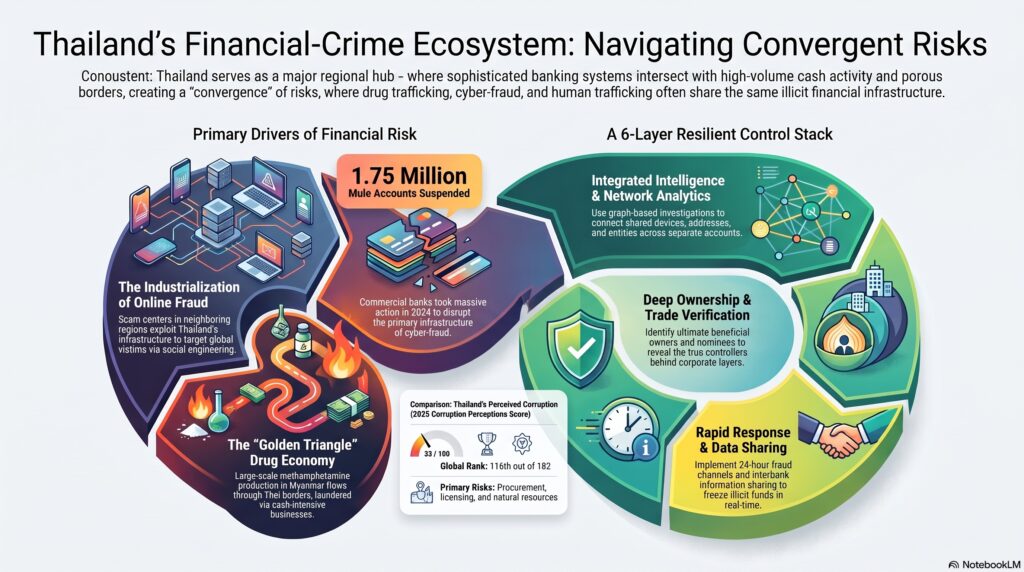
That picture has since been reshaped by industrial-scale online fraud across the Mekong region. Scam centres in neighbouring jurisdictions use social engineering, fraudulent investment platforms, impersonation and romance-based manipulation to target victims globally. Thailand’s borders, communications infrastructure, transport links, financial system and labour market intersect with the recruitment, transit, payment and disruption stages of these operations.
The country has strengthened its legal and operational response. However, the latest publicly available Asia/Pacific Group follow-up assessment kept Thailand in enhanced follow-up, reflecting the difference between improved technical compliance and stronger effectiveness across investigation, supervision, confiscation and risk-based controls.
Drug trafficking and the Golden Triangle economy
The Golden Triangle remains one of the world’s most important illicit drug-production zones. Large-scale methamphetamine manufacture in Myanmar has transformed the regional market, with tablets and crystalline methamphetamine moving through Laos and Thailand towards domestic consumers and international destinations.
Thailand has largely eliminated significant domestic opium cultivation, but its roads, rivers, ports and borders remain exposed to heroin, methamphetamine, ketamine and precursor chemicals. Networks use concealed cargo, smaller crossings, commercial logistics and maritime routes, adapting when enforcement pressure changes.
Their financial requirements include precursor procurement, transport, protection, storage and wholesale distribution. Proceeds may be laundered through cash-intensive businesses, property, vehicles, gold, informal remittance, corporate accounts and cross-border trade.
For regulated institutions, risk may appear through unexplained cash deposits, rapid account-to-account movement, payments involving logistics or chemical businesses and activity inconsistent with declared agricultural or trading income. The objective is not to treat every border customer as suspicious, but to identify when commercial activity lacks a credible economic basis.
Cyber-enabled fraud, mule accounts and scam-centre proceeds
Online scams have become one of Thailand’s most visible financial-crime threats. Fraudsters impersonate banks, police, government agencies and platforms; promote fraudulent investments; compromise devices; and manipulate victims into authorising transfers.
The financial infrastructure is built around mule accounts. Some are opened by willing participants, while others belong to people deceived through fake employment, coerced by criminal groups or persuaded to lease their accounts. Corporate entities may also be used to receive larger transfers or present a more credible beneficiary.
Thailand has responded through the Anti-Online Scam Operation Center, emergency reporting channels and expanded interbank information sharing. The Bank of Thailand reported that commercial banks suspended approximately 1.75 million mule accounts during 2024. Measures introduced subsequently moved detection from the account towards the person and network, allowing institutions to share information on high-risk customers, restrict incoming and outgoing funds and act before a victim report is received.
This is an important transition. Account closures alone will not disrupt networks that recruit replacements quickly. Effective controls must identify shared devices, telephone numbers, addresses, companies, beneficiaries and cash-out routes, while connecting cyber compromise with payment and receiving-account risk.
Thailand’s exposure is regional. Scam compounds near its borders have been associated with organised crime, trafficking and forced criminality. Enforcement may displace activity rather than eliminate it, creating new payment routes and more distributed laundering structures.
Human trafficking and forced criminality
Thailand is a source, transit and destination country for trafficking in persons. Migrant workers can face debt bondage, deceptive recruitment, document retention and exploitation in fishing, agriculture, construction, domestic work and services.
The scam economy has added another dimension. Individuals recruited for technology, sales or customer-service roles may be transported through Thailand or neighbouring countries and forced to conduct online fraud. Some are trafficking victims; others may later become participants or recruiters. This creates difficult evidential questions because the same individual can be both exploited and involved in suspicious transactions.
Financial institutions should consider indicators such as salary-like payments followed by rapid transfers, unrelated workers sharing contact details, recruitment fees, unusual employer control and remittances inconsistent with known employment. A victim-centred approach means distinguishing organisers and beneficiaries from people whose accounts or labour are being exploited.
Corruption, legal persons and influential networks
Corruption remains a material risk. Thailand scored 33 out of 100 in the 2025 Corruption Perceptions Index and ranked 116th among 182 jurisdictions. The index does not prove individual wrongdoing, but it provides context for scrutiny of public procurement, licensing, concessions, natural resources and politically exposed relationships.
Corruption can protect or enable trafficking, illegal gambling, procurement manipulation and natural-resource exploitation. Proceeds may be disguised through relatives, nominees, private companies, property and commercial contracts.
Nominee shareholders, layered ownership, rapid director changes and companies with limited operational substance can obscure effective control. Banks should not rely solely on registration records where behaviour, funding and decision-making suggest another person controls the relationship.
Politically exposed person controls should remain evidence-led. The objective is to understand source of wealth, source of funds, public functions, connected parties and the commercial rationale for transactions—not to treat political exposure as proof of corruption.
Gambling, digital assets and underground financial services
Illegal gambling is a significant predicate offence in Thailand. Online platforms have expanded its reach, allowing operators to serve customers remotely and settle through bank accounts, e-wallets and digital assets.
Gambling networks can generate proceeds directly and provide laundering services for other crimes. High transaction velocity, round-value transfers, numerous unrelated counterparties and rapid conversion into cash or cryptoassets may indicate this model.
Thailand regulates digital-asset businesses through the Securities and Exchange Commission and strengthened its framework in 2025 to restrict unlicensed foreign platforms targeting Thai users. Licensed operators remain subject to AML obligations, but criminals can use offshore exchanges, peer-to-peer trading, stablecoins and unhosted wallets outside the most transparent part of the market.
Cryptoasset activity is not inherently suspicious. Risk increases where transactions lack a credible purpose, move rapidly through several wallets or connect to scam, gambling and mule-account networks.
Trade, wildlife and illicit commodities
Thailand’s manufacturing base, ports and regional trading relationships create exposure to trade-based money laundering through over- or under-invoicing, false descriptions, phantom shipments, repeated invoicing and related-party transactions.
The goods may be legitimate, counterfeit, stolen or illegally extracted. Thailand has also been a source, transit and destination market for wildlife, timber, precious stones, fuel, tobacco and other controlled or high-value commodities.
Institutions need to test the economic reality behind the trade by examining counterparties, ownership, routes, pricing, volumes and the customer’s operational capacity. Documentation is important, but invoices and bills of lading are not conclusive where parties may be colluding.
Terrorist and proliferation financing
Thailand’s terrorism-financing risk is more geographically concentrated than its fraud and money-laundering exposure, particularly around the southern border insurgency. Potential channels include cash, informal transfers, small businesses, charitable collections and digital payments.
Proliferation-financing exposure arises through sanctions evasion, dual-use trade, trans-shipment and relationships involving designated persons or high-risk jurisdictions. Firms must understand both the customer and the end use of sensitive goods.
These risks can involve low-value or commercially ordinary-looking transactions. Effective controls require sanctions screening, trade knowledge, network analysis and escalation based on context rather than value alone.
What a resilient control stack looks like
The first layer is a Thailand-specific risk assessment. Institutions should identify higher-risk sectors, provinces, corridors and products without applying indiscriminate country de-risking.
The second layer is reliable ownership and control analysis. Due diligence should identify ultimate beneficial owners, nominees, connected companies and the people who actually operate accounts or make decisions.
The third layer is integrated fraud and AML intelligence. Mule-account data, scam reports, device indicators, suspicious beneficiaries and cyber intelligence should feed onboarding and transaction monitoring.
The fourth layer is network analytics. Criminal groups reuse accounts, devices, addresses, legal entities, wallets and counterparties. Graph-based investigation can identify the operating network beneath separate customers.
The fifth layer is risk-sensitive trade and payment monitoring. Controls should assess economic purpose, customer capacity, pricing, shipping evidence and the relationship between incoming and outgoing funds.
The sixth layer is rapid response and lawful information sharing. Institutions need clear escalation routes, 24-hour fraud channels and procedures for freezing, recalling and reporting funds while preserving evidence.
Effectiveness should be measured through prevention, disruption, funds recovered, networks identified and intelligence quality—not only alert volumes or accounts closed.
What this means for financial crime leaders
Thailand should be understood as a complex regional financial-crime environment rather than a single country-risk score. Its exposure reflects sophisticated financial services, extensive trade, tourism, cash usage, border geography and proximity to transnational criminal economies.
The principal threats are increasingly connected. Drug networks, scam operations, trafficking groups, illegal gambling businesses and corrupt facilitators can share companies, payment channels, digital assets and laundering specialists.
Leaders should ask whether controls can follow risk across products and institutions, whether corporate and individual mule activity is connected, and whether regional intelligence is translated into customer-level decisions.
Thailand has strengthened its response, particularly against online scams and mule accounts. The next challenge is effectiveness: converting legal powers, data sharing and supervisory requirements into earlier detection, stronger confiscation and sustained disruption of the organisers behind the accounts.
The institutions best positioned to manage Thai exposure will understand the criminal operating model, preserve legitimate access to financial services and concentrate enhanced controls where geography, behaviour, ownership and transaction evidence combine to create material risk.
What Financial Institutions Should Consider
- Develop a Thailand-Specific Financial Crime Risk Assessment
- Identify Higher-Risk Sectors, Provinces and Cross-Border Corridors
- Strengthen Beneficial Ownership and Control Analysis
- Detect Nominee Shareholders and Layered Corporate Structures
- Integrate Fraud and AML Intelligence
- Strengthen Mule Account and Mule Network Detection
- Connect Device, Account, Identity and Beneficiary Intelligence
- Apply Graph Analytics to Identify Criminal Networks
- Strengthen Monitoring of Scam-Related Payment Flows
- Apply Risk-Sensitive Trade Finance Monitoring
- Assess the Economic Purpose of Cross-Border Transactions
- Monitor Gambling and Digital Asset Exposure
- Strengthen PEP and Corruption Risk Controls
- Improve Human-Trafficking and Exploitation Indicators
- Enhance Sanctions and Proliferation-Financing Controls
- Establish Rapid Freezing, Recall and Escalation Processes
- Strengthen Cross-Institution Information Sharing
- Measure Disruption, Recovery and Intelligence Quality Rather Than Alert Volumes Alone
Download the briefing
Thailand’s Financial Crime Landscape: Regional Risks, Emerging Threats, and Control Priorities


Thailand’s financial-crime risk cannot be reduced to a single jurisdictional rating. It reflects the interaction between a sophisticated financial system, extensive regional trade, high-volume tourism, cash-intensive activity, digital payments and proximity to transnational criminal economies operating across mainland Southeast Asia.
The country’s principal threats are increasingly interconnected. Drug trafficking, cyber-enabled fraud, human trafficking, illegal gambling, corruption, trade-based money laundering and cryptoasset misuse can rely on the same companies, mule accounts, payment channels, professional facilitators and cross-border laundering networks.
Thailand has strengthened its response, particularly through expanded anti-scam coordination, mule-account disruption and greater interbank information sharing. However, closing individual accounts is unlikely to produce lasting impact where criminal networks can recruit replacements, rotate legal entities and move activity across institutions or borders.
Financial institutions therefore need controls that extend beyond customer-by-customer monitoring. Effective programmes should combine reliable beneficial-ownership analysis, device and behavioural intelligence, network analytics, trade scrutiny and rapid cross-institution escalation. They must also distinguish criminal organisers from individuals who may have been deceived, coerced or trafficked into facilitating suspicious activity.
Ultimately, managing Thai exposure requires precision rather than indiscriminate de-risking. Institutions that understand the relevant sectors, corridors, ownership structures and criminal operating models will be better positioned to protect legitimate customers while disrupting the networks that exploit Thailand’s financial and commercial infrastructure.