 FinCrime Intelligence

The Philippine authorities’ investigation into an alleged ₱50 billion tax fraud scheme exposed more than a group of companies issuing false receipts. It revealed an organised commercial infrastructure capable of creating the documentary appearance of genuine trade without the underlying goods, services, employees or business operations.
According to the original investigation, businesses allegedly purchased fabricated invoices and receipts from a network of registered but operationally fictitious companies. Those documents were then used to support input value-added tax claims, inflate deductible expenses and reduce the tax liabilities of the companies acquiring them.
The case demonstrated why invoice fraud should not be viewed solely as an accounting irregularity. A ghost receipt can create a false economic event, disguise the movement of funds and give unlawful tax benefits the appearance of ordinary corporate savings. Where proceeds are transferred, concealed or reinvested through companies and financial accounts, the conduct may also intersect with anti-money laundering obligations.
For FinCrime teams, the relevant question is therefore not simply whether an invoice contains the required information. It is whether the supplier existed operationally, whether the transaction occurred and whether the payments, goods and accounting records form a coherent commercial reality.
Key Takeaways
- Ghost Receipts Can Create Artificial Economic Activity
- VAT Fraud Can Extend Into Money Laundering Risk
- Legally Registered Companies May Still Lack Genuine Operations
- False Invoices Can Manufacture Tax Credits and Deductible Expenses
- Shell Companies Can Industrialise Invoice Fraud
- Networked Ghost Suppliers Are Harder to Detect Individually
- Payment Flows Can Expose the Absence of Genuine Trade
- Circular Transfers and Pass-Through Accounts Are Key Indicators
- Professional Enablers Can Facilitate Large-Scale Tax Fraud
- Corporate Governance Failures Can Amplify Exposure
- Documentary Validity Does Not Prove Commercial Reality
- Tax Fraud Detection Requires Financial and Operational Context
- Network Analysis Is Critical to Identifying Connected Ghost Entities
- Electronic Invoicing Can Improve Detection but Is Not Sufficient Alone
Listen the podcast
Watch the video
Why the ₱50 billion investigation matters now
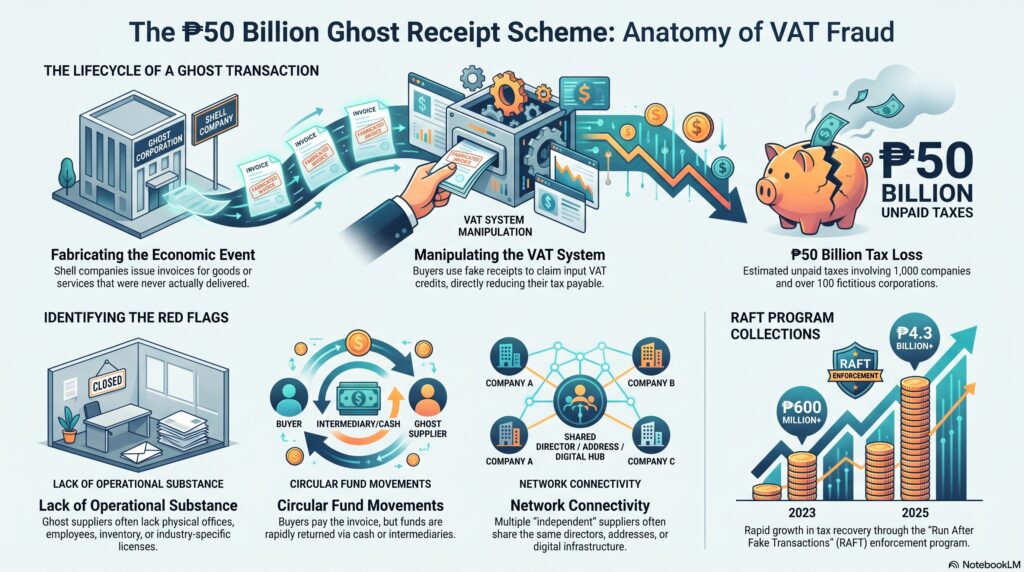
The National Bureau of Investigation announced the case in 2023 after examining a scheme that authorities alleged had operated from 2008 until December 2022. Investigators estimated that approximately 1,000 companies had used the central network to reduce their VAT obligations, contributing to around ₱50 billion in unpaid taxes.
The alleged invoice provider was linked to more than 100 registered corporations, with dozens of additional entities under investigation. Authorities reported that many of the companies had no physical offices, employees, inventory or genuine operations. Their commercial activity was allegedly simulated through purchase orders, sales invoices and receipts produced from a common operational location.
The investigation also involved the seizure of computers and other records for forensic examination. This digital evidence was important because an organised invoice-fraud network may use different legal entities while relying on the same administrators, devices, templates, accounting files and contact details.
The case became a catalyst for a wider enforcement campaign. The Bureau of Internal Revenue established its Run After Fake Transactions programme to investigate both the sellers and buyers of ghost receipts, together with corporate officers and professional advisers involved in their use.
By 2025, the BIR reported that the programme had generated more than ₱4.3 billion in collections, compared with more than ₱600 million during 2023. Further complaints involved companies across construction, manufacturing, food, electronics, retail, marketing and entertainment.
These developments show that the ₱50 billion case was not an isolated historical event. It exposed a repeatable method of corporate tax fraud with potential users across multiple sectors.
How ghost-receipt fraud manipulates the VAT system
VAT is generally collected on taxable sales and offset by eligible VAT paid on business purchases. A legitimate company charges output VAT to its customers and may deduct qualifying input VAT supported by genuine purchases and compliant invoices. The difference is normally paid to the tax authority.
A ghost receipt manipulates this mechanism by creating input VAT without an authentic supply. The buyer records a fictitious purchase and claims the associated tax credit, reducing the amount of VAT payable.
The same invoice may also inflate the company’s business expenses. This lowers reported taxable income and can therefore affect corporate income tax as well as VAT.
The fraud may appear plausible because the document resembles an ordinary commercial invoice. It can contain a registered supplier name, taxpayer identification number, description of goods or services, value, VAT amount and authorised signatory. The weakness lies not necessarily in the form of the document, but in the absence of the economic activity it claims to represent.
This makes invoice fraud different from simple non-reporting. The taxpayer does not merely conceal a sale or income. It creates false evidence designed to survive an audit and justify the tax treatment applied.
Where several companies use the same invoice provider, the scheme becomes a fraudulent service. The supplier network manufactures deductible expenses and tax credits for clients, charging a fee or commission for the documentation.
How ghost corporations industrialise the scheme
A single fictitious supplier can be identified through repeated use. A larger network distributes the activity across multiple legal entities, invoice ranges, bank accounts and business categories.
Ghost corporations may be validly registered but lack genuine operations. They can have incorporation documents, taxpayer numbers, bank accounts and authorised invoices while maintaining no employees, stock, premises or capacity to supply the goods and services appearing in their records.
The network may rotate corporations when one entity becomes subject to investigation. New businesses can be incorporated, existing dormant companies acquired or nominees appointed as officers and shareholders.
Different entities may appear to specialise in construction materials, consulting, food products, marketing, logistics or equipment. This allows fraudulent invoices to be matched to the buyer’s industry and makes the expense appear commercially credible.
Centralised control can still leave identifiable connections. Several supposed suppliers may share directors, incorporators, addresses, telephone numbers, email accounts, accountants, devices or bank beneficiaries. Invoice layouts and transaction values may follow recurring patterns despite the different company names.
This is why network analysis is critical. Reviewing each supplier independently may produce weak or inconclusive indicators. Connecting ownership, contact information, payment activity and digital infrastructure can reveal that several apparently separate businesses form one invoice-production operation.
Payments can reveal the absence of genuine trade
Invoice documentation should be compared with the corresponding flow of funds.
In some schemes, the buyer transfers the full invoice value to the ghost supplier. The supplier retains a commission and returns the remaining money through cash, another company or a connected individual. The buyer gains documentary support for the expense while recovering most of the payment.
Other arrangements may involve partial settlement, circular transfers, fabricated accounts payable or payments routed through intermediaries to obscure the relationship between the invoice buyer and seller.
Relevant financial indicators can include:
large payments to recently incorporated or operationally inactive suppliers;
funds received from several unrelated businesses and rapidly withdrawn or redistributed;
incoming payments inconsistent with the supplier’s size, employees or declared industry;
round-value transfers matching invoice totals;
payments returned to the buyer, its owners or connected parties;
supplier accounts operating primarily as pass-through facilities;
common beneficiaries or cash-withdrawal locations across several invoicing companies.
These patterns are not conclusive individually. New businesses, outsourced services and rapid payment cycles can be legitimate. Suspicion becomes stronger when the financial behaviour conflicts with the stated commercial relationship and there is little evidence of delivery, inventory, staffing or operating costs.
Professional enablers and corporate accountability
Large-scale invoice fraud normally requires more than a buyer and a fictitious supplier. Accountants, bookkeepers, company-formation agents, employees and corporate officers may prepare records, register entities, process payments or incorporate false transactions into tax returns.
Professional involvement can range from negligence to knowing facilitation. An accountant may accept unreliable client documentation without adequate challenge, or may actively structure the entries and prepare returns designed to claim unlawful tax benefits.
The BIR’s later enforcement actions have included complaints against certified public accountants as well as corporations and their officers. This reflects the fact that financial statements and tax filings are produced through a chain of responsibility.
Corporate governance is particularly important for companies purchasing the receipts. Senior officers may argue that the transactions were handled by procurement, finance or external advisers. However, repeated high-value purchases from suppliers with no operational substance may indicate failures extending beyond one employee.
Boards and audit committees should understand how suppliers are selected, how tax invoices are validated and whether internal controls confirm that goods or services were actually received. Delegation of tax preparation does not remove accountability for the data and transactions supplied to the adviser.
When tax fraud becomes a money-laundering concern
Tax evasion and money laundering are related but distinct offences. Not every tax discrepancy or incorrect invoice creates a money-laundering case.
Philippine anti-money laundering legislation nevertheless recognises certain serious tax crimes as predicate offences. A wilful attempt to evade tax may enter the AML framework where the statutory conditions are met, including the required deficiency-tax threshold, a finding of probable cause and evidence of fraud, wilful misrepresentation or malicious intent.
This distinction matters for financial institutions. A bank is not expected to determine the final tax liability of its customer. It is expected to identify transactions that lack an underlying legal or economic purpose, are inconsistent with the customer’s capacity or may relate to unlawful activity.
A ghost-receipt network can generate several types of proceeds. The invoice provider may receive commissions for issuing fraudulent documents. The purchasing company may obtain unlawful tax savings. Funds used to simulate transactions may also be returned, layered through other entities or invested in assets.
Financial institutions should therefore assess the movement of value rather than treating the matter solely as a dispute between the taxpayer and the revenue authority.
The strongest suspicious transaction reports would explain the economic inconsistency: the supplier lacks apparent operating capacity, receives large payments from unrelated companies, rapidly disperses the funds and shows links to other entities exhibiting the same behaviour.
Why conventional controls can miss ghost transactions
The first challenge is documentary credibility. The supplier may be legally incorporated, registered for tax and able to issue apparently valid invoices. Standard onboarding checks may therefore confirm that the entity exists without establishing that it conducts genuine business.
The second challenge is the separation between tax and financial data. The BIR sees tax declarations and claimed credits. Banks see transfers and cash movements. Corporate registries hold ownership and officer information, while buyers hold purchase orders, delivery documents and internal approvals.
The third challenge is the diversity of legitimate commercial activity. Businesses can operate remotely, outsource labour, maintain limited physical inventory or provide intangible services. The absence of a traditional office is not automatically evidence of fraud.
The fourth challenge is related-party opacity. Nominees, family members and employees may appear as independent owners while another person controls several companies.
Finally, fraud may remain dormant within accounting records until an audit compares the buyer’s claims with the supplier’s declarations and operational capacity. By then, companies may have closed, funds may have been withdrawn and records may be incomplete.
What an evidence-led investigation looks like
The investigation should begin by establishing whether the transaction occurred.
Analysts should compare invoices with contracts, purchase orders, delivery records, inventory movements, staff communications and evidence that the goods or services were received. For intangible services, deliverables, work products, correspondence and personnel records become particularly important.
The supplier’s capacity should then be assessed. Investigators need to understand whether it had suitable premises, employees, equipment, stock, licences and upstream purchases to fulfil the orders recorded.
Ownership and control should be reconstructed across the network. Common incorporators, directors, accountants, addresses, devices and bank accounts can expose centrally managed ghost entities.
Payment analysis should identify where the money moved after settlement. Rapid cash withdrawal, circularity and transfers to the buyer or connected individuals may demonstrate that the invoice was designed to create documentation rather than pay for genuine supply.
Investigators should distinguish established facts from allegations and inferences. A suspicious supplier relationship does not prove that every transaction involving that supplier was fictitious, nor that every officer or professional adviser acted knowingly.
What a resilient control stack looks like
The first layer is supplier due diligence. Companies should verify ownership, business activity, operational capacity, address, licences and tax registration before approving material vendors.
The second layer is transaction validation. Purchase orders, invoices, delivery evidence and payment records should be matched before tax credits or deductible expenses are recognised.
The third layer is network analytics. Shared directors, accounts, devices, addresses and invoice characteristics should be identified across the supplier population.
The fourth layer is risk-based accounts-payable monitoring. Controls should flag unusual pricing, repeated round-value invoices, rapid supplier growth, limited operational evidence and payments to newly created entities.
The fifth layer is professional accountability. Finance, procurement, tax and external advisers should have clear responsibilities for challenging unsupported transactions and escalating suspected falsification.
The sixth layer is public-private intelligence sharing. Tax authorities, corporate registries, financial institutions and professional regulators hold complementary evidence. Lawful coordination can identify invoice networks before losses become systemic.
Finally, control effectiveness should be measured by more than the number of invoices checked. Organisations should assess whether controls identify connected ghost suppliers, prevent unsupported claims and trace the funds behind fabricated transactions.
Electronic invoicing as a defensive opportunity
The Philippines is expanding electronic invoicing under a phased implementation framework. Covered taxpayers—including specified e-commerce businesses, large taxpayers and users of computerised accounting or invoicing systems—have been given until 31 December 2026 to meet the applicable electronic-invoice requirements.
Structured electronic invoices can improve tax-authority visibility by allowing supplier and buyer records to be compared more quickly. Duplicate numbers, inconsistent declarations, abnormal transaction volumes and invoices issued by inactive taxpayers can be identified more efficiently than through manual paper-based processes.
Digitalisation is not a complete solution. Criminals may compromise legitimate invoicing systems, create false digital transactions or collude across both sides of the invoice. Poor-quality master data can also reproduce existing weaknesses at greater speed.
The defensive value comes from combining electronic invoicing with identity assurance, beneficial-ownership analysis, payment data and evidence of actual delivery.
What this means for financial crime leaders
The ₱50 billion investigation demonstrates that ghost receipts are not merely false documents. They are instruments for creating artificial economic activity and transferring unlawful tax benefits through the corporate and financial system.
Financial institutions should not attempt to become tax auditors. They should understand when customer payments and supplier relationships lack commercial substance, particularly where several shell companies, circular transfers and professional intermediaries form a connected network.
Corporate leaders face an equally important obligation. Procurement, accounts payable, tax compliance and financial-crime controls cannot operate separately when the same false transaction affects all four.
The most resilient response will combine operational supplier verification, transaction-level evidence, network intelligence, accountable professional judgement and increasingly timely electronic tax data.
Fraudulent invoices succeed when documentation is treated as proof of economic reality. Institutions that test the business activity beneath the document will be better positioned to protect public revenue, identify laundering risks and disrupt the infrastructure that allows ghost transactions to appear legitimate.
What Financial Institutions Should Consider
- Strengthen Supplier and Counterparty Due Diligence
- Verify the Economic Substance Behind Commercial Payments
- Compare Transaction Activity With Declared Business Capacity
- Detect Recently Incorporated or Operationally Inactive Suppliers
- Monitor Round-Value and Invoice-Matched Payments
- Identify Rapid Redistribution and Pass-Through Behaviour
- Detect Circular Payments and Funds Returning to the Buyer
- Connect Directors, Addresses, Devices and Bank Beneficiaries
- Apply Network Analytics Across Corporate Customers
- Strengthen Beneficial Ownership and Control Analysis
- Incorporate Tax-Fraud Typologies Into AML Monitoring
- Review High-Risk Accounts-Payable Activity
- Investigate Inconsistencies Between Payment Flows and Commercial Purpose
- Improve Information Sharing With Tax and Corporate Authorities
- Apply Retrospective Reviews to Connected Supplier Networks
- Distinguish Tax Irregularities From Potential Predicate Offences
- Focus Suspicious Transaction Reporting on Economic Inconsistency
- Integrate Financial, Corporate and Operational Intelligence
Download the briefing
Ghost Receipts and VAT Fraud: Analysis of the Philippines’ ₱50 Billion Tax-Evasion Scheme



The Philippine ghost-receipt investigation demonstrates that VAT fraud is not simply an accounting offence. It can involve organised networks of shell companies, fabricated commercial records, professional facilitation and payment flows designed to create the appearance of legitimate trade where no genuine economic activity exists.
The central weakness is the assumption that a compliant-looking invoice proves that a transaction occurred. Registered companies, valid tax numbers and formally correct documentation can still conceal fictitious suppliers, circular payments and artificial expenses created solely to reduce tax liabilities.
Effective prevention therefore requires institutions to test the economic reality behind the document. Companies should verify supplier capacity, match invoices with delivery evidence, examine ownership connections and monitor whether funds are rapidly returned, withdrawn or routed through linked entities. Financial institutions should also recognise when apparently ordinary business payments display the characteristics of pass-through activity, related-party circularity or transactions without a credible commercial purpose.
The case also highlights the importance of professional accountability. Corporate officers, accountants, tax advisers and procurement personnel all play a role in determining whether suspicious transactions are challenged or incorporated into formal records. Outsourcing tax preparation or supplier management does not remove responsibility for the underlying activity.
Electronic invoicing and improved data sharing can strengthen detection, but technology alone will not eliminate the risk. The strongest controls will combine structured tax data with beneficial-ownership analysis, payment intelligence, supplier due diligence and evidence that goods or services were actually delivered.
Ultimately, fraudulent invoice networks succeed when documentation is accepted without testing the business reality beneath it. Organisations that connect tax, procurement, accounting and financial-crime controls will be better positioned to identify ghost transactions before they become systemic revenue losses or laundering channels.