 FinCrime Intelligence

The international takedown of ChipMixer demonstrated how cryptocurrency mixing services can become critical infrastructure for ransomware operators, darknet markets, fraud networks, state-sponsored hackers and digital-asset thieves.
In March 2023, authorities in Germany and the United States seized ChipMixer’s online infrastructure after alleging that the service had processed more than US$3 billion in Bitcoin since 2017.
German authorities seized back-end servers, extensive operational data and cryptocurrency then valued at more than US$46 million. United States authorities seized domains directing users to the service and an associated software-development account.
The United States also charged Vietnamese national Minh Quốc Nguyễn with money laundering, operating an unlicensed money-transmitting business and identity-related offences. The charges remain allegations. Nguyễn has not been convicted and continues to appear on the FBI’s wanted list.
The enforcement action was significant because it targeted more than an individual suspect. It removed infrastructure, immobilised cryptocurrency and secured data capable of supporting investigations into thousands of transactions and connected criminal networks.
ChipMixer’s closure did not eliminate cryptocurrency laundering. It demonstrated how authorities can use blockchain analytics, undercover transactions, hosting records, digital forensics and international cooperation to dismantle services designed to break the connection between criminal proceeds and their beneficiaries.
Key Takeaways
- Crypto Mixers Can Be Used to Obscure the Origin and Destination of Illicit Funds
- ChipMixer Processed Billions of Dollars in Cryptocurrency
- Mixing Services Can Support Ransomware, Drug Trafficking and Payment Card Fraud
- Criminals Use Privacy-Enhancing Services to Break Transaction Traceability
- Darknet Infrastructure Can Facilitate Large-Scale Money Laundering
- Cryptocurrency Transactions Are Not Necessarily Anonymous
- Blockchain Analysis Can Support Asset Tracing and Law Enforcement Investigations
- Mixing Services Can Create Significant AML and Sanctions Exposure
- Criminal Actors May Use False or Stolen Identities to Operate Illicit Services
- Ransomware Proceeds Frequently Intersect With Crypto Laundering Typologies
- Seizure of Digital Assets Demonstrates the Recoverability of Crypto Proceeds
- International Cooperation Is Critical to Disrupting Crypto Laundering Infrastructure
- Takedowns Can Generate Valuable Intelligence on Previously Hidden Transactions
- Criminals Are Likely to Migrate to Alternative Obfuscation Methods After Enforcement Actions
Listen the podcast
Watch the video
Why the ChipMixer case matters now
Cryptocurrency transactions recorded on public blockchains are transparent, but the people controlling the relevant wallet addresses are not automatically identified.
This creates a form of pseudonymity. Investigators can observe value moving between addresses, but attribution may require customer records, device data, exchange information, communications and other evidence linking an address to a person or organisation.
Mixing services exploit the gap between transaction visibility and identity.
A customer sends cryptocurrency to the service and receives different cryptocurrency from another wallet or pooled reserve. The objective is to weaken the analytical connection between the original deposit and the subsequent withdrawal.
Privacy can have legitimate purposes. Individuals may not want employers, counterparties or the wider public to reconstruct their complete financial history from one known address.
The compliance risk arises when a service accepts and transmits customer assets without effective customer identification, actively markets itself as a way to evade law enforcement or knowingly processes substantial criminal proceeds.
ChipMixer was alleged to have combined all three characteristics.
How ChipMixer operated
ChipMixer was accessible through conventional internet domains but operated primarily as a Tor hidden service.
Tor helped conceal the location of the service’s infrastructure and reduced the visibility of its users. The platform did not require customers to create conventional accounts or provide identifying information.
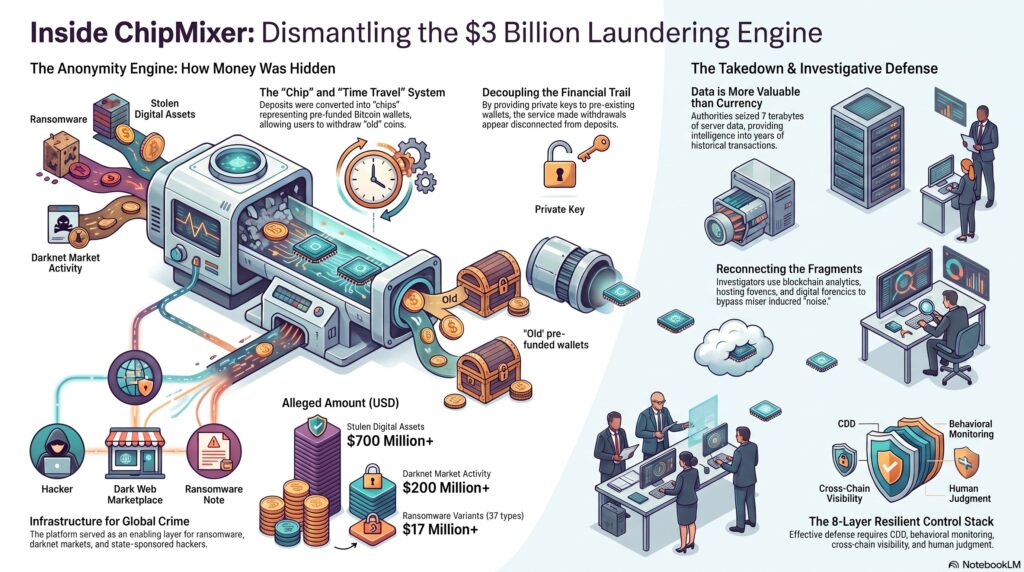
According to the US criminal complaint, the service converted customer deposits into credits called “chips”.
Those chips corresponded to pre-existing Bitcoin wallets controlled by ChipMixer. A user depositing one Bitcoin could receive several chips with a combined value equivalent to the deposit.
The customer could split chips into smaller units, merge them or return part of the value to the service. These options introduced additional variation into the transaction pattern.
At withdrawal, ChipMixer provided private keys associated with the wallets represented by the chips. The customer could then control and spend the Bitcoin held at those addresses.
This model differed from a simple transfer in which the service receives funds and later sends a corresponding amount to a new address. Providing access to pre-funded wallets made the withdrawal appear disconnected in time and origin from the customer’s deposit.
The service promoted this feature as a form of financial “time travel” because the coins received by the customer could have entered the relevant wallet before the customer made the original deposit.
What mixing changes—and what it does not
A mixer can complicate blockchain tracing, but it does not make evidence disappear.
Investigators may still identify addresses controlled by the service, determine when deposits were made and analyse how funds entered or left the broader wallet cluster.
The analytical challenge is attribution. The investigator may be able to establish that a customer used a mixer without immediately identifying which output represented that customer’s withdrawal.
Mixers increase the number of plausible transaction paths. They create breaks in the direct flow of funds and force investigators to use probabilistic analysis, behavioural patterns and off-chain evidence.
Operational mistakes can restore visibility. Customers may withdraw directly to a regulated exchange, reuse addresses or access multiple services through the same device or internet connection.
The mixer itself also generates records. Servers may contain wallet information, transaction data, communications, configuration files and administrative logs.
The seven terabytes of data reportedly seized during the ChipMixer operation may therefore have been as important as the cryptocurrency. Infrastructure seizures can create historical intelligence capable of identifying users, connected services and transactions long after the platform disappears.
The criminal ecosystem using ChipMixer
US authorities alleged that ChipMixer processed cryptocurrency connected with ransomware, darknet markets, stolen digital assets, fraud shops and state-sponsored hacking.
Between 2017 and March 2023, the service allegedly handled approximately US$17 million connected with around 37 ransomware variants.
Ransomware operators depend on laundering infrastructure because the payment itself is visible on the blockchain. Once a victim sends cryptocurrency to an address supplied by the attacker, investigators can monitor subsequent movements.
A mixing service creates distance between the ransom address and the point where the attacker converts, spends or reinvests the proceeds.
Authorities also linked more than US$700 million in ChipMixer activity to wallets associated with stolen cryptocurrency. This included assets connected with major bridge exploits attributed to North Korean cyber actors.
More than US$200 million was associated directly or indirectly with darknet markets, including substantial exposure to Hydra Market before its 2022 shutdown.
A further category involved fraud shops selling stolen payment-card information, compromised credentials and data obtained through network intrusions.
The service was also allegedly used to purchase infrastructure supporting state-sponsored malware activity.
These connections demonstrate why mixing should not be treated as a standalone typology. It is an enabling layer connecting several forms of cyber-enabled financial crime.
Cybercrime-as-a-service needs laundering-as-a-service
Modern cybercrime operates through specialised providers.
One actor develops malware. Another obtains initial access to corporate systems. An affiliate deploys ransomware, while a negotiator communicates with the victim. Other specialists provide hosting, stolen identities, cryptocurrency conversion or laundering.
Mixing services fit into this outsourced criminal economy.
A ransomware affiliate does not need to develop sophisticated obfuscation technology. The criminal can transfer proceeds to an established mixer and use its infrastructure to reduce traceability.
This lowers the technical barrier to financial crime and allows multiple criminal groups to use the same laundering mechanism.
The result is concentration risk within the underground economy. A widely trusted mixer can become a financial hub serving ransomware groups, darknet vendors, fraudsters and state-linked actors simultaneously.
Targeting that hub can disrupt several criminal markets at once.
The alleged operator and the identity infrastructure
Prosecutors alleged that Nguyễn created and operated ChipMixer’s online infrastructure and promoted the service through cryptocurrency forums and social-media platforms.
The complaint alleged that he used pseudonyms, anonymous email services and identities belonging to other people when registering domains, procuring servers and paying service providers.
This part of the case illustrates why identity theft can support financial infrastructure rather than merely consumer fraud.
Stolen or fabricated identities can be used to acquire hosting, register domains, open payment accounts and create distance between the technical operator and the service.
Investigators allegedly connected the different personas through provider records, email accounts, server information, internet addresses and payment data.
The case also demonstrates that Tor does not protect every operational interaction. A service operator still needs domains, hosting, software repositories, communications and payment mechanisms.
Each external dependency creates an investigative opportunity.
As of August 2026, the criminal charges against Nguyễn have not resulted in a publicly reported conviction. The FBI continues to list him as wanted, and the presumption of innocence remains applicable.
Why the unlicensed money-transmission allegation matters
The United States did not treat ChipMixer solely as a privacy tool or software product.
The government alleged that the service accepted value from customers and transmitted equivalent value to other addresses. Under that theory, it operated as a money-transmitting business.
Money transmitters operating in the United States may be required to register with the Financial Crimes Enforcement Network, maintain an anti-money laundering programme, retain relevant records and report suspicious activity.
The complaint alleged that ChipMixer did none of those things despite serving US customers.
Legal analysis depends on the service’s actual functions. Software that users operate independently can present different legal issues from an administrator who accepts customer funds, controls pooled assets and determines how withdrawals occur.
The distinction between publishing code and operating a financial service remains central to enforcement involving decentralised protocols, self-hosted wallets and privacy-enhancing technologies.
Technology does not remove legal obligations where an identifiable actor is conducting regulated financial activity.
Why mixer exposure is not automatic proof of crime
A transaction involving a mixer is a material risk indicator, but it is not by itself proof that the customer committed money laundering.
A person may use privacy technology for personal security, commercial confidentiality or protection from public wallet profiling.
Funds can also acquire indirect mixer exposure because they were received from another person after passing through the service. The present holder may have no knowledge of the earlier transaction.
Blockchain analytics platforms therefore need to distinguish direct exposure from indirect exposure and record the number of transaction steps between the customer and the mixer.
Institutions should also consider the proportion of funds exposed, the timing, repeated behaviour and the customer’s explanation.
Risk becomes stronger where mixer use is combined with darknet-market exposure, ransomware indicators, stolen assets, rapid cross-chain movement, false customer information or an unexplained attempt to cash out.
A risk score should initiate analysis rather than replace it.
How criminals adapt after a takedown
Removing one service creates disruption, but demand for anonymity and laundering remains.
Users may migrate to another mixer, decentralised protocol, cross-chain bridge, informal exchange or peer-to-peer broker.
Criminals can also divide assets across several services, convert Bitcoin into other cryptocurrencies or move value through decentralised exchanges before returning to a regulated platform.
The closure of competitors had previously benefited ChipMixer by directing criminal customers towards the remaining service. ChipMixer’s removal created the same potential opportunity for successors.
International authorities have therefore continued targeting the wider laundering ecosystem.
German authorities shut down multiple unlicensed digital-asset exchange services in 2024 and seized the eXch crypto-swapping service in 2025. Europol-supported operations have also targeted additional mixing and exchange platforms.
The enforcement strategy increasingly focuses on infrastructure: domains, servers, wallets and transaction data. This approach can generate disruption even where the suspected operators remain beyond immediate arrest.
Regulation has continued to evolve
In October 2023, FinCEN proposed treating convertible virtual currency mixing involving foreign jurisdictions as a class of transactions of primary money-laundering concern.
The proposed measure would require covered US financial institutions to maintain records and report transactions they know, suspect or have reason to suspect involve relevant mixing activity.
As of August 2026, the measure remained a proposal rather than a final rule.
Its significance lies in the shift from identifying particular mixing services to examining mixing as a class of transactions.
FATF guidance similarly identifies mixing and tumbling services as risk indicators requiring contextual assessment. The guidance does not state that one indicator alone establishes money laundering.
The regulatory direction is therefore towards increased transparency, attribution and reporting—not simplistic assumptions that every privacy transaction is criminal.
What an evidence-led investigation looks like
The investigation should begin with the customer and the complete asset flow.
Analysts should identify the source of the cryptocurrency, the addresses used, the service exposure, subsequent destinations and any points at which assets entered or left regulated platforms.
The review should distinguish direct interaction with a mixer from indirect exposure several transactions removed.
Timing is important. A customer who repeatedly transfers assets to a mixer immediately after receiving ransomware-linked funds presents a different risk from a customer receiving a small payment that once passed through a mixer months earlier.
Cross-asset activity should also be reconstructed. Criminals may use mixers alongside bridges, decentralised exchanges, privacy coins and peer-to-peer brokers.
Customer explanations should be tested against the blockchain evidence and known financial profile.
Investigators should preserve wallet addresses, transaction hashes, screenshots, analytics results and the version of the attribution data used. Blockchain labels can change as new intelligence becomes available.
Where suspicion remains, the resulting report should describe the transaction path, criminal exposure, customer behaviour and analytical reasoning rather than merely stating that a mixer was used.
What a resilient control stack looks like
The first layer is reliable customer due diligence at digital-asset entry and exit points.
The second is blockchain analytics capable of identifying mixer exposure, darknet-market links, ransomware proceeds, stolen assets and connected wallet clusters.
The third is behavioural monitoring across transactions, devices, accounts and counterparties.
The fourth is exposure governance. Institutions should define how direct, indirect and historical mixer connections affect risk and escalation.
The fifth is cross-chain visibility. Monitoring limited to one blockchain can miss layering through bridges, exchanges and alternative assets.
The sixth is retrospective review. When law enforcement identifies new mixer infrastructure, institutions should re-examine historical transactions.
The seventh is effective record retention. Transaction hashes, customer information, access logs and communications may become important years after the original activity.
The eighth is rapid asset response. Institutions should be able to restrict or preserve assets when a valid legal order, sanctions requirement or credible theft notification applies.
Finally, human judgement must remain central. Automated analytics can identify exposure, but investigators must determine whether the wider evidence supports suspicion.
What this means for financial crime leaders
The ChipMixer takedown demonstrates that cryptocurrency laundering services can become strategic infrastructure for several forms of organised and state-linked financial crime.
Its importance did not rest only on the volume allegedly processed. ChipMixer connected ransomware payments, stolen assets, darknet commerce and cyber operations through one anonymisation service.
Financial crime leaders should ensure that mixer exposure is assessed within the wider transaction narrative. Neither a clean customer name nor an adverse wallet label is sufficient on its own.
The strongest institutions combine blockchain tracing, customer information, device intelligence, cross-chain analysis and independent investigation.
They also recognise that digital privacy and criminal concealment are not identical. Controls should identify services and behaviours designed to frustrate lawful oversight without treating every user of privacy-enhancing technology as a criminal.
ChipMixer promised to break the financial trail between deposit and withdrawal. The international investigation showed that the trail did not disappear. It moved into servers, wallet clusters, hosting records, online communications and regulated financial gateways.
Effective crypto-financial-crime defence depends on reconnecting those fragments before illicit assets can be converted, dispersed or returned to the legitimate economy.
What Financial Institutions Should Consider
- Identify Direct and Indirect Exposure to Crypto Mixers
- Integrate Blockchain Analytics Into AML Monitoring
- Strengthen Wallet Screening and Attribution
- Apply Enhanced Due Diligence to High-Risk Crypto Activity
- Monitor Interaction With Known Mixing Services
- Detect Rapid Layering Across Multiple Wallets
- Identify Peel Chains and Complex Transaction Flows
- Monitor Links to Ransomware-Associated Wallets
- Strengthen Source-of-Funds Analysis for Crypto Transactions
- Assess Exposure to Darknet Marketplaces
- Connect On-Chain Activity With Customer Identity
- Conduct Retrospective Reviews Following Mixer Takedowns
- Update Risk Models When New Illicit Wallets Are Identified
- Apply Network Analytics Across Connected Wallets
- Strengthen Crypto Sanctions Screening
- Preserve Blockchain Evidence for Investigations
- Improve Information Sharing With Cryptoasset Service Providers
- Treat Privacy-Enhancing Services as Risk Indicators Rather Than Automatic Proof of Illicit Activity
Download the briefing
Inside ChipMixer: Crypto Mixing as Infrastructure for Global Financial Crime



The ChipMixer operation demonstrates that cryptocurrency mixing services can become strategic financial infrastructure for multiple forms of organised and state-linked crime.
The service was alleged to have processed value connected with ransomware, darknet markets, stolen digital assets, fraud networks and state-sponsored cyber activity. Its significance therefore extended beyond individual users seeking to obscure a transaction. It allegedly provided a reusable laundering mechanism capable of serving several criminal ecosystems at the same time.
The takedown also shows that mixing complicates blockchain analysis without making evidence disappear. Transaction histories remain recorded, while operators and users continue to depend on servers, domains, exchanges, wallets, devices and communications that can create new points of attribution.
For financial institutions and virtual-asset service providers, mixer exposure should be treated as a material risk indicator rather than automatic proof of criminal activity. Effective analysis must consider whether the exposure was direct or indirect, how frequently the customer used the service, where the assets originated and what happened after withdrawal.
The case further highlights the importance of retrospective review. Wallets and infrastructure may only be identified as criminal years after the relevant activity. Institutions therefore need durable records and the ability to reassess historical transactions when new intelligence becomes available.
Ultimately, cryptocurrency mixers do not remove the financial trail. They fragment it across blockchain addresses, infrastructure providers, identity records and regulated gateways. The strongest financial crime programmes will be those capable of reconnecting those fragments before illicit assets are dispersed, converted or returned to the legitimate economy.