 FinCrime Intelligence

Ransomware is often described as malicious software that encrypts files and demands payment for their release. That definition remains technically correct, but it no longer captures the scale or structure of the threat. Modern ransomware is an organised extortion business combining network intrusion, credential theft, data exfiltration, encryption, public-leak threats, operational disruption and cryptocurrency-based money movement.
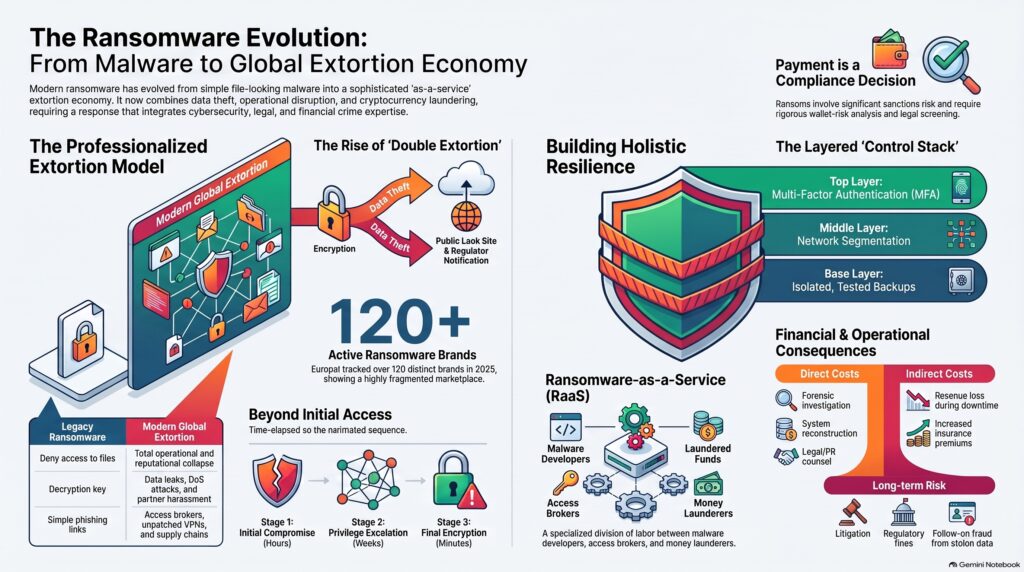
Europol observed more than 120 active ransomware brands during 2025, while the FBI received more than 3,600 ransomware complaints involving reported direct losses above $32 million. That figure excludes many business-interruption and remediation costs and incidents reported through other channels.
For a FinCrime audience, ransomware is not only a cybersecurity event. It sits at the intersection of extortion, sanctions exposure, cryptoasset tracing, money laundering, data protection, fraud, operational resilience and third-party risk. The attack may begin with a stolen password, but its consequences can include interrupted healthcare, delayed manufacturing, exposed customer records, fraudulent follow-on approaches and payments routed through a transnational laundering network.
Key Takeaways
- Ransomware Has Evolved Into a Global Extortion Economy
- Modern Attacks Combine Encryption With Data Theft
- Double Extortion Increases Criminal Leverage
- Ransomware-as-a-Service Has Industrialised Cyber Extortion
- Initial Access Brokers Lower the Barrier to Entry
- Stolen Credentials Remain a Major Ransomware Enabler
- Third-Party Providers Can Become Routes Into Multiple Organisations
- Data Exfiltration Creates Risks Beyond Operational Disruption
- Ransomware Can Generate Downstream Identity Theft and Fraud
- The True Cost Extends Far Beyond the Ransom Payment
- Ransom Payments Can Create Significant Sanctions Exposure
- Cryptocurrency Enables Payments but Also Supports Asset Tracing
- Criminal Laundering Infrastructure Is Increasingly a Law Enforcement Target
- Ransomware Is a Financial Crime, Cybersecurity and Operational Resilience Issue
- Effective Defence Requires Reducing Criminal Leverage Across the Entire Attack Lifecycle
Listen the podcast
Watch the video
Why ransomware remains a strategic threat
Early ransomware campaigns concentrated on denying access to files. The victim paid for a decryption key or restored from backups. That model became less reliable as organisations improved recovery capabilities.
Criminal groups adapted by stealing data before encryption and threatening to publish it. This “double extortion” model gives the attacker two sources of leverage: the organisation’s need to restore operations and its fear of regulatory, commercial and reputational consequences.
Some operations add denial-of-service attacks, contact customers or journalists and threaten business partners. The event becomes a coordinated crisis involving technology, legal obligations, communications and executive decision-making.
ENISA describes encrypting ransomware as one of the most directly impactful cyber threats and found ransomware activity distributed across a broad range of EU sectors. Manufacturing, digital services, healthcare and public administration remain attractive because downtime can produce immediate physical and economic consequences.
The ransomware-as-a-service economy
Ransomware has become scalable because criminal capability can be purchased as a service.
Ransomware-as-a-service operators develop the malware, maintain negotiation portals, host data-leak sites and provide infrastructure to affiliates. Affiliates gain access to victim networks and deploy the payload, then share a percentage of any payment with the platform operator.
Other specialists sell network access, stolen credentials, resilient hosting and laundering services.
This division of labour lowers the technical barrier to entry. An affiliate does not need to develop encryption software, maintain a leak site or create a payment workflow. They need access, operational discipline and a willingness to use the tools supplied by the service.
The result is a volatile marketplace in which brands disappear, rebrand or fragment after law-enforcement action, while administrators and affiliates move between operations. A takedown can disrupt a name without eliminating the underlying workforce.
How attackers gain initial access
Phishing remains an important entry route, particularly where malicious links or attachments deliver credential stealers or remote-access tools. However, ransomware operations increasingly use several access methods depending on the target.
Unpatched internet-facing systems, exposed remote services, weak virtual-private-network controls and compromised administrator accounts can provide direct entry. Stolen credentials may come from earlier data breaches, infostealer malware or access brokers operating in criminal marketplaces.
Managed service providers, software suppliers and remote-support platforms can provide routes into multiple environments. Attackers also exploit trusted administrative tools because their activity can resemble normal operations.
Once inside, the objective is usually not immediate encryption. The intruder seeks to understand the environment, escalate privileges, obtain domain-level control, locate valuable data and identify systems required for recovery. Security tools and backups may be disabled or deleted before the ransomware is deployed.
The visible encryption event is therefore often the final stage of a longer compromise.
Data theft has changed the extortion calculation
Reliable backups reduce the attacker’s leverage over availability, but they do not reverse data theft.
Modern groups search for customer records, intellectual property, legal documents, financial information, employee data and commercially sensitive communications. Selected files may be published as proof that exfiltration occurred, while countdown timers and victim profiles are used to intensify pressure.
This creates difficult decisions. Paying for a promise of deletion does not prove that every copy has been destroyed. The attacker may have shared the data, retained it for future extortion or sold it to another criminal group.
Stolen information can support identity theft, phishing, impersonation and business-email compromise, while recovered credentials may be reused against customers, suppliers or connected organisations.
The ransomware incident may therefore continue generating fraud and privacy risk long after systems are restored.
The real cost is wider than the ransom
A ransom demand is only one component of the financial impact.
Organisations may lose revenue during downtime, pay for forensic investigation and system reconstruction, replace hardware, notify affected individuals and retain legal, communications and identity-protection services. Contractual penalties, litigation, regulatory action and higher insurance costs can follow.
Operational consequences can be more serious than the immediate loss: hospitals may postpone procedures, manufacturers halt production and public bodies lose access to essential services.
Recovery can take weeks or months even where backups exist. Systems must be rebuilt safely, credentials rotated, vulnerabilities closed and data validated before operations return to normal.
Employees also experience significant pressure. Incident-response teams may work extended hours while customer-facing staff deal with uncertainty and anger. Senior leaders must make decisions with incomplete information and under deadlines imposed by both attackers and regulators.
For individuals, the impact can include inaccessible devices, permanent loss of files and exposure of identity or health information, often with limited recovery resources.
The payment decision is a compliance decision
Law-enforcement and cybersecurity authorities generally discourage ransom payments because payment funds criminal activity, encourages further attacks and provides no guarantee of decryption or data deletion.
The decision is nevertheless complex where public safety, critical services or organisational survival are at risk. Boards may consider operational urgency, restoration capability, the sensitivity of stolen data and the likelihood that a decryptor will work.
Payment also creates legal and financial-crime exposure. The recipient may be a sanctioned person, group or jurisdiction. U.S. authorities have warned that facilitating a payment with a sanctions nexus can create liability, including for intermediaries involved in negotiation or settlement.
A resilient process therefore requires more than commercial negotiation. Organisations need sanctions screening, wallet-risk analysis, legal advice, law-enforcement engagement and documented governance. Insurers, incident-response firms, negotiators, financial institutions and cryptoasset providers may all hold relevant information.
A payment should never be treated as an ordinary procurement decision. It is a transfer to an unidentified or partially identified criminal counterparty within a rapidly changing legal environment.
Cryptocurrency enables payment but also investigation
Ransomware demands are frequently denominated in cryptoassets because they can be transferred internationally without conventional correspondent banking. Attackers provide a wallet address and may use multiple addresses, exchanges, bridges, mixers or laundering services to obscure the flow.
Public blockchains preserve transaction histories that investigators can analyse alongside exchange records, seized infrastructure and victim reports.
Law-enforcement operations increasingly target the laundering infrastructure supporting ransomware rather than focusing only on malware developers. Freezing wallets, seizing servers and disrupting conversion services can deny groups access to proceeds and reveal links between apparently separate operations.
Wallet screening, transaction monitoring and rapid information sharing can identify exposure to extortion infrastructure and help trace proceeds.
What a resilient control stack looks like
The strongest defence is layered resilience rather than reliance on one security product.
Asset and identity management come first. Organisations need to know which systems, accounts, applications and third parties support critical operations. Privileged access should be restricted, monitored and protected with phishing-resistant multifactor authentication where possible.
Vulnerability management must prioritise internet-facing systems and actively exploited weaknesses. Remote access should be limited to what is operationally necessary, while obsolete services and unsupported software should be removed.
Network segmentation can prevent a compromise in one area from becoming enterprise-wide control. Endpoint detection, centralised logging and alerting should focus on credential theft, privilege escalation, unusual administrative activity, data staging and attempts to disable security tools.
Backups remain essential, but only when they are isolated, encrypted, protected from administrative compromise and tested through realistic restoration exercises. A backup that exists but cannot be restored within the required timeframe is not a reliable resilience control.
Data minimisation also matters: sensitive information should be identified, access-controlled and retained only for a defined purpose.
Third-party risk should include the provider’s security architecture, privileged access, incident-notification obligations and recovery capability. Contractual assurance is not a substitute for understanding how a supplier compromise could affect operations.
Responding when ransomware is detected
The immediate priorities are to contain the intrusion, preserve evidence and maintain safe operations.
Affected systems may need to be isolated, but indiscriminate shutdowns can destroy evidence or disrupt critical services unnecessarily. The response should follow a rehearsed plan with clear authority for technical, legal, communications and business-continuity decisions.
Organisations should engage appropriate law enforcement and national cyber authorities early. Insurers, legal advisers, forensic specialists and regulators may also need to be notified according to the jurisdiction and type of data involved.
Where personal data has been encrypted, destroyed or exfiltrated, the organisation must assess confidentiality, integrity and availability impacts. In the UK, reportable personal-data breaches generally require notification to the ICO without undue delay and, where feasible, within 72 hours.
Recovery should not begin by simply reconnecting cleaned devices. The organisation must identify the entry point, remove persistence, rotate compromised credentials and validate that the restored environment is trustworthy.
Communication should be factual and coordinated; overstating certainty creates risk, while silence allows attackers to control the narrative.
What this means for financial crime leaders
Ransomware has evolved from disruptive malware into a multi-layered financial-crime business. Its revenue depends on access brokers, extortion specialists, cryptoasset infrastructure and laundering services, while its impact extends into fraud, sanctions, data protection and operational resilience.
For FinCrime leaders, the attack should not remain solely within the cybersecurity function. AML, sanctions, fraud, legal, privacy and crisis-management teams need predefined roles before an incident occurs.
Institutions should know how they will screen an attacker, assess a wallet, escalate a potential sanctions match, preserve transaction evidence and engage law enforcement. They should also consider how stolen customer or employee data could generate downstream account takeover, impersonation and payment fraud.
The strategic objective is not simply to prevent encryption. It is to reduce the attacker’s leverage at every stage: deny initial access, limit lateral movement, protect recovery systems, minimise valuable data, identify laundering routes and maintain the ability to operate under pressure.
Ransomware thrives when one intrusion can become an existential crisis. Resilient organisations change that calculation by making compromise containable, recovery credible and criminal monetisation more difficult.
What Financial Institutions Should Consider
- Integrate Ransomware Into Enterprise Financial Crime Risk Assessments
- Strengthen Phishing-Resistant Multi-Factor Authentication
- Protect Privileged Accounts and Administrative Access
- Prioritise Vulnerability Management for Internet-Facing Systems
- Strengthen Network Segmentation and Endpoint Monitoring
- Maintain Isolated and Tested Recovery Backups
- Monitor Stolen Credential and Infostealer Exposure
- Strengthen Third-Party Cyber and Financial Crime Risk Controls
- Establish Predefined Ransomware Response Governance
- Conduct Sanctions Screening Before Any Ransom Payment
- Apply Wallet Screening and Blockchain Analytics
- Assess Direct and Indirect Exposure to Ransomware-Linked Wallets
- Integrate Cyber, AML, Sanctions, Fraud and Legal Teams
- Preserve Transaction and Digital Evidence
- Engage Law Enforcement Early During Material Incidents
- Monitor Stolen Data for Downstream Account Takeover and Fraud
- Conduct Retrospective Reviews Following Ransomware Intelligence Updates
- Strengthen Rapid Information Sharing Across Financial Institutions and Crypto Providers
- Test Incident Response Through Realistic Ransomware Exercises
- Measure Resilience Through Recovery Capability, Not Prevention Alone
Download the briefing
Beyond Encryption: The Evolution of Ransomware into a Global Extortion Economy



Ransomware is no longer simply a form of malware that encrypts files. It has developed into an organised extortion economy supported by access brokers, ransomware-as-a-service operators, data-leak platforms, negotiators and cryptoasset-laundering networks.
For organisations, resilience depends on reducing criminal leverage throughout the attack chain. Strong identity controls, network segmentation, vulnerability management, protected backups and tested recovery plans can limit the impact of an intrusion. Effective preparation must also include sanctions screening, wallet analysis, legal escalation and clear governance around any potential payment.
Financial-crime teams have an important role alongside cybersecurity, privacy and operational-resilience functions. Stolen data can enable further fraud and account takeover, while ransom payments may expose organisations and intermediaries to sanctions and money-laundering risk.
Ultimately, the objective is not only to prevent encryption. It is to make compromise containable, recovery credible and criminal monetisation more difficult. Organisations that prepare across technology, financial crime and crisis management are better positioned to resist extortion without allowing one intrusion to become an existential event.