 FinCrime Intelligence

Facebook is not merely a communications platform. It combines social profiles, advertising, community groups, business pages, Marketplace listings and private messaging within one interconnected environment. Those features allow legitimate users and businesses to build trust, reach audiences and complete commercial interactions at scale.
They also provide criminal actors with an unusually complete fraud infrastructure. A scammer can identify potential victims, study their interests, create or compromise a credible profile, purchase targeted advertising, initiate a private conversation and move the victim towards a fraudulent payment—all without leaving the broader social-media ecosystem.
For financial crime teams, Facebook fraud is therefore not a single typology. It can involve impersonation, account takeover, investment fraud, purchase scams, romance fraud, rental fraud, employment scams, financial sextortion and money-mule recruitment. The platform may provide the initial contact, while the resulting payment moves through banks, payment providers, cryptoasset services and criminally controlled accounts.
The strategic issue is not whether Facebook itself originates the financial loss. It is how social trust, personalised targeting and digital payments are connected across the criminal operating model.
Key Takeaways
- Social Media Has Become a Major Fraud Origination Channel
- Facebook Provides Scammers With Access to Large Pools of Potential Victims
- Fake Advertisements Are a Key Fraud Vector
- Fraudulent Marketplace Listings Exploit Consumer Trust
- Direct Messages Enable Targeted Social Engineering
- Brand and Individual Impersonation Increase Scam Credibility
- Social Media Fraud Can Lead to Significant Financial and Emotional Harm
- Fraudsters Continuously Adapt to Platform Security Controls
- Platform Trust Can Make Victims Less Suspicious of Fraudulent Offers
- Fraud Prevention Requires Cooperation Between Platforms, Banks and Law Enforcement
- Customer Awareness Remains an Important Layer of Defence
- Stronger Platform Accountability May Become Increasingly Important
Listen the podcast
Watch the video
Why Facebook fraud matters now
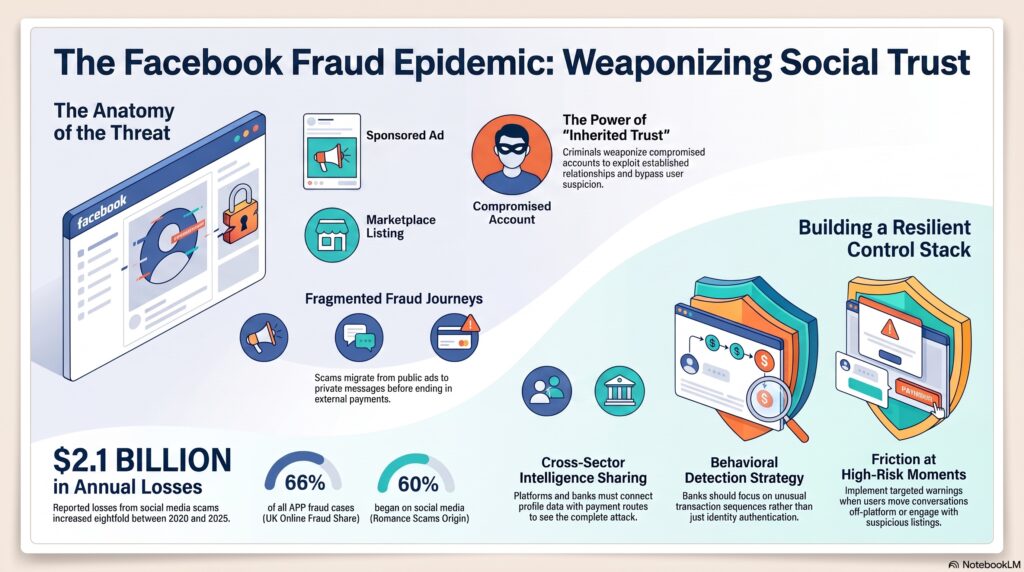
Social media has become one of the most productive channels for mass-market fraud. US Federal Trade Commission data show that reported losses from scams beginning on social media reached $2.1 billion in 2025, approximately eight times the amount reported in 2020. Nearly 30% of people who reported losing money to a scam said that it began through social media.
Facebook was particularly significant. Consumers reported losing more money to scams beginning on Facebook in 2025 than to scams originating on any other social-media platform. Reported losses associated with Facebook alone exceeded those attributed to text messages or email.
The scale is not explained by one weakness or one type of victim. Facebook gives criminals access to a broad population, including consumers, business owners, investors, job seekers, tenants, collectors and members of specialist interest groups. Public profiles and interactions can reveal interests, employment, relationships, recent purchases and major life events, allowing scammers to personalise their approach.
The wider payment consequences are visible in UK data. UK Finance recorded £576.4 million in authorised push payment fraud losses during 2025, with 66% of cases beginning online. Purchase scams represented the largest number of cases, while investment fraud generated the greatest value of losses.
Facebook can participate in both journeys: the apparently attractive product advertised through Marketplace and the supposedly exclusive investment opportunity promoted through a sponsored post or private group.
How criminal actors weaponise Facebook advertising
Paid advertising allows criminals to use the same targeting tools as legitimate businesses. A fraudulent campaign can be aimed at users based on age, location, interests, browsing behaviour or engagement with financial content.
Investment scammers may promote trading systems, cryptocurrency opportunities, artificial-intelligence investment tools or supposed endorsements by celebrities and business leaders. The advertisement directs the user to a cloned website, fraudulent application or messaging group where the manipulation continues.
The initial payment is often deliberately small. A fake investment dashboard displays profits, and the victim may be permitted to withdraw a limited amount. This creates confidence before larger deposits, fees or tax payments are requested. The apparent investment does not exist; the interface is designed to control the victim’s perception.
Shopping scams use a similar acquisition model. Advertisements promote discounted clothing, electronics, vehicle parts, event tickets or other desirable goods. The linked website may impersonate a recognised retailer or disappear after collecting payment details.
The FTC found that shopping scams were the most frequently reported form of social-media fraud in 2025. More than 40% of consumers who reported losing money through a social-media scam said the incident began with a product they had seen advertised.
The advertisement is therefore more than promotional content. It is the entry point into a payment and identity-harvesting journey.
Marketplace fraud and manufactured commerce
Facebook Marketplace gives buyers and sellers access to large local and national audiences. Most activity is legitimate, but the informal structure of person-to-person commerce creates opportunities for both buyer and seller fraud.
Fraudulent sellers may advertise vehicles, electronics, rental properties, pets, furniture or event tickets that do not exist. They create urgency by claiming that several other buyers are interested and request a deposit before inspection or collection.
Images and descriptions may be copied from genuine listings. A seller profile with historical posts, friends and community activity can make the transaction appear credible, particularly where the profile has been compromised rather than newly created.
Fraudulent buyers use different techniques. They may claim to have paid through a platform service, send a false payment confirmation or tell the seller that an account upgrade fee is required before funds can be released. Others arrange collection through a courier and provide phishing links designed to capture card or banking information.
Moving the conversation outside Facebook or Messenger is a recurring warning sign. Criminals encourage users to communicate through text, email or another messaging service because this reduces platform visibility and can remove transaction protections.
The marketplace transaction may also support money laundering. Criminals can use stolen payment credentials to obtain goods, recruit parcel mules to receive them and resell the merchandise through another account. The resale proceeds then appear to originate from ordinary consumer commerce.
Cloned profiles and compromised accounts
A newly created account with no history may attract suspicion. A genuine account taken over from an established user provides something far more valuable: inherited trust.
Criminals obtain Facebook credentials through phishing, credential reuse, infostealer malware and fraudulent security messages. Once inside, they can review previous conversations, identify close contacts and send requests that appear consistent with the victim’s writing style and relationships.
A compromised user may supposedly need emergency assistance, have tickets available for sale or be collecting money for a personal cause. Friends and relatives may send funds because the request arrives from a known account within an existing conversation.
Business-page compromise creates further opportunities. Attackers can impersonate the company, redirect customers, publish fraudulent promotions or attempt to gain access to connected advertising and payment capabilities.
Account recovery scams can extend the incident. A victim who posts publicly that their account has been hacked may be contacted by a supposed support representative offering to recover it. The service is itself fraudulent and is designed to obtain further credentials, verification codes or payment.
The account is therefore not only a communications channel. It is a reusable digital identity with an established network of potential victims.
Messenger, romance fraud and long-term manipulation
Messenger allows an initial public interaction to become a private and sustained relationship. This is particularly important in romance, friendship and investment scams, where the criminal needs time to establish trust.
A romance fraudster may construct a profile representing a military officer, professional, entrepreneur or overseas worker. The relationship develops through frequent messages, emotional disclosures and promises of a shared future.
Financial requests may begin with a medical emergency, travel problem or temporary inability to access funds. They can later evolve into investment proposals, requests to receive third-party payments or instructions to open financial accounts.
FTC data show that nearly 60% of consumers who reported losing money to a romance scam in 2025 said the relationship began through social media. The manipulation may continue for months, and the victim may make repeated payments even after concerns are raised by family members or banks.
Messenger can also support fake employment, grant and prize scams. Criminals imitate employers, government programmes or trusted community members and request fees for equipment, training, processing or tax.
The relationship between the profile and the payment is the key control consideration. A beneficiary may appear unrelated to the Facebook persona because funds are directed to a mule, company, payment agent or cryptoasset wallet.
How fraud migrates across Meta’s platforms
Facebook fraud frequently moves across applications. A user may see an advertisement on Facebook, exchange initial messages through Messenger and then be directed to WhatsApp for further communication.
This migration gives criminals operational flexibility. Different accounts can perform different roles, and the victim may interpret the move to a private messaging channel as evidence of a developing commercial or personal relationship.
Scammers may also create groups containing fake investors, customers or supporters. These controlled personas provide testimonials, display fabricated profits and reassure the victim when concerns emerge. The apparent community is part of the deception.
The fraud journey may ultimately leave Meta’s services altogether. Victims are directed to external trading platforms, payment pages, remote-access applications or cryptocurrency services. By the time the financial transaction occurs, the originating Facebook content may have been removed or the account disabled.
For investigators, platform migration creates evidential fragmentation. The advertisement, profile, messages, website, payment and receiving account may all be held by different organisations.
Why Facebook fraud scales so efficiently
The first reason is reach. Criminals can access a global audience without building their own distribution network.
The second is targeting. Public profiles, group memberships and advertising tools allow campaigns to be directed towards people likely to respond to a particular product, relationship or opportunity.
The third is inherited trust. Compromised accounts allow criminals to communicate through genuine identities, established friendships and historical conversations.
The fourth is automation. Fake profiles, advertisements, messages and engagement can be generated, tested and replaced rapidly. Artificial intelligence improves language quality, translation, image creation and impersonation scripts.
The fifth is criminal specialisation. One group may obtain accounts, another purchase advertising, another conduct conversations and another manage mule accounts or cryptoasset cash-out.
The final reason is adaptability. When an advertisement is removed, the domain, page or creative content can be changed. When an account is blocked, another profile takes its place. Enforcement must therefore target networks and infrastructure rather than individual pieces of content alone.
Meta reported removing more than 159 million scam advertisements during 2025 and disabling 10.9 million Facebook and Instagram accounts associated with criminal scam centres. Those figures demonstrate both the scale of enforcement and the industrial capacity of the adversary.
Why conventional financial controls miss the attack
The bank usually does not see the Facebook interaction. It sees a customer making a payment to a new beneficiary, purchasing cryptoassets or transferring money to an apparently legitimate business.
Authentication may be successful because the customer is making the payment personally. The relevant risk is not whether the customer controlled the device, but whether their understanding was created through deception.
Payment references may also appear ordinary. A purchase scam can be described as a deposit, an investment payment as professional services and a romance transfer as family support.
The strongest indicators may sit in the sequence surrounding the payment: sudden interest in cryptoassets, rapid liquidation of savings, repeated transfers to unfamiliar recipients, misleading explanations and continued payments after failed withdrawals.
Receiving institutions face a different view. A mule account may receive payments from several victims whose scams began through unrelated advertisements or profiles. Network analysis can reveal the shared criminal infrastructure beneath those separate narratives.
What a resilient control stack looks like
The first layer is platform prevention. Social-media services need risk-sensitive advertiser verification, account-integrity controls, scam-pattern detection and rapid disruption of linked profiles, pages, domains and payment instruments.
The second layer is friction at high-risk moments. Warnings should appear when users interact with suspicious friend requests, move conversations off-platform or encounter patterns associated with employment, investment and Marketplace fraud.
The third layer is financial-sector behavioural detection. Banks should connect beneficiary risk, customer behaviour, device events and the stated payment purpose. Interventions should be specific to the suspected typology rather than relying on generic fraud messages.
The fourth layer is receiving-account disruption. Mule detection should analyse unexpected inbound payments, rapid dispersal, shared devices, common contact details and links to previous scam reports.
The fifth layer is intelligence sharing. Platforms can contribute profile, advertising, messaging and domain intelligence, while financial institutions can identify beneficiaries, payment routes and recovery opportunities. Neither side sees the complete attack chain independently.
The sixth layer is customer safeguarding. Victims may be emotionally invested, embarrassed or still under the scammer’s influence. Effective intervention requires neutral questioning, clear explanations and procedures that recognise vulnerability and coercion.
What this means for financial crime leaders
Facebook fraud should not be treated only as a platform-moderation or consumer-awareness issue. It is a cross-sector financial-crime threat connecting digital advertising, identity compromise, social engineering, payment fraud and money laundering.
The UK Online Safety Act has strengthened expectations that online services assess how their systems may facilitate fraud and implement proportionate measures to reduce illegal activity. Regulatory duties, however, do not remove the need for banks, payment providers and law enforcement to act on their own intelligence.
Leaders should ask whether their institution can connect a customer’s reported Facebook scam with the receiving account, linked beneficiaries and wider mule network. They should also examine whether confirmed cases improve payment interventions and customer communications quickly enough to prevent repetition.
The central control objective is not to predict every fraudulent advertisement, listing or persona. It is to recognise the operating model beneath them: targeted acquisition, manufactured trust, migration into private communication and conversion of that trust into a payment.
Criminals use Facebook because it brings identity, audience, commerce and communication together. The most resilient response will come from institutions capable of connecting those same elements defensively—before a convincing profile, post or message becomes an irreversible financial loss.
What Financial Institutions Should Consider
- Treat Social Media as a Distinct Fraud Origination Channel
- Capture Scam-Origination Data During Customer Investigations
- Strengthen Detection of Social-Media-Linked Payment Fraud
- Monitor Payments to Newly Added or High-Risk Beneficiaries
- Detect Repeated Payments to Accounts Associated With Multiple Victims
- Strengthen Money Mule and Receiving-Account Detection
- Apply Risk-Based Interventions to Suspicious Payments
- Incorporate Customer Vulnerability Into Scam Controls
- Improve Customer Warnings for Marketplace and Investment Scams
- Monitor Account Activity Following Social Media Account Compromise
- Connect Fraud, AML, Cyber and Customer-Support Intelligence
- Share Confirmed Scam Intelligence With Relevant Platforms
- Feed Confirmed Social Media Fraud Typologies Back Into Detection Models
- Analyse Scam Networks Rather Than Individual Transactions Alone
- Strengthen Cross-Sector Intelligence Sharing
- Measure Prevention and Disruption Alongside Reimbursement Outcomes
Download the briefing
Facebook Fraud: How Scammers Are Exploiting Social Media for Financial Gain


Facebook fraud is not a single scam type but a connected financial-crime ecosystem that combines digital advertising, compromised identities, private messaging, online commerce and criminal payment infrastructure.
The platform’s strength—its ability to bring together audience, trust, communication and commerce—is also what makes it attractive to fraud networks. Criminals can use sponsored advertisements to acquire victims, cloned profiles to create credibility, Messenger conversations to deepen manipulation and mule accounts or cryptoasset services to receive and disperse the proceeds.
For financial institutions, the challenge is that the decisive evidence often sits outside the payment system. The bank may see only an authorised transfer, while the deception developed across advertisements, profiles, groups and private conversations. Effective detection therefore requires behavioural analysis, typology-specific intervention, receiving-account intelligence and timely collaboration between platforms, banks, payment providers, telecommunications firms and law enforcement.
Customer education remains important, but responsibility cannot rest on users alone. Social-media platforms must strengthen advertiser and account verification, financial institutions must identify suspicious payment journeys, and confirmed fraud cases must be converted into actionable intelligence against the wider network.
Ultimately, the most resilient response is not to focus solely on removing one fraudulent advertisement, profile or listing. It is to identify and disrupt the operating model behind them: targeted victim acquisition, manufactured trust, migration into private channels and the rapid conversion of that trust into financial loss.