 FinCrime Intelligence
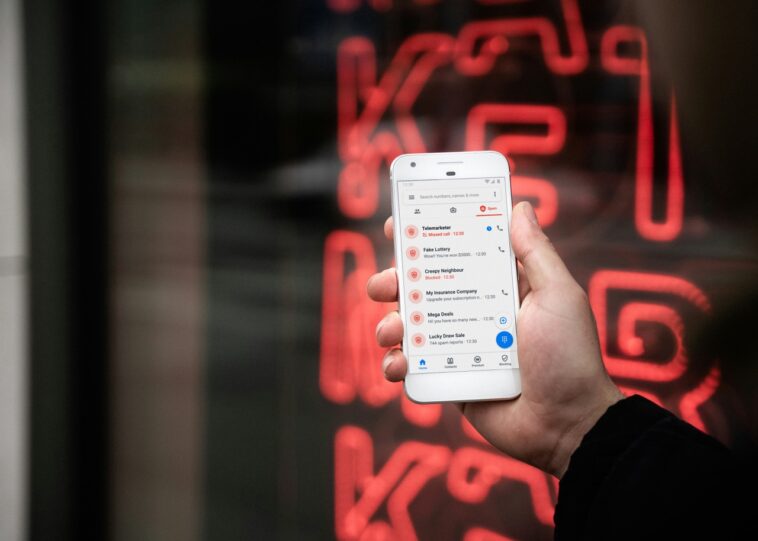
Phone scams are no longer defined by a stranger making an obviously suspicious call and asking for card details. Modern campaigns combine caller-ID spoofing, breached personal data, automated dialling, artificial intelligence, remote-access tools and professionally managed mule networks. The telephone call is often only one stage in a wider operation that may begin with a text message, continue through a convincing impersonation and end with an authorised transfer or account takeover.
For financial institutions, the central problem is that the customer may complete every security step personally. They may use a recognised device, answer authentication questions, disclose a one-time passcode or approve a payment while believing they are speaking to their bank, the police, a government agency, an employer or a relative. The technical instruction can be genuine even when the decision-making environment has been manufactured by a criminal.
The sophistication of phone scams therefore lies less in one technology than in the orchestration of trust. Criminal actors combine credible data, familiar communications and real-time psychological pressure to make an abnormal request feel urgent, necessary and safe.
Key Takeaways
- Phone Scams Are Becoming More Targeted and Sophisticated
- Fraudsters Exploit Moments of Distraction and Vulnerability
- Caller ID Spoofing Increases the Credibility of Impersonation Scams
- Banks and Trusted Organisations Are Frequently Impersonated
- Social Engineering Remains Central to Phone-Based Fraud
- Victims Can Be Manipulated Into Disclosing Sensitive Financial Information
- Tech-Support Scams Can Enable Wider Account and Device Compromise
- Government Impersonation Scams Exploit Fear and Urgency
- Phone Scams Can Lead to Both Financial Loss and Identity Theft
- Elderly and Vulnerable Customers May Face Elevated Risk
- Authentication Alone Cannot Confirm Genuine Customer Intent
- Customer Awareness Remains an Important Layer of Fraud Prevention
Listen the podcast
Watch the video
Why phone scams matter now
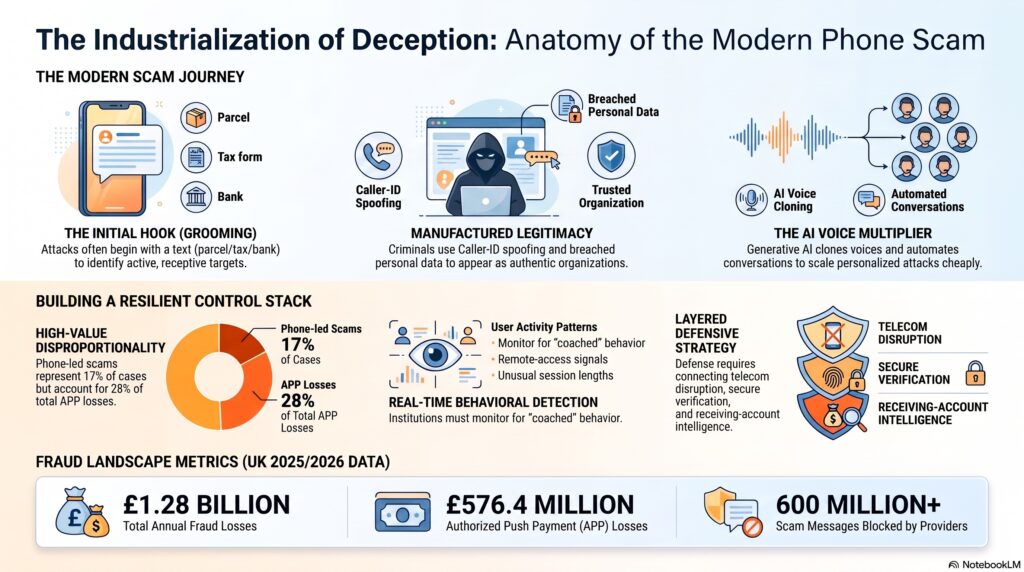
Telecommunications remain a major entry point into payment fraud. UK Finance reported that 17% of authorised push payment fraud cases recorded in 2025 began through telecommunications networks, but those cases accounted for 28% of APP losses. Phone-led scams may therefore be less frequent than online-originated fraud while still causing disproportionately high-value harm.
UK payment fraud losses reached £1.28 billion in 2025, including £576.4 million through APP fraud. Although bank and police impersonation losses declined, criminals continued to use sophisticated social engineering and compromise one-time passcodes.
Ofcom reported in July 2026 that four in ten UK mobile users had received at least one suspicious mobile message during the previous three months. Providers were already blocking more than 600 million scam messages each year, yet malicious campaigns continued to reach consumers and businesses.
Phone scams are therefore an industrialised acquisition channel connecting telecommunications infrastructure with fraud, account takeover, identity theft and money laundering.
How the modern phone-scam journey works
The attack frequently begins before the call. A message may claim that a parcel is delayed, a tax payment is overdue, a bank transaction has been blocked or a family member is using a new number. It encourages the recipient to click a link or call a supplied number.
This interaction confirms that the number is active, identifies receptive targets and may capture information used to personalise the call.
The caller may know the victim’s address, recent purchase, employer, partial card number or bank. Those details may come from breaches, phishing, social media or compromised email. Accurate information makes the caller appear to be working from an authentic customer record.
The criminal then creates a controlled crisis. The victim is told that an account is under attack, a payment is pending, a relative is in danger or an urgent corporate transfer is required. The proposed solution benefits the criminal: disclose a code, install remote-access software, approve a notification or move money to a “safe account”.
Funds then move through mule accounts, payment providers, cryptocurrency services or cash-out networks. Receiving accounts can be replaced quickly after being reported.
Caller-ID spoofing and manufactured legitimacy
Caller-ID spoofing allows a criminal to alter the number displayed on the recipient’s phone. A call originating abroad or through internet telephony may appear to come from a UK mobile number, a local landline or a recognised organisation.
The displayed number is presentation data, not proof of origin. People are more likely to answer a domestic or familiar-looking number than an unexpected international call.
Spoofing also supports false verification. A victim may be told to compare the incoming number with the number printed on a bank card or official website. A match appears to provide independent confirmation even though the caller controls what is displayed.
Telecom controls are becoming stronger. Ofcom has introduced measures aimed at calls from abroad that imitate UK numbers and has required more consistent blocking, sender verification and traffic monitoring across messaging services. These measures raise attacker costs but do not remove the need for bank-side verification. Criminals can rotate numbers, compromise business messaging accounts or persuade victims to call fraudulent numbers themselves.
AI voice cloning and automated vishing
Artificial intelligence changes the economics of voice fraud. Traditional vishing depends on human operators who can speak the target’s language, follow a script and respond convincingly to questions. Generative systems can create personalised scripts, translate conversations and produce synthetic or cloned voices.
Voice cloning is relevant to family-emergency, executive-impersonation and authority scams. A short public recording may provide material to imitate a relative, senior manager or official. The criminal does not need a perfect replica when the call is brief, emotional and affected by background noise, poor signal quality or an explanation such as injury.
The more significant long-term risk is automation. AI voice agents can initiate calls, maintain basic conversations, identify receptive targets and escalate promising cases to human operators. This reduces the cost of failed attempts and allows groups to test different accents, scripts, institutions and emotional triggers at scale.
AI does not remove the need for a persuasive pretext or payment route, but it makes credible interaction cheaper, adaptable and easier to localise.
Remote access and real-time account control
Some phone scams aim to obtain direct visibility of the victim’s device. The caller claims to be from technical support or a fraud department and instructs the customer to install screen-sharing or remote-access software.
Once connected, the criminal may observe online banking, guide security changes or conceal activity. The customer may be asked to register a device, increase a limit or read out a code while the attacker manages questions and overrides warnings.
Remote-access activity can blur the distinction between APP fraud and unauthorised account takeover. The customer may initiate some actions while the criminal controls others. Investigators therefore need device, session and communication evidence rather than relying solely on whether valid credentials were used.
OTP compromise, authentication fatigue and coaching
One-time passcodes and push approvals remain important controls, but they can be defeated when the legitimate customer is manipulated into completing them.
A criminal may claim that a code is needed to cancel fraud when it is actually authorising a payment, registering a new device or enrolling a digital wallet. The customer sees a genuine bank message, which reinforces the caller’s credibility.
Repeated prompts can create fatigue. The caller explains that an earlier attempt failed and asks the customer to approve another notification. Each genuine system event becomes part of the scam narrative.
Authentication success should therefore not be treated as proof of informed intent. The institution must assess what the customer believed they were approving and whether behaviour indicates coaching, hesitation or third-party control.
Why phone scams scale efficiently
The first reason is infrastructure commoditisation. Voice-over-internet services, automated diallers, bulk messaging, number spoofing, SIM farms and stolen data can be combined without building a conventional call centre.
The second is specialisation. Different groups can obtain data, distribute messages, operate calls and manage mule accounts, separating the speaker from the wider organisation.
The third is feedback. Criminals learn which banks intervene, which scripts create trust, which warnings customers ignore and which beneficiary accounts remain active. Scripts and payment routes can be changed quickly.
The fourth is cross-border reach. Operators can display local numbers from abroad and move funds through several institutions, each seeing only part of the event.
Finally, trust is reusable. Compromised contacts and conversation history support further impersonation, while victims may later be targeted through recovery scams.
What a resilient control stack looks like
The first layer is telecom-level disruption. Providers should identify spoofed calls, verify business senders, monitor traffic patterns, restrict abnormal SIM activity and act quickly on reported numbers, links and sender identities. Cross-network call tracing is essential where traffic passes through several carriers.
The second layer is secure customer verification. Banks and trusted organisations should give customers a reliable way to terminate an unsolicited call and reconnect through an independently accessed channel. Staff should never normalise requests for complete passwords, security codes or transfers to protective accounts.
The third layer is real-time behavioural detection. Financial institutions should connect active-call indicators, remote-access signals, authentication events, device changes, internal transfers, beneficiary creation and payment attempts. A high-value transfer during a long telephone session after savings have been consolidated creates a different risk profile from an ordinary payment.
The fourth layer is typology-specific intervention. A generic warning is less effective than a clear challenge explaining that banks and police do not ask customers to transfer money to safe accounts, disclose passcodes or conceal a payment’s purpose.
The fifth layer is receiving-account intelligence. Preventing the call does not dismantle the infrastructure behind it. Banks should monitor unexpected inbound payments, rapid pass-through activity, shared devices and links to previous scam reports to identify mule networks before funds are withdrawn.
The sixth layer is voice and identity governance. Voice biometrics require anti-spoofing controls, independent testing and alternative verification; a voice match is not conclusive proof of identity.
Finally, customer-facing teams need escalation authority. Staff who detect coaching or coercion should be able to pause a payment, separate the customer from the caller and conduct a sensitive assessment without assuming that confusion indicates dishonesty.
What an effective incident response looks like
Speed is critical once a phone scam is identified. The sending institution should attempt to stop or recall the payment, notify the receiving provider and preserve transaction, device and communication evidence.
The customer’s wider identity should be assessed. Credentials, registered devices, email accounts, mobile numbers and recovery information may all have been exposed. Remote-access software should be removed from a clean environment, and active sessions should be revoked.
The receiving account should be treated as an intelligence lead rather than the end of the case. Investigators should examine linked beneficiaries, common devices, associated phone numbers, previous reports and downstream movement.
Victims may have been coached to mislead staff or remain convinced that the caller was genuine. A non-accusatory approach improves safeguarding and evidence quality.
What this means for financial crime leaders
Phone scams are no longer simply fraudulent calls. They are multi-channel, data-driven operations combining telecommunications, digital identity, psychological manipulation and rapid money movement.
The strategic challenge is not to detect a particular accent, script or telephone number. Those features will change. Institutions need to recognise the underlying sequence: unsolicited contact, manufactured urgency, identity manipulation, unusual authentication, coached behaviour and payment to criminally controlled infrastructure.
Fraud, AML, cybersecurity, payments, customer vulnerability and telecom partners should therefore share intelligence and escalation protocols. The strongest defence is created when a suspicious call affects payment risk, a reported beneficiary affects future onboarding and confirmed cases improve both customer messaging and detection.
Criminals are making phone scams more sophisticated by connecting technologies that institutions often govern separately. Financial organisations that connect those same signals defensively will be better positioned to interrupt the conversation before trust is converted into an irreversible payment.
What Financial Institutions Should Consider
- Strengthen Impersonation Scam Detection
- Monitor High-Risk Payments Following Suspicious Calls
- Apply Behavioural Analytics to Identify Unusual Customer Activity
- Detect New Beneficiaries and Rapid Funds Movement
- Use Risk-Based Payment Interventions
- Strengthen Customer Verification During High-Risk Interactions
- Monitor Changes in Contact and Authentication Details
- Connect Device, Call-Related and Transaction Intelligence
- Incorporate Customer Vulnerability Into Fraud Controls
- Improve Real-Time Scam Warnings
- Train Frontline Teams to Recognise Social Engineering Indicators
- Strengthen APP Fraud Prevention Controls
- Improve Receiving-Account and Mule Detection
- Share Scam Intelligence Across Fraud, AML and Cyber Teams
- Feed Confirmed Phone-Scam Typologies Back Into Detection Models
- Treat Phone Scams as Part of the Wider Digital Fraud Journey



Modern phone scams are no longer simple confidence tricks delivered through a single call. They are coordinated, multi-channel operations that combine caller-ID spoofing, breached personal data, automated messaging, artificial intelligence, remote-access tools and mule-account infrastructure.
The central challenge for financial institutions is that the customer may complete the payment and authentication journey personally while acting under criminal manipulation. Valid credentials, familiar devices and successful security checks do not necessarily prove informed intent. Effective controls must therefore assess the wider context: how contact began, whether the customer appears to be coached, what identity or device changes occurred and where the funds are being sent.
Telecommunications providers, banks, payment firms and digital platforms each hold different parts of the intelligence required to disrupt these schemes. Stronger prevention depends on connecting suspicious communications with authentication events, transaction behaviour and receiving-account risk before the criminal network can disperse the proceeds.
Customer education remains important, but responsibility cannot rest with individuals alone. Warnings must be specific, support channels must allow customers to reconnect independently, and frontline teams need the authority to pause high-risk payments where coercion or impersonation is suspected.
Ultimately, criminals succeed by converting manufactured trust into genuine customer action. Institutions that integrate communications intelligence, behavioural analytics, customer safeguarding and mule-network detection will be better positioned to interrupt that process before a convincing conversation becomes an irreversible financial loss.