 FinCrime Intelligence

Financial crime has always evolved in response to control. When institutions strengthened sanctions screening, criminal networks increased their use of spelling variations, opaque ownership structures, intermediaries and layered payment chains. When fraud teams introduced transaction rules, attackers tested thresholds, altered timing and spread activity across multiple accounts. When cyber teams relied on signatures and known indicators, malware developers changed code, infrastructure and execution paths while preserving the same malicious objective.
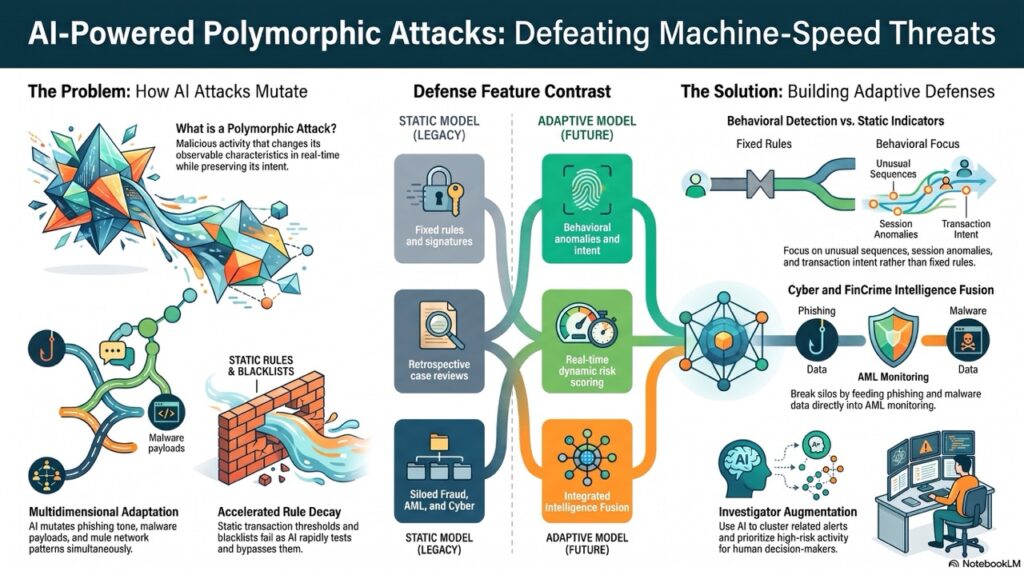
Artificial intelligence is accelerating that cycle. It gives threat actors the ability to generate, test and modify attack components at a speed that is difficult to match through conventional control-tuning processes. The result is an emerging class of AI-powered polymorphic attacks: campaigns that continuously change their observable characteristics while maintaining a stable criminal purpose.
For a FinCrime audience, the important point is that polymorphism is no longer limited to malware. It can affect phishing messages, synthetic identities, onboarding journeys, device signals, social-engineering scripts, payment patterns, mule-account networks and laundering routes. The attack is not simply automated. It is adaptive, feedback-driven and capable of learning where defensive friction exists.
Key Takeaways
- AI Is Accelerating the Evolution of Financial Crime
- Polymorphic Attacks Adapt in Real Time
- Financial Crime Typologies Are Becoming Dynamic
- Machine-Speed Attacks Increase Detection Latency Risk
- Static Rules and Indicators Are Losing Effectiveness
- Cybercrime, Fraud and AML Risks Are Converging
- AI Enables Faster and More Scalable Evasion
- Behaviour and Intent Matter More Than Individual Indicators
- Defensive Controls Must Become Adaptive
Listen the podcast
Watch the video
Why AI-powered polymorphism matters now
Financial institutions increasingly operate through real-time digital channels. Customers open accounts remotely, authenticate through mobile devices, initiate instant payments and interact with automated support services. These developments improve accessibility and speed, but they create a structural asymmetry: the institution must make a trusted decision within seconds, while the attacker can run repeated experiments against the decisioning process.
AI makes those experiments cheaper and more productive. A criminal campaign can generate thousands of message variations, rotate infrastructure, rewrite malicious code, alter identity attributes and adjust transaction behaviour without rebuilding the operation. Google Threat Intelligence Group has described industrial-scale use of generative AI across adversarial workflows, including defence evasion, polymorphic malware development and increasingly autonomous attack activity. Palo Alto Networks has separately demonstrated how large language models can generate natural-looking variants of malicious JavaScript that degrade existing classifiers.
This is why polymorphic risk belongs in mainstream financial-crime governance rather than only in cybersecurity. A campaign may begin with credential theft, move into account takeover, trigger fraudulent payments, use mule accounts for cash-out and generate suspicious activity requiring AML investigation. The event crosses multiple control domains, but the institution may still be organised around separate fraud, cyber, AML, identity and payments teams.
The strategic lesson is straightforward: when an attack can change during execution, a control framework dependent on periodic updates and slow hand-offs will operate against an earlier version of the threat.
How criminal actors weaponise adaptive campaigns
The clearest use case is AI-generated social engineering. Instead of sending one phishing template to thousands of recipients, criminals can create messages tailored to a victim’s employer, role, language or recent activity. Tone, urgency and pretext can be modified automatically, and the campaign can learn which versions produce clicks, disclosures or payment authorisations.
The same principle applies during live interaction. A voice-phishing or business-email-compromise script can change in response to hesitation, verification questions or unexpected objections. Synthetic voice, deepfake imagery and generative text can support impersonation at scale, while human operators intervene only when a high-value target requires judgement.
Polymorphism also strengthens account takeover. If one access method is blocked, the operation can shift from password reuse to session theft, device-code phishing, push-notification fatigue or manipulation of customer-support processes. Once access is established, the attacker can test beneficiary creation, contact-detail changes, device registration and payment limits, adapting the sequence when controls introduce friction.
The transaction itself can mutate. If a high-value transfer is blocked, the amount can be fragmented. If velocity rules trigger, payments can be delayed or distributed. If one payment rail receives additional scrutiny, funds can be rerouted through cards, instant payments, wallets, cryptoassets or merchant channels. If a receiving account is identified, the mule network can rotate accounts, counterparties and jurisdictions.
Synthetic identity and onboarding abuse create another adaptive surface. AI can generate variations of identity documents, selfies, supporting information and behavioural interaction. Failed applications tell the attacker which fields are challenged, which document features are detected and which profiles are approved with less friction. The onboarding process becomes an optimisation problem.
Europol’s cybercrime assessments describe an environment in which AI, anonymity services and other technological enablers are increasing the speed, efficiency and scope of criminal operations. For financial institutions, stolen credentials and identity data are not only cyber artefacts; they are inputs into fraud, mule recruitment, account opening and money laundering.
Why polymorphic financial crime scales so efficiently
The first reason is technical commoditisation. Generative models, automation frameworks, cloud infrastructure, proxy services, phishing kits, malware builders and stolen-data marketplaces can be combined into repeatable workflows. Criminal groups no longer need every capability in-house. They can acquire components, automate routine stages and reserve specialist labour for higher-value decisions.
The second reason is economics. Traditional campaign variation required manual rewriting or redevelopment. AI reduces that cost. Once an attack workflow is established, producing additional variants becomes inexpensive. That encourages experimentation with different messages, identities, devices, timings, payment values and laundering routes.
The third reason is feedback. A declined payment, step-up authentication request, blocked login, rejected document or frozen account tells the attacker something about the control environment. In a static campaign, that information may shape the next operation. In an adaptive campaign, it can influence the next attempt immediately.
The fourth reason is fragmentation inside the defender. A phishing domain may be visible to cyber teams, a device anomaly to fraud teams, a new beneficiary to payments teams and a mule pattern to AML investigators. Each signal may appear weak in isolation. The criminal advantage comes from exploiting the delay before those signals are connected.
Static indicators remain useful, but their value decays more quickly. A known domain, malware hash, message template or transaction pattern may identify yesterday’s variant while the underlying campaign continues through a new form. The defender must look for continuity of intent, infrastructure and behaviour beneath changing surface indicators.
What a resilient control stack looks like
The first layer is behavioural and sequence-based detection. Institutions should analyse how events unfold across sessions rather than assess every event independently. A new device, password reset or beneficiary may each be legitimate. But a new device followed by a password reset, contact-detail amendment, beneficiary creation and urgent outbound payment creates a materially different risk picture.
The second layer is dynamic risk scoring. Customer, account, device, payment and counterparty risk should update as information arrives. Risk decisions made at onboarding cannot remain fixed when behaviour, device environment or network relationships change. Real-time decisioning is particularly important where funds can leave faster than a manual investigation can begin.
The third layer is entity and network analysis. Polymorphic campaigns often change individual attributes while reusing wider infrastructure. Accounts may share devices, IP ranges, phone numbers, addresses, beneficiaries, merchants, cryptocurrency wallets or behavioural patterns. Graph analysis helps institutions detect the operating model rather than only the individual transaction.
The fourth layer is cyber-FinCrime intelligence fusion. Intelligence on credential theft, phishing domains, malware, bots and compromised devices should feed fraud and AML monitoring. Suspicious payment flows, mule clusters and unusual customer behaviour should in turn inform cyber investigations. This requires shared data, common escalation criteria and protocols that function at incident speed.
The fifth layer is layered identity assurance. As AI improves impersonation, institutions should reduce dependence on any single identity or authentication signal. Phishing-resistant authentication, device binding, behavioural biometrics, transaction signing, robust account-recovery controls and risk-based human intervention can make adaptation more expensive.
Finally, firms need continuous control validation. Testing should not ask only whether systems detect known typologies. It should ask how controls respond when an adversary changes the message, device, identity, payload, timing or transaction route. Red-team exercises, synthetic scenarios and adversarial testing should be linked to fraud losses, investigation outcomes and model recalibration.
How institutions can use AI on the defensive
It would be a mistake to frame AI only as criminal infrastructure. The same capabilities that increase attacker speed can help institutions identify relationships, prioritise risk and shorten the distance between detection and action.
AI can support investigators by clustering related alerts, summarising cases, extracting entities, identifying typology drift and highlighting inconsistencies across customer, device and transaction data. It can help threat-intelligence teams connect phishing infrastructure with compromised accounts and suspicious beneficiaries. It can also generate controlled attack variations for testing, allowing institutions to measure whether detection remains effective when the form changes.
Palo Alto Networks’ work on LLM-generated malicious-code variants illustrates the defensive value: adversarially generated samples were used to retrain a detection model and improve performance against malicious JavaScript observed in the wild. The broader FinCrime lesson is that simulated mutation can strengthen controls when it is governed, validated and tied to measurable outcomes.
Defensive AI does not remove the need for governance. Models require explainability, monitoring, bias assessment, data-quality controls, access restrictions and human accountability. NIST’s adversarial machine-learning taxonomy emphasises that AI systems themselves face evasion, poisoning, privacy and abuse risks across their lifecycle. Institutions therefore need to secure both the control and the data on which it depends.
The objective is not to automate every decision. It is to use automation where speed and scale matter, while preserving expert judgement for ambiguous, high-impact and customer-sensitive cases.
What this means for financial crime leaders
The right way to think about AI-powered polymorphic attacks is as an operating-model threat, not a single typology. The same adaptive capability can appear in phishing, malware, identity fraud, account takeover, payment fraud, mule networks and laundering activity. Treating each manifestation as isolated allows the wider campaign to remain hidden.
For financial crime leaders, the strategic implication is clear. Detection programmes must become more adaptive, but technology alone will not achieve that outcome. Fraud, AML, cyber, payments, identity, data science and operational-resilience teams need shared telemetry, rapid escalation routes, common scenario testing and feedback loops that convert incidents into control improvements.
Boards and senior management should ask whether controls can detect changing behaviour, whether intelligence moves quickly enough across functions, whether models are tested against evasion and whether the institution can intervene before funds move beyond recovery. The relevant measure is not simply how many rules, alerts or models exist. It is whether the control environment can recognise a criminal objective when its visible form keeps changing.
AI-powered polymorphic attacks are part of the industrialisation of financial crime. They lower the cost of variation, accelerate experimentation and allow criminals to learn from defensive responses. Institutions that depend primarily on fixed indicators and retrospective reviews will face growing detection latency and rule decay.
In the machine-speed era of financial crime, the winning defence is not the one that memorises yesterday’s pattern. It is the one that can identify the underlying behaviour, connect weak signals and adapt before the money moves.
What Financial Institutions Should Consider
- Prioritise Behavioural Detection
- Implement Real-Time Dynamic Risk Scoring
- Integrate Cyber and FinCrime Intelligence
- Strengthen Adaptive Model Governance
- Test Controls Against Polymorphic Attack Scenarios
- Use AI to Augment Investigators
- Strengthen Identity and Authentication Controls
- Reduce Detection and Response Latency
- Build Cross-Functional Intelligence Sharing
- Monitor Typology and Model Drift
- Develop Scenario-Based Resilience Plans
- Increase Board-Level Oversight of AI-Enabled Threats
- Move From Static Detection to Adaptive Defence
Download the briefing
Machine-Speed Crime: The Expansion of the Financial Threat Landscape



For financial crime professionals, AI-powered polymorphic attacks should be viewed as more than a cybersecurity issue. They are a financial crime operating model. They affect onboarding, authentication, fraud prevention, transaction monitoring, mule detection, AML investigations, sanctions risk, customer protection and regulatory reporting.
This requires a shift in mindset.
Financial crime teams should not only ask: “Does this transaction match a known typology?”
They should also ask:
What changed in the customer’s behaviour?
What changed in the device, session or identity profile?
What changed before the payment was made?
Are multiple accounts showing related behaviour?
Is this fraud event connected to mule activity?
Is this AML alert linked to upstream cyber compromise?
Is the institution seeing a campaign, not just an incident?
AI-enabled criminals are becoming more adaptive. Financial crime controls must become adaptive too.