
Product description
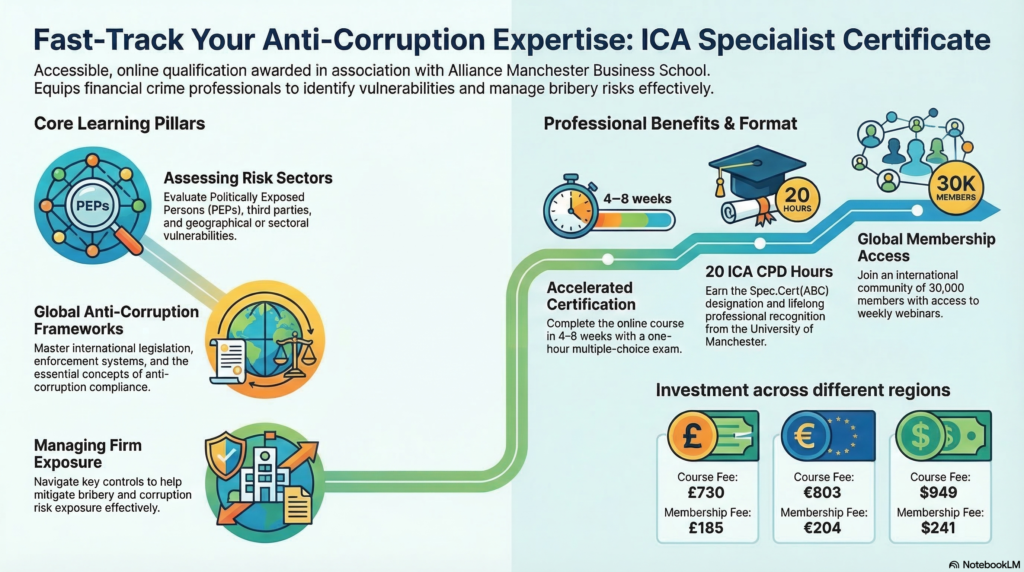
The ICA Specialist Certificate in Anti-Corruption is a focused qualification developed by the International Compliance Association (ICA) that provides professionals with a solid foundation in understanding, identifying, and mitigating corruption risks in both public and private sector environments. Corruption, including bribery, facilitation payments, and conflicts of interest, remains one of the most significant and widespread financial crime threats worldwide.
This certification offers a deep dive into the causes and consequences of corruption, global anti-corruption frameworks (such as the UK Bribery Act and the U.S. Foreign Corrupt Practices Act), risk assessment strategies, and the implementation of effective anti-corruption compliance programs. It also emphasizes the importance of transparency, ethical leadership, and whistleblower protections in preventing corrupt practices.
Watch on YouTube: Anti-Corruption
Designed for professionals in compliance, legal, audit, and risk functions—as well as individuals with governance or corporate responsibility roles—this course strengthens the ability to identify red flags, manage exposure, and promote a culture of integrity.
https://www.int-comp.org/courses/ica-specialist-certificate-in-anti-corruption/



FinCrime Intelligence –
Overall score: ★★★★☆ (4/5)
The ICA Specialist Certificate in Anti-Corruption is a strong specialist qualification for professionals working in compliance, financial crime prevention, ethics, governance, and risk management. Its main strength is its focused coverage of bribery and corruption risk, including how corruption operates in practice, the business and regulatory consequences it creates, and the controls organizations need to manage exposure effectively.
This qualification is especially valuable for compliance officers, anti-bribery and corruption specialists, internal auditors, risk professionals, and managers with responsibility for third-party risk, governance, or control frameworks. It is well suited to professionals who need practical knowledge that can be applied to real anti-corruption challenges rather than broad theoretical coverage alone.
A key advantage is its relevance to modern compliance environments. Anti-corruption risk remains a major concern across jurisdictions, industries, and supply chains, and a focused qualification in this area can add clear professional value for those responsible for policies, monitoring, due diligence, and organizational controls. The programme is also accessible in format, which makes it suitable for targeted upskilling without requiring a long-term qualification commitment.
Public review volume for this specific course appears limited, but the available sentiment is positive and consistent with the programme’s practical positioning. The overall impression is of a credible, focused course that provides useful professional development value, particularly for those with direct responsibility for bribery and corruption risk.
Its main limitation is that it is a specialist certificate rather than a broad flagship qualification. For professionals seeking wider coverage across AML, fraud, sanctions, or general compliance, a broader programme may offer more flexibility. However, for those with a clear anti-corruption focus, it is a relevant and worthwhile credential.