
Product description
FraudHunt is a digital fraud prevention and browser fingerprinting platform designed to help online businesses identify risky users, detect malicious automation and prevent abuse in real time. The platform focuses on analyzing visitor and device characteristics to generate persistent identifiers, risk scores and supporting telemetry that can be consumed through API or server-side integration. FraudHunt describes its offering around fraud detection, deep user analysis and real-time prevention, with stated coverage for fake account creation, account takeovers, content theft, ad-budget abuse and other disruptive fraudulent activity.
Watch on YouTube: FraudHunt
From a financial-crime perspective, FraudHunt is best categorized as a fraud prevention, device intelligence and digital-risk screening solution rather than a traditional AML transaction-monitoring or sanctions-screening platform. Its utility in a fin-crime or fraud stack lies in identifying suspicious digital behavior before downstream loss events occur, particularly where abuse originates from repeat devices, masking techniques or bot-driven activity. FraudHunt states that it detects malicious bots, proxy and VPN usage, emulations and user-agent changes, and uses a complex trigger system to score visitors and detect fraudsters capable of harming digital businesses.
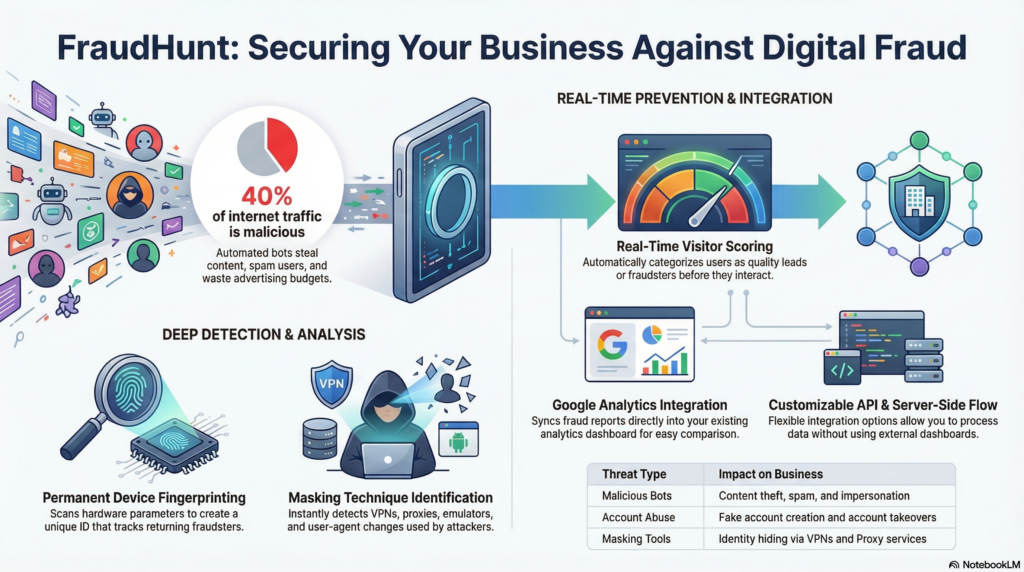
Operationally, the product appears most relevant for ecommerce, digital platforms, publishers and other online businesses that need lightweight, integration-friendly controls to separate legitimate users from bots, abusers and suspicious repeat actors. FraudHunt says it aggregates raw device and browser data points such as operating system, browser version, plug-ins, screen resolution, platform and IP address, and uses those inputs to create a permanent user ID and real-time visitor scoring. For fraud and financial-crime teams, the platform is most applicable in account creation screening, account takeover prevention, bot mitigation, device-based investigation support and broader digital abuse detection where browser fingerprinting and fast automated decisions are important.


FinCrime Intelligence –
Overall score: ★★★★☆ (4/5)
FraudHunt is a niche fraud-prevention platform focused on device fingerprinting, real-time visitor scoring, bot detection, account fraud prevention, ad-fraud mitigation, and traffic-quality analysis. Its clearest strength is that it targets a specific operational problem well: helping online businesses identify suspicious devices and user behavior before those users create fake accounts, abuse ad spend, or automate attacks. FraudHunt’s own materials emphasize real-time scoring, trigger-based detection, and active fraud prevention, and its documentation makes clear that the platform is designed for teams that want hands-on fraud controls rather than a simple plug-and-play tool.
The platform appears most useful for businesses dealing with bot traffic, fake account creation, click fraud, and suspicious user quality, especially where device-level analysis matters. Public third-party descriptions also position it as a lower-cost or more focused anti-fraud option for organizations that want traffic-quality analysis and user verification without buying a broader enterprise fraud suite.
Its main limitation is that the public review footprint is very thin. There is a product page on G2 and a company page on Trustpilot, but the visible open-web evidence is much lighter than for larger fraud vendors, so there is not a deep pool of independent user commentary to rely on. There is also a recurring signal in FraudHunt’s own documentation that the platform requires a certain degree of expertise to use effectively, which suggests it may be better suited to technically comfortable fraud or risk teams than to buyers looking for an extremely simple out-of-the-box experience.
Overall, FraudHunt appears to be a credible specialist fraud tool with clear practical value in device intelligence, bot mitigation, and account-fraud prevention, but with more limited public validation than larger, more established platforms. For the right use case, it looks useful and relevant, though the smaller review base keeps the overall rating slightly below the strongest market leaders.