
Product description
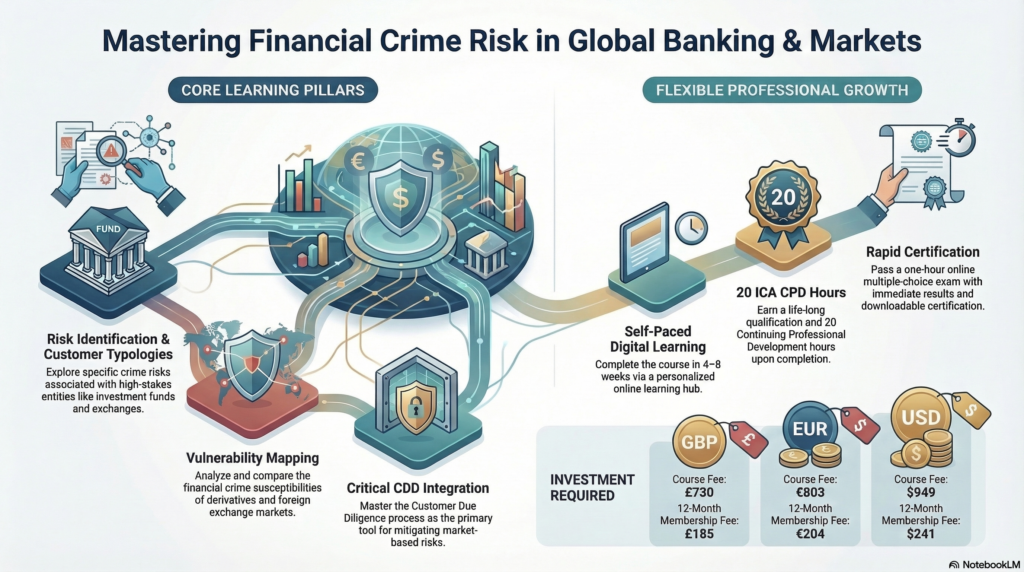
The ICA Specialist Certificate in Financial Crime Risk in Global Banking and Markets is a targeted qualification offered by the International Compliance Association (ICA), specifically designed for professionals working in the complex and fast-paced world of global banking and financial markets. This certification addresses the unique financial crime risks that arise in institutional banking, capital markets, and investment services, where the scale and speed of transactions create significant challenges for compliance.
The course provides in-depth knowledge of financial crime threats such as market abuse, insider trading, money laundering, and bribery and corruption in a global banking context. It also explores relevant regulations, governance expectations, and best practices for managing risk across products, clients, and jurisdictions. Topics include trade surveillance, cross-border compliance challenges, risk-based approaches, and the importance of culture and conduct in large financial institutions.
Watch on YouTube: Financial Crime Risk in Global Banking and Markets
Ideal for compliance officers, AML specialists, risk managers, and professionals working in investment banking, trading, or capital markets, this certification equips learners with the tools to detect and prevent financial crime while aligning with evolving global regulatory standards.




FinCrime Intelligence –
Overall score: ★★★★☆ (4/5)
The ICA Specialist Certificate in Financial Crime Risk in Global Banking and Markets is a strong niche qualification for professionals who need a more targeted understanding of financial crime risk in capital markets and investment-banking environments. Its main strength is its specialized focus on the vulnerabilities linked to financial market products, customer risk, service risk, and the ways money laundering risk can arise in global banking and markets activity.
This qualification is especially valuable for compliance professionals, financial crime analysts, surveillance teams, investigators, and risk practitioners working in capital markets, correspondent banking, investment services, or related wholesale financial environments. It is more specialized than a general AML qualification and is particularly useful for professionals who need a credential aligned to the complexities of market-facing financial crime risk rather than retail banking compliance.
A key advantage is its practical relevance to a niche area where general AML training often does not go into enough depth. It helps bridge the gap between core anti-financial-crime knowledge and the specific risk patterns seen in global banking and markets. That makes it a useful option for professionals seeking more role-specific expertise in a technically demanding part of the industry.
Public feedback on this specific course appears limited, but the available sentiment around ICA specialist certificates is generally positive, particularly on focused content and practical professional value. The overall impression is that this qualification is well suited to targeted upskilling, although it is more of a specialist development credential than a broad market-defining certification.
Its main limitation is its narrow scope. For professionals working mainly in retail AML, fraud, or general compliance, a broader qualification may offer more flexibility and wider recognition. However, for those working in global banking and markets, it is a credible and professionally relevant specialist credential.