
Product description
Emailage, now part of LexisNexis Risk Solutions, is an email intelligence and fraud risk assessment solution designed to help organizations evaluate the legitimacy of digital interactions wherever an email address is present. The product analyzes multiple attributes tied to an email address and combines them with broader network intelligence and related signals to generate a rapid, interpretable risk score that can be used across channels, transaction types and customer touchpoints. LexisNexis positions Emailage as a fast, easy-to-deploy solution for enabling risk-appropriate customer experiences while improving operational efficiency and profitability.
Watch on YouTube: Emailage
From a financial-crime perspective, Emailage is best categorized as a fraud prevention, digital identity intelligence and risk-screening tool rather than a traditional AML transaction-monitoring or sanctions-screening platform. Its utility in a fin-crime stack lies in strengthening front-end controls around onboarding, account access, payments and suspicious digital interactions by using email-based intelligence as an early warning signal. LexisNexis states that Emailage assesses risk using not only the email address itself but also network intelligence, fraud feedback, email behavior, velocity, history and related attributes such as IP and name to detect patterns and anomalies in real time. It explicitly highlights use cases including account opening fraud, account takeover, email tumbling or enumeration, bonus and promotion abuse, business email compromise, card-not-present fraud and chargebacks, peer-to-peer payments, and merchant or supplier onboarding email domain risk analysis.
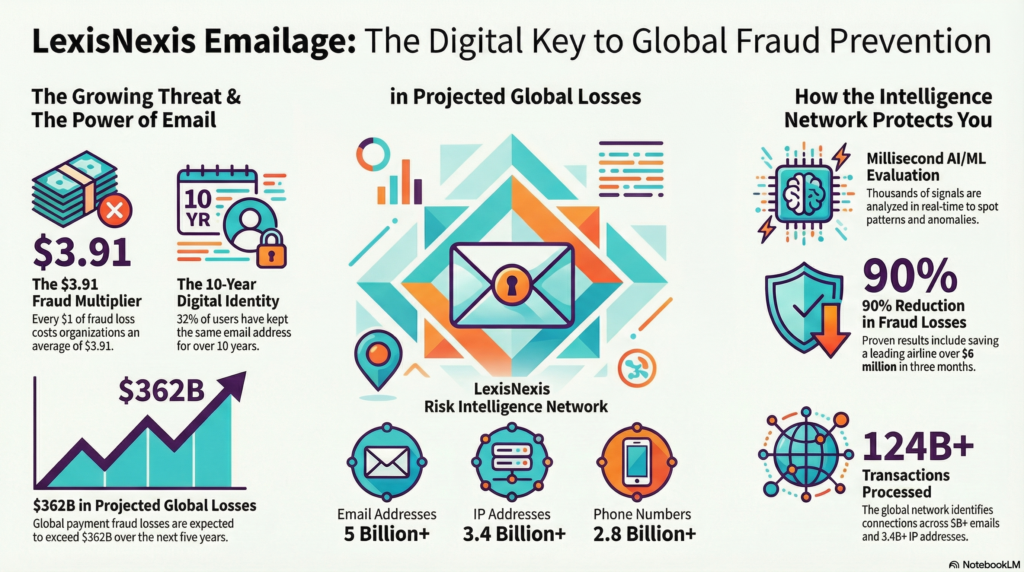
Operationally, Emailage is suited to financial institutions, payments firms, ecommerce merchants and digital platforms that need low-friction, real-time risk assessment at the point of interaction. Its value proposition centers on improving decision automation, reducing fraud losses and limiting unnecessary disruption to genuine users by turning a common digital identifier—the email address—into a scalable trust signal. LexisNexis describes Emailage as backed by a leading email intelligence network and designed to automate decision-making so businesses can admit legitimate users while blocking higher-risk ones earlier in the journey. For fraud and financial-crime teams, the solution is most applicable in onboarding risk assessment, account protection, payment fraud prevention, scam and abuse detection, and investigation support where email-centric intelligence materially improves risk triage.


FinCrime Intelligence –
Overall score: ★★★★☆ (4/5)
Emailage is a strong specialist solution for email-based fraud risk assessment and identity intelligence. Its main strength is its focused use of email-centered signals, network intelligence, and real-time risk scoring to help businesses identify suspicious activity early in the customer journey. That makes it especially relevant for onboarding, account protection, transaction screening, and other moments where an email address can provide meaningful fraud insight.
Public feedback is generally positive. Gartner’s reviews page currently shows LexisNexis Emailage at 4.0/5 based on 10 ratings, while public review commentary also highlights ease of use, helpful risk scoring, and relatively straightforward API integration. One recurring positive theme is that the product gives teams access to a network of fraud intelligence they would struggle to build internally.
A key advantage is its practical operational value. Emailage is designed to deliver interpretable, customizable risk scores in milliseconds, and it can work as a lightweight but effective identity-risk layer without requiring a full end-to-end fraud suite. That makes it appealing for organizations that want to improve fraud decisioning and reduce manual review using email intelligence as an early trust signal. LexisNexis case-study material also points to significant manual-review reduction in live use cases, which supports its positioning as an efficiency tool as well as a fraud-control tool.
Its main limitation is that it is a specialist enrichment solution rather than a full-spectrum fraud platform. For organizations that need broader workflow orchestration, chargeback management, or more extensive identity verification, Emailage may work best as one component in a larger fraud stack. The public review base is also relatively small, so the overall assessment is positive but not built on as deep an open review pool as some larger vendors.
Overall, Emailage appears to be a credible and professionally useful fraud and identity-risk solution, particularly for businesses that want fast, email-driven risk intelligence and simple integration into existing fraud workflows. It looks strongest where early digital trust assessment is important and teams want practical value without excessive operational complexity.