
Front running is a form of market abuse in which a person trades ahead of a client order or other imminent transaction using material, non-public information about that pending activity. FINRA Rule 5270 prohibits a member or associated person from trading a security or related financial instrument while in possession of material, non-public market information concerning an imminent block transaction before that information is public or stale. ESMA has also described front running as a market abuse practice in its MAR review work.
Key Takeaways
- Front Running Is a Form of Market Abuse
- Confidential Client Order Information Can Create an Unfair Trading Advantage
- Front Running Can Harm Client Execution Quality
- The Misconduct Can Affect Both the Same Instrument and Related Instruments
- FINRA Rule 5270 Is a Core U.S. Reference for Front-Running Risk
- Front Running Is Closely Linked to Insider Information Controls
- Legitimate Pre-Hedging Must Be Distinguished From Abusive Pre-Positioning
- Information Barriers Are Critical to Preventing Misuse of Pending Order Information
- Control Rooms Play an Important Role in Restricting Sensitive Information
- Personal Account Dealing Can Create Additional Front-Running Exposure
- Trade Surveillance Alone May Not Be Sufficient
- Communications Surveillance Can Help Evidence Intent and Coordination
- Order, Position and Access Data Should Be Analysed Together
- Weak Governance Can Allow Confidential Order Information to Spread Too Widely
- Front Running Can Distort Price Formation and Undermine Market Integrity
- Effective Detection Requires Reconstructing Who Knew What and When
- Front Running Is Both a Conduct Risk and a Financial Crime Risk
- Strong Surveillance and Information Governance Are Essential to Prevention
In the financial crime environment, front running is significant because it is fundamentally an abuse of informational advantage and fiduciary position. The person engaging in it is not merely making a lucky trade; they are exploiting confidential order knowledge to profit ahead of the client or market. That makes front running both a conduct failure and a market-integrity failure. It can distort prices, harm execution quality, disadvantage clients, and undermine confidence in the fairness of financial markets. ESMA’s market abuse framework is aimed at preventing abusive practices that damage market integrity, and FINRA treats front running as part of manipulative trading risk.
From a professional compliance perspective, front running usually arises where someone has advance knowledge of a pending order, block trade, or quote-related activity and uses that knowledge to trade first. The classic example is a broker or trader who knows a large client order is about to move the market and trades for a proprietary, personal, or affiliated account ahead of it. FINRA’s rule is specifically focused on imminent block transactions and extends to related financial instruments, showing that the misconduct is not limited to the exact instrument in the customer order.
Watch on YouTube: Front Running
This is why front running is closely connected to information-barrier controls, control-room functions, personal account dealing restrictions, and surveillance over trading and communications. If confidential order information can move too freely across a firm, or if staff can trade without effective restriction and review, the risk of front running rises materially. The FCA’s Market Conduct sourcebook and ESMA’s broader MAR materials both sit within a framework concerned with inside information, abusive conduct, and fair market operation.
A key practical distinction is between legitimate risk management and abusive pre-positioning. ESMA’s work on pre-hedging acknowledges that some trading ahead of a client transaction may occur for risk-management reasons in specific contexts, but it also states that where such activity lacks a genuine risk-management rationale it could amount to market abuse, including front running. That distinction matters because not all pre-trade activity is automatically improper; the issue is whether the conduct is genuinely connected to lawful execution or risk transfer, or whether it is opportunistic trading that exploits confidential information for gain.
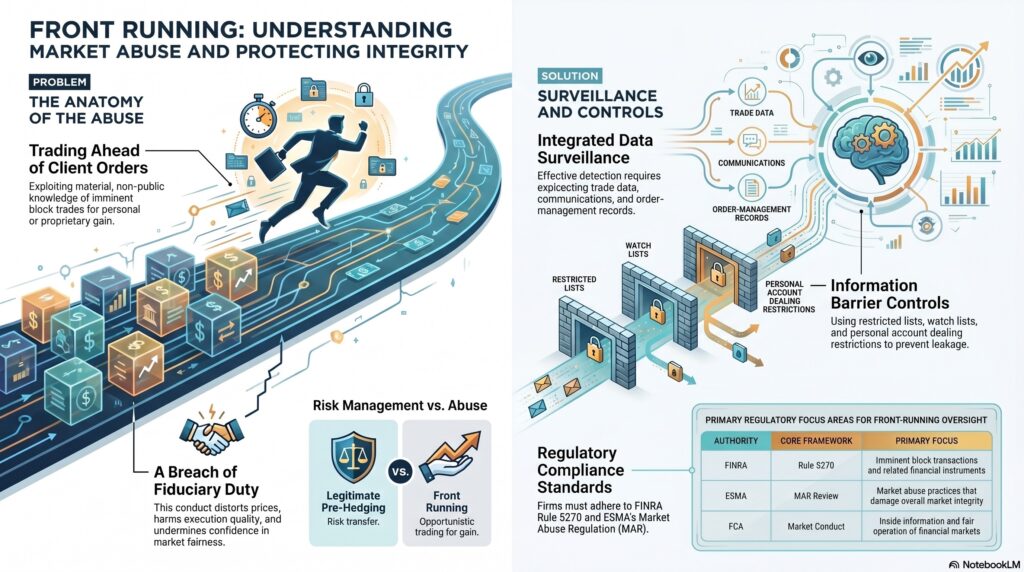
In operational terms, front running is difficult to detect unless firms can connect several data sources. Trade surveillance alone may identify unusual proprietary or employee trading before a client block order. Communications surveillance may reveal awareness of the pending order or improper coordination. Order-management and control-room records may show who had access to the information and when restrictions should have applied. This is why front-running controls usually depend on integrated surveillance across orders, executions, positions, restricted lists, and communications rather than on a single alert type. This is an inference supported by FINRA’s focus on block-transaction information and ESMA’s treatment of front running as market abuse.
For firms, the control response should include strong information barriers, restricted and watch lists, personal account dealing controls, front-office supervision, surveillance of proprietary and employee trading, and clear escalation where client-order information may have been misused. In U.S. broker-dealer environments, FINRA Rule 5270 is a core rule reference, and FINRA’s manipulative trading guidance continues to identify it as a live obligation.
What Financial Institutions Should Consider
- Maintain Strong Information Barriers
- Strengthen Control Room Governance
- Maintain Accurate Restricted and Watch Lists
- Apply Clear Wall-Crossing Procedures
- Monitor Proprietary Trading Ahead of Client Orders
- Monitor Employee and Personal Account Trading
- Correlate Employee Trades With Client Order Activity
- Integrate Trade and Communications Surveillance
- Review Access to Confidential Order Information
- Maintain Audit Trails Showing Who Accessed Sensitive Information
- Monitor Trading in Related Instruments
- Distinguish Legitimate Hedging From Opportunistic Pre-Positioning
- Strengthen Front-Office Supervision
- Escalate Suspicious Pre-Trade Activity Promptly
- Conduct Retrospective Reviews Around Large Client Orders
- Test Surveillance Scenarios for Front-Running Coverage
- Monitor Repeated Timing Patterns Around Client Transactions
- Strengthen Conflicts of Interest Controls
- Train Relevant Staff on Front-Running Restrictions
- Treat Front Running as a Core Market Integrity Risk
Ultimately, front running matters in the financial crime environment because it converts confidential market information into unfair trading advantage. It harms clients directly, distorts price formation, and weakens trust in the integrity of execution and markets. For that reason, it should be treated as a serious market abuse risk requiring strong information controls, surveillance, and governance.


