
Product description
Sift is an AI-powered digital fraud prevention and risk-based authentication platform designed to help organizations secure the full customer journey while enabling revenue growth. The platform supports risk decisioning across key stages of the digital lifecycle, including account creation, login, account activity, transactions and post-transaction events. Sift positions its offering as a fraud platform that helps enterprises stop fraud quickly, improve customer experience and scale fraud operations using a global data network, AI-driven automation and real-time decisioning.
Watch on YouTube: Sift
From a financial-crime perspective, Sift is best categorized as a digital fraud prevention, identity-risk and trust-and-safety solution rather than a traditional AML transaction-monitoring or sanctions-screening platform. Its relevance in a fin-crime and fraud stack lies in detecting and mitigating account takeover, payment fraud, chargeback fraud, first-party abuse, suspicious account creation, money movement risk and content-related scams. Sift explicitly presents use cases including Account Creation, Account Takeover, Money Movement, Chargeback Fraud, Payment Fraud and Content Scams, which makes it particularly relevant for fraud and financial-crime teams operating in ecommerce, fintech, marketplaces and other high-volume digital environments.
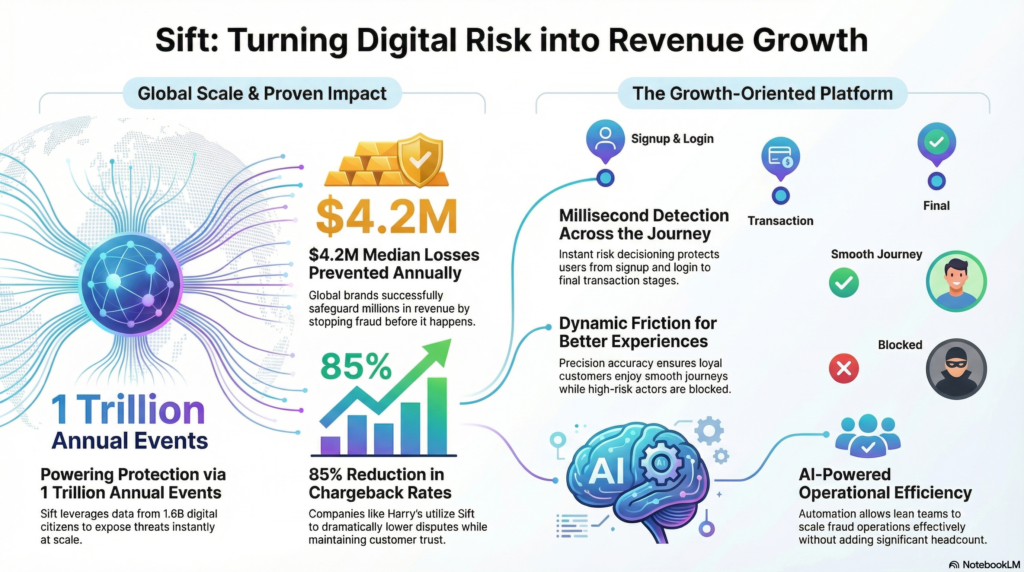
Operationally, Sift’s value proposition centers on combining network-scale intelligence with rapid decisioning to reduce fraud losses, minimize false positives and protect legitimate customer activity with dynamic friction and automation. The company states that its platform is powered by roughly 1 trillion annual events across more than 700 global brands, enabling split-second detection of threats and scalable fraud operations. For financial-crime practitioners, Sift is most applicable in front-end fraud prevention, account and transaction risk scoring, abuse prevention, authentication strategy and digital trust controls that reduce downstream losses before suspicious activity matures into confirmed fraud or financial harm.


FinCrime Intelligence –
Overall score: ★★★★☆ (4/5)
Sift is a strong specialist platform for digital fraud prevention and trust decisioning. Its main strength is its combination of real-time fraud detection, risk scoring, workflow automation, and behavioral insight, which makes it especially relevant for ecommerce, fintech, marketplaces, and other digital businesses that need to manage fraud without creating excessive friction for legitimate users. Public product listings and customer feedback consistently position it as a leading fraud-prevention platform with strong operational value.
Public feedback is broadly positive. Verified review platforms show strong ratings, including about 4.6/5 on G2 from hundreds of reviews and about 4.5/5 on Capterra based on 15 user reviews. Review summaries consistently praise Sift for accurate fraud detection, strong risk scoring, easy-to-read dashboards, and reduced manual review effort.
A key advantage is its practical operational impact. Users frequently highlight real-time monitoring, automation, clear insights into suspicious behavior, and the ability to tailor workflows to business needs. That makes it attractive for companies trying to balance fraud prevention with conversion, approval rates, and team efficiency rather than relying only on static rules or manual checks.
Its main limitation is that the experience is not uniformly flawless. Some public reviews mention false positives, occasional scoring inaccuracy, reporting friction, and slower support response in specific cases. Independent ratings are also somewhat mixed across platforms: Gartner comparison pages show Sift at 3.9/5 in the online fraud detection category based on verified reviews, which is positive but not as high as some of its stronger ratings elsewhere.
Overall, Sift appears to be a credible and well-regarded fraud prevention platform with strong practical value for organizations that need scalable, real-time fraud controls and workflow flexibility. It looks especially compelling for digital businesses with meaningful transaction volume and fraud exposure, though results likely depend on tuning, support experience, and tolerance for false positives.