
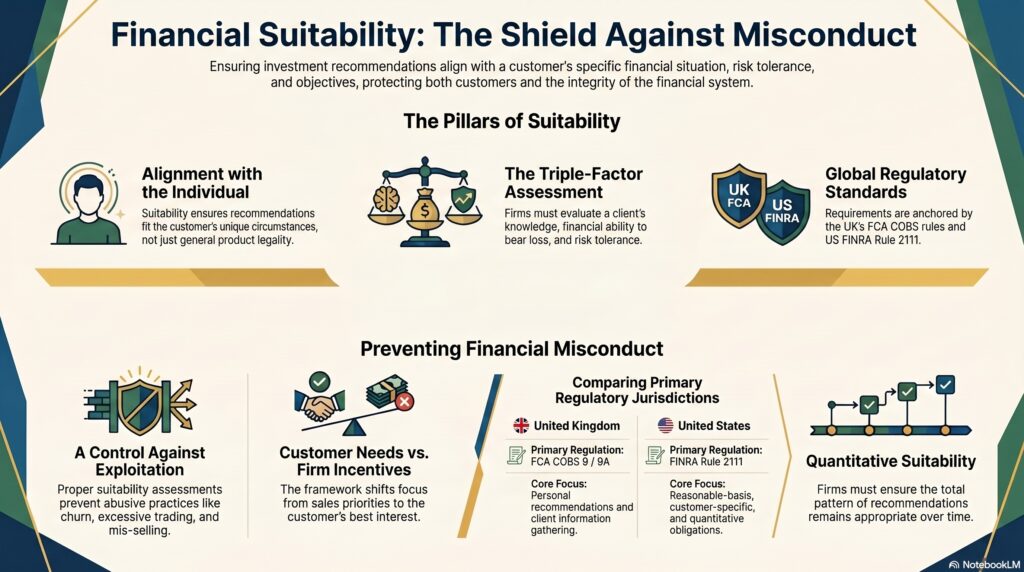
Suitability is the requirement that a recommended investment, product, strategy, or related action be appropriate for the particular customer in light of that customer’s circumstances, objectives, needs, and risk profile. In the UK, the FCA’s COBS 9 and COBS 9A rules require firms to assess suitability when making personal recommendations, and in the U.S. FINRA Rule 2111 sets out the broker suitability standard for recommendations.
In the financial crime environment, suitability matters because it is a core conduct and customer-protection control. It is not an AML rule in the narrow sense, but it has direct relevance to financial misconduct because unsuitable recommendations can expose customers to inappropriate risk, conceal conflicted selling, support abusive account switching or excessive trading, and create the conditions for fraud-like or exploitative behavior. FINRA states that suitability obligations are central to promoting ethical sales practices and high standards of commercial honor and just and equitable principles of trade.
From a professional perspective, suitability is about whether the recommendation fits the customer, not whether the product is generally lawful or commercially available. A product can be legitimate and still be unsuitable for a particular investor if it does not match their knowledge, experience, financial situation, investment horizon, objectives, or ability to bear loss. The FCA’s COBS 9A rules require firms to obtain the necessary information about the client’s knowledge and experience, financial situation including ability to bear losses, and investment objectives including risk tolerance and sustainability preferences where relevant, so the firm can recommend suitable investment services and financial instruments.
Watch on YouTube: Suitability
This is why suitability sits close to the wider financial crime environment even though it is primarily a conduct concept. Mis-selling, conflicted recommendations, churn, unsuitable switches, and excessive trading can all create customer harm and may overlap with fraud, market-conduct failures, books-and-records issues, or supervisory failures. FINRA’s suitability topic explains that Rule 2111 includes reasonable-basis, customer-specific, and quantitative suitabilityobligations, which shows that the rule is designed not just to assess one recommendation in isolation, but also the broader pattern of recommendations made to the customer.
A key professional distinction is that suitability is not the same thing as best interest, although the two are closely related in some regimes. In the U.S., Reg BI now applies to broker-dealer recommendations to retail customers, while FINRA Rule 2111 remains a core suitability rule. In the UK and EU context, the suitability rules under MiFID and related FCA provisions continue to focus on whether the firm has enough information to conclude that the recommendation is suitable. This means suitability should be understood as a specific conduct assessment with its own legal structure, not as a vague fairness concept.
In practical terms, a suitability assessment usually asks several core questions. Does the firm understand the client well enough? Is the recommendation consistent with the client’s objectives and risk tolerance? Can the client understand the nature and risks of the product or strategy? Is the client financially able to bear the loss or illiquidity that may result? Does the pattern of recommendations remain suitable when viewed together rather than one by one? The FCA’s COBS 9A obligations and FINRA’s Rule 2111 framework both support this multi-factor approach.
Suitability is also a live supervisory topic. On 25 March 2026, the FCA published CP26/10, proposing to simplify pensions and investment advice rules by consolidating suitability requirements in COBS 9 and COBS 9A and clarifying the flexibility firms have in gathering “sufficient” information for suitability assessments. That matters because it shows suitability is not a static legacy rule; it remains an actively developing part of the conduct framework.
For firms, suitability is therefore a control issue as much as an advice issue. It depends on strong fact-finding, accurate client records, conflict management, supervisory review, and documentation that shows why the recommendation was appropriate. Where suitability controls are weak, firms can drift into mis-selling, excessive trading, conflicted product pushes, or recommendations that expose vulnerable customers to harm. In that sense, suitability is an important part of the broader framework for preventing customer-facing financial misconduct. This is an inference supported by FINRA’s and the FCA’s emphasis on the rule as a conduct safeguard.
Ultimately, suitability matters in the financial crime environment because it helps ensure that recommendations are aligned to the customer rather than to the firm’s incentives or sales priorities. It supports customer protection, reduces the risk of exploitative or abusive recommendation practices, and strengthens the integrity of the investment advice and distribution process.