
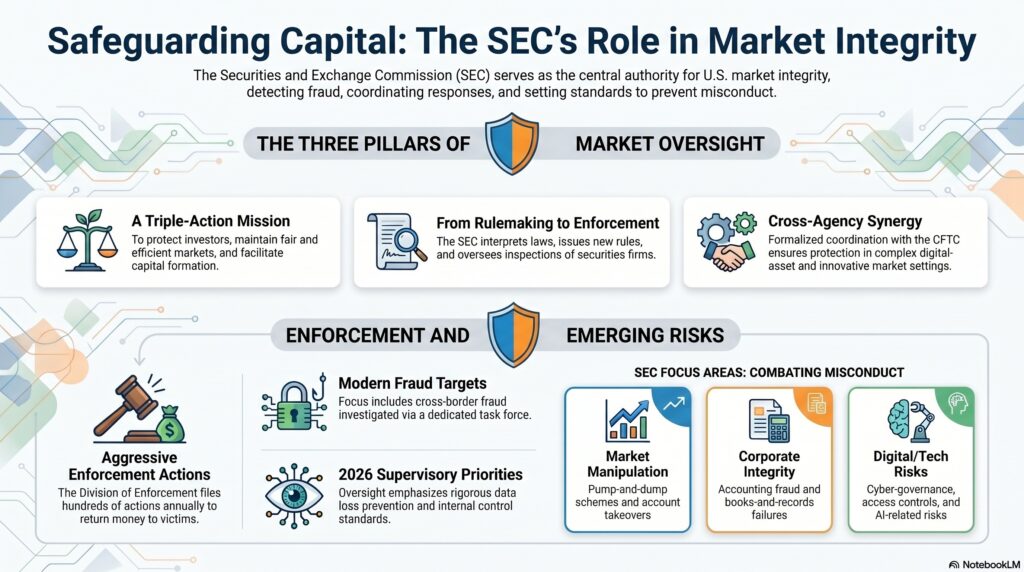
The Securities and Exchange Commission (SEC) is the U.S. federal agency responsible for overseeing securities markets and enforcing federal securities laws. The SEC states that its mission is to protect investors, maintain fair, orderly, and efficient markets, and facilitate capital formation.
In the financial crime environment, the SEC is significant because it sits at the center of the U.S. framework for market integrity, securities enforcement, disclosure oversight, and investor protection. It is not a bank-focused AML supervisor in the way FinCEN is, but it plays a major role wherever financial crime takes the form of securities fraud, market manipulation, insider dealing, disclosure misconduct, adviser or broker-dealer abuse, and failures in supervision or controls that harm investors or undermine confidence in markets. The SEC’s own “About” materials say the federal securities laws give it broad authority over all aspects of the securities industry.
From a professional perspective, the SEC is best understood as a markets, disclosure, and enforcement authority. Its relevance to the financial crime environment comes through several channels. It writes and amends securities rules, oversees registrants such as broker-dealers and investment advisers, supervises market structure and disclosure regimes, and pursues civil enforcement against misconduct. The SEC explains that it has responsibility to interpret and enforce federal securities laws, issue rules, oversee inspections of securities firms and investment advisers, and coordinate U.S. securities regulation with other authorities.
A major reason the SEC matters in the financial crime environment is enforcement. The SEC’s Division of Enforcement says it conducts investigations into possible securities law violations, files hundreds of enforcement actions each year, and returns money to harmed investors whenever possible. In practical terms, that means the SEC is a key actor where misconduct involves securities fraud, accounting fraud, offering fraud, manipulative trading, insider trading, books-and-records failures, or other violations that can overlap with broader financial crime.
Watch on YouTube: Securities and Exchange Commission
That enforcement role remains active and current. The SEC’s fiscal year 2025 enforcement results, published in April 2026, state that the Commission continued to pursue actions involving potential market manipulation, including account takeover and pump-and-dump or ramp-and-dump schemes, and had formed a Cross-Border Task Force in September 2025 to address fraudsters located abroad. This is especially relevant because it shows the SEC’s financial crime focus is not limited to traditional disclosure cases; it also extends to modern cross-border fraud and manipulation patterns.
The SEC is also important because of its examinations and supervisory priorities. The Division of Examinations announced 2026 priorities that cover a broad range of risks relevant to investor protection and market integrity, and the published priorities include oversight connected to FINRA initiatives such as Regulation Best Interest and Form CRS. The SEC’s 2026 exam materials also point to cyber-related controls, governance practices, access controls, data loss prevention, and AI-related risks. In the financial crime environment, that means the SEC’s role is not only punitive after misconduct occurs; it also influences how firms design compliance and control frameworks in advance.
Another core reason the SEC matters is market integrity. The SEC’s mission includes maintaining fair, orderly, and efficient markets, and its rulemaking and oversight authority affect market structure, disclosures, trading practices, advisers, broker-dealers, and self-regulatory organizations. In financial crime terms, this matters because manipulation, insider misuse, fraudulent disclosures, and conflicted conduct all become easier when market structure and supervisory discipline are weak. This is an inference supported by the SEC’s stated mission and oversight responsibilities.
The SEC also has strong relevance to cross-agency cooperation. In March 2026, the SEC and CFTC announced a memorandum of understanding to guide coordination and collaboration to support lawful innovation, uphold market integrity, and ensure investor and customer protection. That matters because many financial crime issues, especially in modern market and digital-asset settings, do not fit neatly into one agency’s perimeter.
A professionally mature view therefore places the SEC within the broader financial crime ecosystem as a core U.S. capital-markets authority. It does not replace AML supervisors or criminal prosecutors, but it is central wherever financial crime affects securities markets, investor protection, market transparency, disclosures, and firm supervision. Through rulemaking, examinations, enforcement, and cross-agency coordination, it helps define how misconduct is prevented, detected, investigated, and remedied in U.S. capital markets.
Ultimately, the Securities and Exchange Commission matters in the financial crime environment because it protects the integrity of U.S. securities markets and the investors who rely on them. It is one of the principal institutions shaping the legal, supervisory, and enforcement landscape for securities fraud, manipulation, disclosure failures, and wider market misconduct.