A sanctions list is an official register of persons, entities, vessels, aircraft, or other targets subject to sanctions measures such as asset freezes, blocking, or transaction restrictions. In the U.S., OFAC publishes the Specially Designated Nationals and Blocked Persons (SDN) List and also maintains a broader Sanctions List Service, including non-SDN sanctions lists. In the UK, the UK Sanctions List is now the only current source for all UK sanctions designations, replacing the old OFSI Consolidated List as of 28 January 2026.
In the financial crime environment, sanctions lists matter because they are one of the main operational tools firms use to identify whether they are dealing with a prohibited or restricted party. A payment, trade, customer relationship, or service may become unlawful if it involves a listed person or entity, or in some cases an unlisted entity that is owned or controlled by a listed person. The UK Sanctions List search tool specifically notes that prohibitions can also apply to unlisted entities owned or controlled by a designated person, which is a critical point for firms conducting due diligence and screening.
From a professional perspective, a sanctions list is not the whole sanctions regime. It is the list-based expression of a wider legal framework. Some sanctions obligations are directly tied to designated names on a list, but others arise from broader country, sectoral, or activity-based restrictions. OFAC’s sanctions pages make this clear by separating sanctions lists from sanctions programs and country information. This means firms cannot rely on list screening alone; they also need to understand the wider legal restrictions surrounding jurisdictions, sectors, ownership, and prohibited services.
Watch on YouTube: Sanctions List
A key operational issue is that different jurisdictions maintain different list structures. In the U.S., the SDN List is the best-known blocking list, but OFAC also maintains a Non-SDN Consolidated Sanctions List through its Sanctions List Service. In the EU, firms often rely on the consolidated list of persons, groups and entities subject to EU financial sanctions and the EU sanctions map for regime details. In the UK, firms should now use the UK Sanctions List rather than the withdrawn OFSI Consolidated List for current designations.
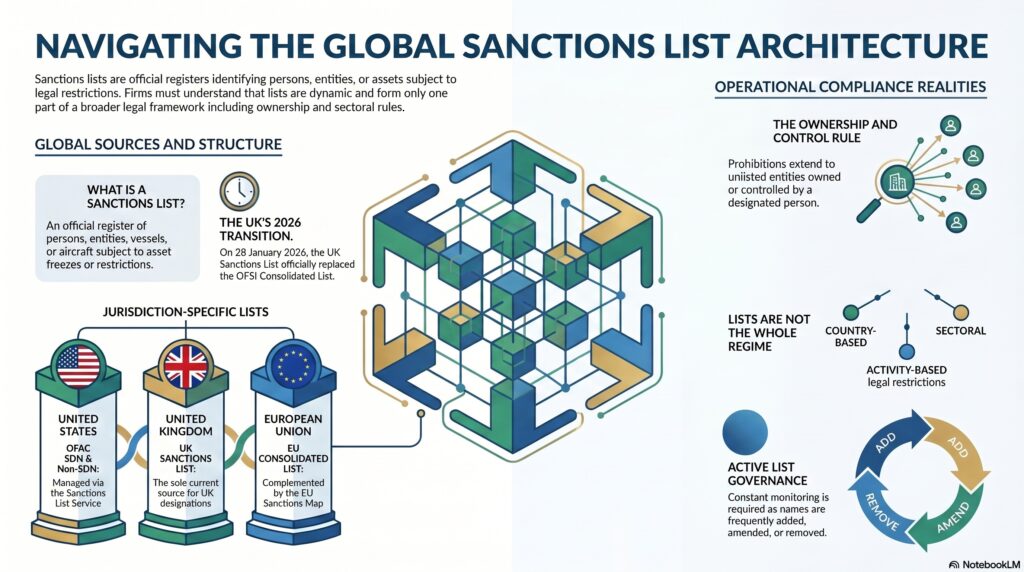
This matters because sanctions lists are dynamic. Names are added, amended, or removed, and list formats or official sources can change. The UK’s move in January 2026 from the OFSI Consolidated List to the UK Sanctions List is a good example of why firms need active list governance rather than assuming the source structure stays fixed. OFAC likewise maintains a search tool and recent-actions pages specifically to support current screening and updates.
In practical financial crime terms, a sanctions list is most useful when combined with strong screening, data quality, beneficial ownership analysis, and escalation procedures. A name match is not automatically a true hit, and the absence of a direct list hit does not eliminate sanctions risk if ownership, control, geography, or trade restrictions are relevant. So the sanctions list should be understood as a core input into sanctions compliance, not a complete compliance framework by itself. This is an inference supported by the official list structures and the UK guidance that ownership and control can extend prohibitions beyond listed names.
Ultimately, a sanctions list is a foundational control tool in the financial crime environment because it identifies who or what is subject to legal restrictions. It supports customer screening, payment screening, trade controls, and investigative review, but it only works effectively when firms use the correct official source, keep it current, and understand the wider sanctions rules that sit behind the list entries.


