
A red flag is an indicator, pattern, or circumstance that suggests a transaction, customer, account, communication, or relationship may involve financial crime risk and should receive closer review. The FFIEC describes red flags as examples of potentially suspicious activity that may indicate money laundering or terrorist financing, while FATF states that red flag indicators may help identify suspicious activity but are not, by themselves, proof of criminal conduct.
In the financial crime environment, red flags matter because firms cannot investigate everything at the same depth. They need practical indicators that help them identify where risk may be higher and where further scrutiny, escalation, or monitoring is justified. A red flag is therefore not a conclusion. It is an alerting concept. It tells the firm that something may be inconsistent with the customer profile, transaction purpose, normal behavior, or known typologies, and that the matter should be assessed more carefully. The FFIEC explicitly notes that many legitimate transactions can raise a red flag simply because they are inconsistent with normal account activity.
Watch on YouTube: Red Flag
From a professional perspective, the key point is that a red flag is an indicator of possible risk, not proof of wrongdoing. A single red flag may have a legitimate explanation. Several red flags together, especially where there is little obvious business or legal rationale, are more likely to justify escalation. FATF says a single indicator is not necessarily proof of criminal activity, but a transaction with multiple indicators and little or no logical business explanation could indicate potential criminal activity and require further examination and reporting where appropriate.
Red flags can arise across many parts of the financial crime framework. In customer due diligence, they may include unusual ownership structures, inconsistent identification information, or reluctance to provide basic details. In transaction monitoring, they may include rapid movement of funds, unusual velocity, unexplained changes in account behavior, or payment activity inconsistent with the customer profile. In trade finance, FCA materials refer to red flags such as weak escalation procedures and insufficient scrutiny of high-risk transactions. In fraud environments, red flags may include sudden changes in customer behavior, unusual urgency, or payment requests that do not fit normal patterns.
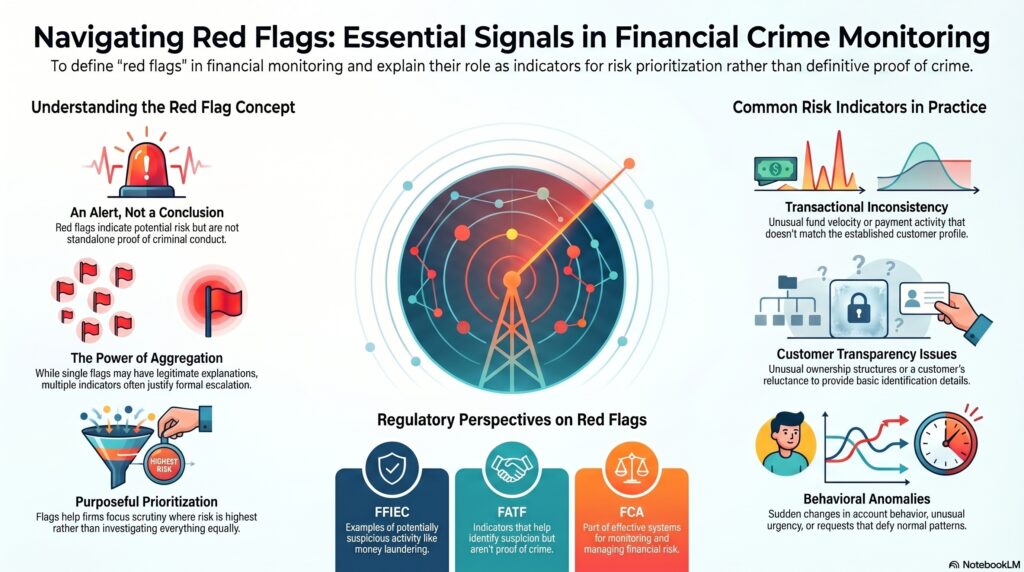
This is why red flags are best understood as part of a risk-based control framework. They help firms prioritize attention, but they only work properly when linked to investigation quality, customer understanding, and management judgment. A firm that treats every red flag as proof of crime will create unnecessary friction and poor customer outcomes. A firm that ignores or normalizes repeated red flags will weaken its AML, fraud, and sanctions controls. The FCA’s Financial Crime Guide is built around effective systems and controls for identifying, assessing, monitoring, and managing financial crime risk, which is the broader context in which red flags are used.
Ultimately, a red flag in the financial crime environment is a warning signal that something may be suspicious, unusual, or inconsistent enough to require closer scrutiny. Its value lies not in certainty, but in helping firms recognize when normal activity may in fact mask money laundering, fraud, sanctions evasion, or other misconduct.