
An Offshore Alert Center Model is an operating model in which a firm establishes a surveillance or alert-review team in another geographic location, typically to perform first-level review of compliance or financial crime alerts. NICE Actimize’s glossary defines it as an operating model used to establish a team in other geographical locations, and says these teams typically perform first-level review of electronic and audio communications alerts triggered by a lexicon-based model.
In the financial crime environment, this is best understood as a delivery model, not a regulatory category. It does not describe a specific legal obligation or a distinct financial crime typology. Instead, it describes how an institution organizes alert handling operationally, usually to gain scale, time-zone coverage, specialized staffing, or cost efficiency. The source-backed core meaning is that the offshore team performs initial surveillance review, particularly in eComms and voice-alert environments.
From a professional perspective, the significance of the offshore alert center model lies in the separation between alert generation and alert adjudication. Alerts may be created by lexicon-based communications surveillance, voice surveillance, or other monitoring systems in one jurisdiction, while the first-line review and triage are performed in another. That can be effective if the offshore center has clear procedures, strong escalation rules, appropriate language and business understanding, and good access to contextual information. But it can also create risk if the offshore team lacks market context, product knowledge, or enough authority to escalate difficult cases properly. This is an inference from the operating-model definition and the fact that the model centers on first-level review of surveillance alerts.
Watch on YouTube: Offshore Alert Center Model
This model is especially relevant in communications surveillance and conduct monitoring. Because alert volumes from lexicon-based models can be high, firms often need a scalable process for reviewing potential hits before escalating them to specialist investigators, compliance officers, or market-surveillance teams. An offshore alert center can help reduce the burden on onshore specialists by filtering out obvious false positives and identifying items that require deeper review. The operational logic here follows directly from the NICE Actimize description of offshore teams reviewing lexicon-triggered alerts.
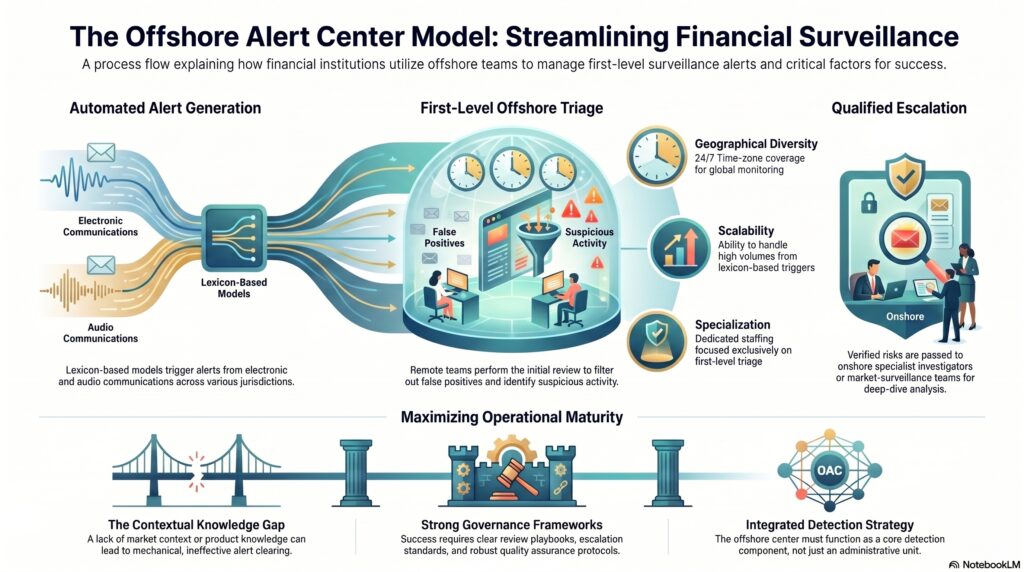
The control challenge is that first-level review quality matters enormously. If the offshore center is too mechanical, it may clear genuinely risky alerts without understanding context. If it is poorly calibrated or poorly trained, it may create excessive noise or inconsistent triage. In financial crime terms, that can weaken communications surveillance, market-abuse detection, employee-conduct monitoring, and wider detection-management capability. This is an inference based on the role of offshore teams in reviewing first-level alerts and the general dependence of surveillance quality on accurate triage.
A mature offshore alert center model therefore requires strong governance: clear review playbooks, escalation standards, quality assurance, language and product expertise, documented service levels, and close linkage to onshore compliance and investigation teams. The offshore team should be treated as part of the firm’s detection and surveillance framework, not merely as an outsourced administrative function. This conclusion is an inference from the operating-model nature of the term and the first-level surveillance role described in the source.
I should note one limitation: I found this term mainly in industry glossaries rather than in primary regulatory rulebooks. So it appears to be an industry operating-model term, not a standard regulatory definition. A second glossary source gives a different and less precise description, which makes NICE Actimize the more reliable basis for the meaning used here.