
A Money Laundering Reporting Officer (MLRO) is the senior individual within a firm responsible for overseeing its anti-money laundering framework and acting as the focal point for internal AML activity. The FCA states that the MLRO is responsible for oversight of the firm’s compliance with its AML obligations and should act as the focal point for the firm’s AML activity. It also describes heads of compliance and MLROs as important roles at financial services firms, often requiring FCA-approved senior management status.
In the financial crime environment, the MLRO is significant because the role sits at the intersection of governance, escalation, regulatory accountability, and suspicious activity handling. The MLRO is not simply a report recipient or policy owner. The role is central to whether a firm can identify money laundering risk, challenge the business effectively, receive internal disclosures, decide whether external reporting is required, and maintain a credible AML framework in practice. The FCA’s financial crime pages describe the MLRO as the focus for the firm’s AML activity, while the FCA Handbook says the job of the MLRO is to act as the focal point for all AML-related activity within the firm.
From a professional perspective, the MLRO role has both a strategic and an operational dimension. Strategically, the MLRO helps oversee the design and effectiveness of the AML control framework, including policies, monitoring, escalation standards, and management information. Operationally, the MLRO is often the person to whom internal suspicious activity disclosures are made and who then decides whether further action, including external reporting, is required. UK legislation reflects this directly: under the Money Laundering Regulations 2017, an individual in the firm must be appointed as a nominated officer, and under the Proceeds of Crime Act 2002, a nominated officer can commit an offence for failure to disclose where the statutory conditions are met.
Watch on YouTube: Money Laundering Reporting Officer (MLRO)
That legal point matters because, in many firms, the MLRO and the nominated officer are the same person, even though the functions should still be understood clearly. The Money Laundering Regulations require appointment of a nominated officer, while FCA and JMLSG materials describe the role and responsibilities of the MLRO alongside that nominated-officer framework. In practical terms, this means the MLRO often carries both the oversight function and the internal disclosure gateway role for suspicious activity.
A professionally mature MLRO is therefore more than a technical specialist. The role requires enough authority, seniority, and access to challenge the business and to support senior management focus on AML risk. JMLSG guidance states that the MLRO will need to be involved in establishing the basis on which a risk-based approach is put into practice and will support and coordinate senior management focus on money laundering and terrorist financing issues.
This is why the MLRO is so important to risk-based control design. The role should have visibility over the firm’s business-wide financial crime risk assessment, customer risk, transaction monitoring outcomes, sanctions-adjacent AML issues, training effectiveness, suspicious activity trends, and remediation priorities. If the MLRO is too junior, too operationally isolated, or lacks access to management, the firm may have an AML framework on paper without an effective point of control and escalation in reality. This is an inference supported by the FCA’s statement that the MLRO acts as the focal point for AML activity and JMLSG’s expectation that the role supports senior management focus and risk-based implementation.
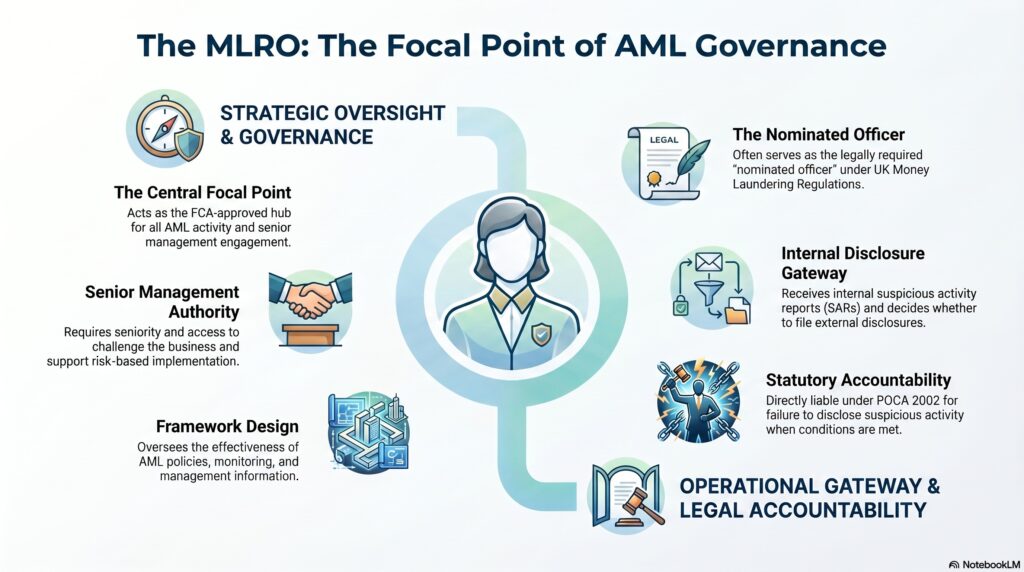
The MLRO is also central to suspicious activity reporting. Internal disclosures made by staff under POCA sections 330 and 331 are designed to flow through the nominated officer structure, and the MLRO is typically responsible for assessing those concerns, documenting the rationale, and deciding whether an external suspicious activity report should be filed. That means the quality of the MLRO’s judgment can directly affect whether suspicious activity is escalated properly or missed.
Governance is a defining feature of the role. The FCA expects firms to maintain effective systems and controls against financial crime, and the MLRO is one of the key people through whom those controls are coordinated and evidenced. JMLSG’s current guidance includes a dedicated chapter on the role and responsibilities of the nominated officer and the MLRO, which reflects how central the role is to the UK AML framework.
Ultimately, the MLRO matters in the financial crime environment because the role provides the firm with a clear focal point for AML oversight, internal escalation, suspicious activity assessment, and senior management engagement. A strong MLRO can materially improve the coherence and credibility of a firm’s AML framework. A weak or unsupported MLRO often signals deeper governance weakness in the way the firm manages money laundering risk.


