
In the financial crime environment, a lexicon is a structured library of words, phrases, patterns, symbols, and related linguistic signals used by surveillance systems to identify communications or records that may indicate misconduct, market abuse, fraud, or other compliance risk. The FCA’s 2025 off-channel communications review explicitly refers to firms updating surveillance lexicons to include terms linked to emerging communication channels, and notes that some lexicons also covered emojis, GIFs, voice notes, and video messages. FINRA materials likewise refer to email surveillance using complaint-related words in keyword lexicons to help identify unreported written customer complaints.
From a professional perspective, a lexicon is not simply a glossary or list of definitions. It is a detection tool. Its function is to help firms surface potentially risky content from large volumes of communications and other unstructured data. In practical terms, that means a lexicon may include language associated with insider dealing, market manipulation, bribery, off-channel communications, inappropriate customer treatment, complaints, harassment, concealment, or attempts to avoid supervision. The FCA’s off-channel review shows that regulators expect firms to keep these lexicons current as communication behaviors and channels evolve.
In the financial crime environment, lexicons are most closely associated with eComms surveillance and communications monitoring. Firms use them to review email, chat, messaging platforms, and other communications for indicators that staff may be discussing conduct that creates regulatory or financial crime risk. Industry surveillance materials describe lexicons as long-standing compliance tools used to scan staff communications for specific words and sequences of words that could suggest market abuse or misconduct.
Watch on YouTube: Lexicon
A key strength of a lexicon is scale. Financial institutions generate huge volumes of communications, and manual review of all content is not realistic. Lexicons allow firms to identify a subset of communications that may merit review based on language, context, or usage patterns. That makes them a core part of the first-stage filtering process in many surveillance programmes. FINRA’s use of keyword lexicons in complaint surveillance is a simple example of this principle in practice.
At the same time, lexicons have important limitations. A keyword hit does not prove misconduct, and many ordinary business communications may contain words that appear risky out of context. Industry surveillance sources note that traditional lexical approaches can generate high volumes of false positives, especially when they rely on specific words without sufficient contextual understanding. That is one reason firms increasingly combine lexicons with analytics, context-reading tools, AI, and risk-based review processes rather than relying on keyword hits alone.
This means lexicon quality matters as much as lexicon size. A poorly designed lexicon may be too narrow and miss important conduct signals, or too broad and overwhelm analysts with noise. A stronger lexicon is usually tailored to the firm’s actual risks, business lines, products, communication channels, and regulatory obligations. FCA materials imply this need for adaptation by highlighting the updating of lexicons to reflect emerging channels and “channel hopping.”
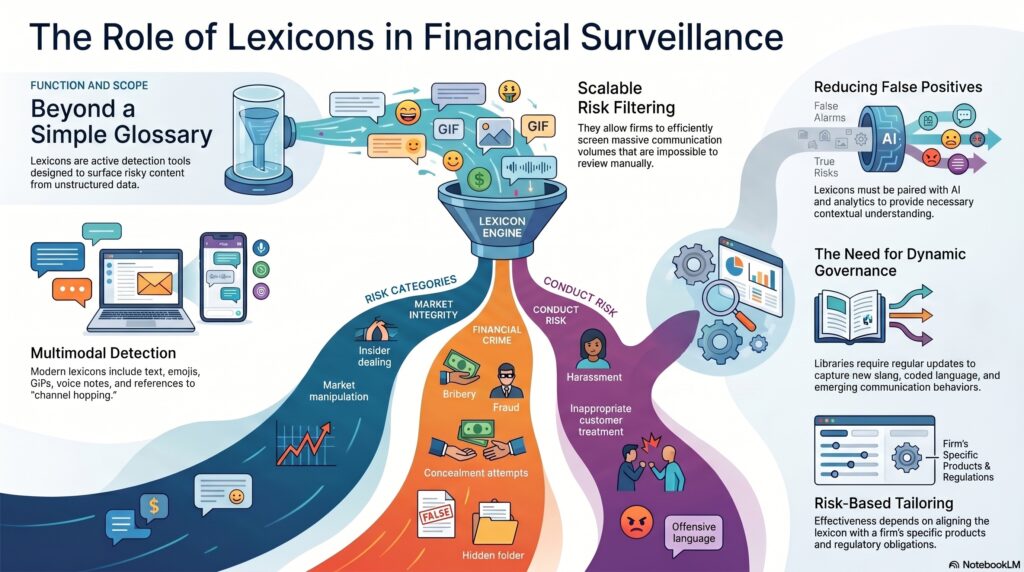
A professionally mature lexicon framework also requires governance. Firms need to know who owns the lexicon, how terms are added or retired, how new slang or coded language is identified, how multilingual content is handled, and how alert outcomes feed back into future tuning. Because communications risk evolves over time, a lexicon cannot be static. New products, platforms, abbreviations, emojis, and avoidance behaviours can all change how misconduct appears in communications. The FCA’s 2025 review is particularly relevant here because it shows regulators expect lexicons to adapt beyond traditional text-only channels.
In broader financial crime terms, lexicons are useful because misconduct often appears first in language before it appears in transactions. A suspicious payment may later be explained by a message thread. A market-abuse pattern may be foreshadowed by internal chat. An off-channel issue may be detectable from references to moving a conversation elsewhere. For that reason, lexicons should be understood as part of the wider surveillance and evidence framework, not merely as technical keyword lists. This is an inference supported by the regulatory and industry use of lexicons within communications surveillance.
Ultimately, a lexicon in the financial crime environment is a structured surveillance vocabulary used to identify communications that may indicate risk. Its value lies in helping firms review large volumes of unstructured content in a more targeted way. But its effectiveness depends on calibration, context, governance, and integration with broader surveillance and investigative processes.