The International Monetary Fund (IMF) is an international organization whose core mission is to promote macroeconomic and financial stability among its member countries. The IMF says it does this mainly through policy advice, financial assistance, and capacity development.
In the financial crime environment, the IMF is significant not because it acts as a direct financial regulator of individual firms, but because it shapes the stability, governance, and resilience of national financial systems. Weak controls against money laundering, terrorist financing, corruption, and related financial crime can undermine financial-sector soundness, reduce investor confidence, weaken governance, and threaten external stability. The IMF’s own AML/CFT materials state that these policies and measures are essential to protect the integrity and stability of financial markets and the global financial system.
From a professional perspective, the IMF is best understood as a macro-financial institution whose financial-crime relevance comes through system-wide policy, diagnostics, and technical support. It does not replace FATF as the global AML/CFT standard setter, nor does it supervise firms in the way a domestic regulator does. Instead, it helps countries build stronger legal, regulatory, and institutional frameworks, and it assesses how weaknesses in those frameworks can affect financial stability and economic resilience. The IMF states that effective AML/CFT frameworks and financial integrity more broadly are key to the soundness and stability of the financial sector and to preventing broader macroeconomic harm.
Watch on YouTube: International Monetary Fund (IMF)
A major reason the IMF matters in the financial crime environment is its role in AML/CFT policy and capacity development. The IMF states that AML/CFT work is integrated into its core functions and that it helps members strengthen legal and regulatory frameworks, supervision, and institutional capacity. Its public factsheet says the IMF expanded its AML work in 2000, extended it to CFT after September 11, 2001, and in 2004 made AML/CFT assessments and capacity development a regular part of its work.
This is important because financial crime is not only a law-enforcement issue. The IMF’s position is that money laundering, predicate crimes, terrorist financing, and proliferation financing can have macroeconomic and financial-stability consequences. Weak AML/CFT frameworks can damage confidence in the financial sector, reduce capital flows, distort markets, and undermine governance and external stability. The IMF’s AML/CFT strategy review and governance materials both make that connection explicit.
The IMF is also relevant through its country surveillance and financial-stability work. Its Global Financial Stability Report assesses the global financial system and markets and highlights systemic issues that could pose risks to financial stability. In the financial crime environment, this matters because financial crime vulnerabilities often become more dangerous when combined with weak institutions, fragile financial systems, poor governance, or external shocks. The IMF’s broader stability mandate gives it a system-level perspective that complements more focused AML/CFT or prudential authorities.
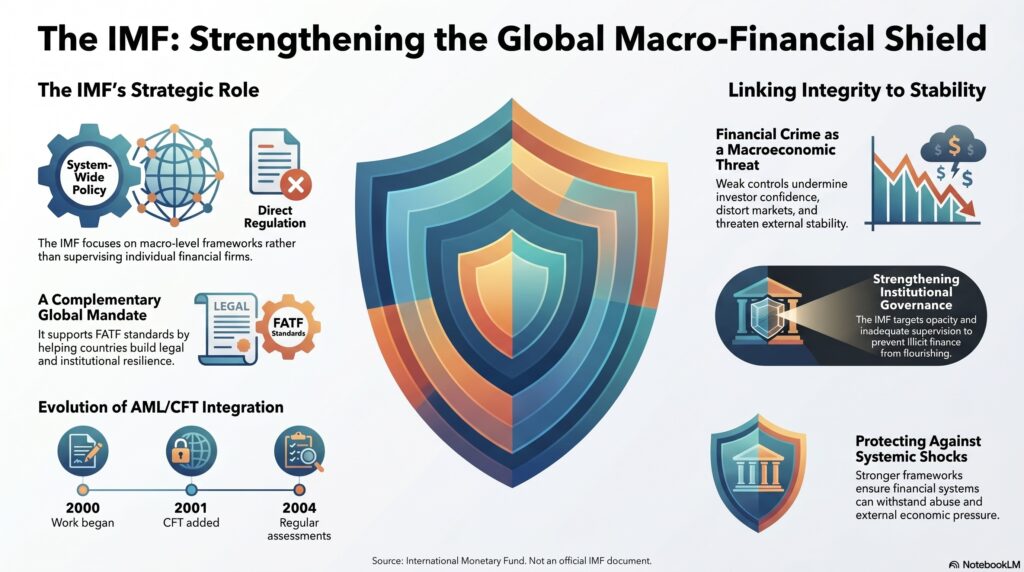
Another important dimension is governance and anti-corruption. The IMF’s public governance materials state that it contributes to international efforts on AML/CFT, assesses legal and regulatory frameworks, and provides policy-oriented research and technical assistance in this area. In practice, this means the IMF’s work often touches not only classic money laundering risk, but also the institutional conditions that allow illicit finance to flourish, including weak public governance, opacity, and inadequate supervision.
A professionally mature view therefore places the IMF within the financial crime ecosystem as a system-strengthening institution. It helps countries understand how financial crime risk affects broader economic and financial outcomes, supports legal and supervisory reform, and reinforces the link between financial integrity and macroeconomic stability. It is less about case-by-case enforcement and more about whether the overall policy and institutional environment is strong enough to withstand abuse. That role is an inference from the IMF’s own statements on financial stability, AML/CFT strategy, and governance.
Ultimately, the International Monetary Fund matters in the financial crime environment because it helps connect financial integrity to financial stability. By supporting stronger AML/CFT frameworks, governance standards, and system-wide resilience, the IMF plays an important role in reducing the economic and financial damage that can arise when illicit finance is allowed to weaken institutions and markets.