
Governance is the framework through which an organization directs, oversees, and controls its activities, including how it identifies risk, makes decisions, assigns accountability, and monitors whether its controls are working as intended. In the financial crime environment, governance is one of the most important foundations of an effective control framework because it determines how fraud, money laundering, sanctions risk, market abuse, bribery, corruption, and wider misconduct are understood, owned, challenged, and escalated across the institution.
From a professional perspective, governance is not simply about committees, reporting lines, or formal policy documents. It is about whether the organization has a clear and functioning structure for managing financial crime risk in practice. A firm may have sophisticated monitoring systems and detailed procedures, but if responsibility is unclear, management information is weak, challenge is ineffective, or remediation is poorly tracked, the control environment will still be vulnerable. In that sense, governance is the mechanism that converts policy into accountability and control into actual oversight.
In the financial crime environment, strong governance begins with clear ownership of risk. Senior management and boards need to understand the institution’s exposure to financial crime and be able to show that appropriate controls are in place for the nature, scale, and complexity of the business. That includes understanding which products, customer segments, jurisdictions, transaction types, and delivery channels create the greatest risk, and whether the control framework is proportionate to those exposures. Governance therefore depends heavily on the quality of the institution’s risk assessment. If the organization does not understand where its risk lies, its decisions about monitoring, due diligence, escalation, staffing, and investment are unlikely to be reliable.
A central feature of governance is the allocation of roles and responsibilities. In a mature financial crime framework, the first line of defense owns and manages risk in the business, the second line provides oversight, challenge, and policy direction, and the third line offers independent assurance through internal audit. Good governance does not blur these roles, but it also does not isolate them. The lines need to work together in a structured and disciplined way, with clear escalation routes, regular information flow, and no uncertainty about who is responsible for making decisions or correcting weaknesses. When these lines are unclear or poorly coordinated, financial crime issues often fall between functions rather than being properly addressed.
Watch on YouTube: Governance
Governance is also closely linked to decision-making quality. Financial crime risk rarely presents as a purely technical issue. It often involves judgment: whether to onboard a customer, whether a source-of-funds explanation is credible, whether an alert should be escalated, whether a sanctions match is real, whether a payment should be stopped, or whether a suspicious activity report should be filed. Strong governance ensures that these judgments are made within a clear framework, by appropriately skilled individuals, with adequate information, proper documentation, and the right level of senior review. Weak governance, by contrast, often leads to inconsistent decisions, poor escalation, commercial override of risk concerns, and difficulty evidencing why decisions were taken at all.
Management information is one of the clearest practical expressions of governance. Senior leaders cannot oversee financial crime risk effectively unless they receive information that is timely, accurate, relevant, and sufficiently detailed to support action. This includes data on customer risk, screening performance, transaction monitoring outcomes, fraud losses, sanctions issues, alert backlogs, suspicious activity reporting, control testing results, staff training, regulatory findings, and remediation progress. Governance fails when management receives either too little information, too much unusable information, or information that is so aggregated that material risks are obscured. Effective governance therefore depends not only on reporting frequency, but on reporting quality and usefulness.
Another essential element of governance is challenge. A credible financial crime framework requires a culture in which concerns can be raised, assumptions can be questioned, and decisions can be revisited when risk indicators change. Challenge must exist at multiple levels: within front-line business functions, from compliance and risk functions, from senior management, and through internal audit. Without challenge, weak controls may continue untested, commercially important customers may avoid appropriate scrutiny, and emerging typologies may go unaddressed. In practice, many serious financial crime failures are not caused by an absence of policy, but by a failure of challenge and escalation when warning signs were already visible.
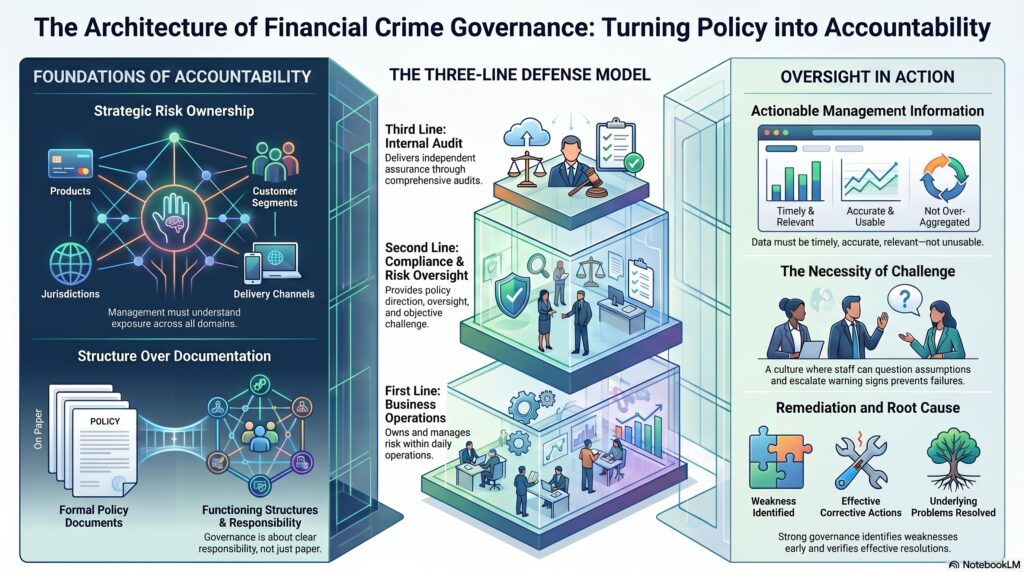
Governance also determines whether control weaknesses are treated seriously. No firm has a perfect control environment, and issues will inevitably arise. The real test of governance is how the institution responds. Strong governance identifies weaknesses early, investigates root causes properly, assigns remediation ownership, tracks delivery, and verifies that corrective action has actually improved the control environment. Weak governance allows known issues to remain open for too long, treats remediation as a reporting exercise rather than a control exercise, or closes actions without resolving the underlying problem. In the financial crime environment, this can be especially dangerous because unresolved weaknesses may continue to expose the firm to fraud losses, sanctions breaches, suspicious activity, or regulatory action.
Culture is also inseparable from governance. Financial crime governance cannot function properly if the wider organization signals that revenue, speed, or client retention matter more than control quality. Tone from the top, incentive design, accountability, and staff confidence in escalation processes all shape whether governance is real or merely formal. A well-written governance framework can be undermined quickly if employees believe that raising concerns is unwelcome, commercially inconvenient, or likely to be ignored. Conversely, a strong culture of escalation and challenge can materially improve the quality of financial crime control even in complex operating environments.
Technology and data governance are increasingly part of this picture as well. Monitoring systems, sanctions screening engines, fraud platforms, analytics tools, and case-management systems all require oversight, validation, ownership, and change control. Governance now includes not only who makes customer-risk decisions, but also who owns model calibration, who approves control changes, how false positives are managed, how system limitations are tracked, and whether data quality is good enough to support reliable outputs. In modern financial crime environments, poor governance over systems and data can be just as damaging as poor governance over people and process.
Ultimately, governance is central to the financial crime environment because it defines whether the institution can manage risk in a controlled, accountable, and defensible way. It is the structure through which boards, senior management, business functions, compliance teams, and auditors understand their roles and exercise control over how financial crime risk is identified, assessed, escalated, and mitigated. Without strong governance, even well-designed policies and advanced systems can fail. With strong governance, the institution is far more likely to detect weaknesses early, respond proportionately to risk, and maintain a financial crime framework that is credible in practice rather than only on paper.


