
The first line of defense is the part of the organization that owns and manages risk in day-to-day business activity. In the Institute of Internal Auditors’ Three Lines Model, first-line roles are part of management and are responsible for leading and directing actions, including managing risk, to achieve the organization’s objectives. In the financial crime environment, this means the first line is not merely expected to follow policies written elsewhere; it is responsible for applying controls directly where customers, payments, trades, products, and transactions actually enter the business.
From a professional financial crime perspective, the first line of defense is critical because it sits closest to the activity that creates risk. Onboarding teams decide whether customer information is credible. Relationship managers observe unusual customer behavior. Operations teams handle payments, exceptions, and account activity. Front-office staff receive instructions, interact with counterparties, and initiate or process transactions. If these teams do not identify and manage financial crime risk effectively, second-line oversight and third-line assurance will often be reacting too late. The FCA has stated that financial services firms are the first line of defence against financial crime and must use systems, processes, data, and new approaches to keep up with emerging risks.
In practical terms, the first line of defense includes business units and operational teams that perform controls as part of normal workflow. In the financial crime environment, that often means customer due diligence at onboarding, sanctions and screening checks within operational processes, fraud controls in payments handling, escalation of suspicious activity, review of alerts or exceptions in front-line operations, and immediate challenge where transactions or customer behavior do not align with expectations. The IIA’s model makes clear that first-line roles are about managing risk as part of running the business, not treating risk management as something external to it.
Watch on YouTube: First Line of Defense
A key point is that the first line of defense owns risk; it does not outsource responsibility to compliance or internal audit. Compliance and specialist risk functions may set policy, provide guidance, and challenge, but the front-line business remains accountable for how controls are applied in practice. In the financial crime environment, this matters because many failures occur when business teams assume that financial crime is “owned” by compliance alone. The result can be superficial onboarding, weak escalation, tolerance of unexplained activity, or excessive reliance on automated tools without sufficient challenge. The FCA’s financial crime materials are built around firms having systems and controls to reduce the risk that they are used to further financial crime, which necessarily includes the business areas where that risk first arises.
The first line is especially important because it usually holds the earliest warning signs. A customer explanation that does not make commercial sense, a payment instruction that feels inconsistent with normal activity, an account behaving unlike its stated purpose, or pressure to override controls for a profitable client are all examples of issues the first line may see before any monitoring system or second-line review does. In this sense, the first line functions as the organization’s first responder layer in the fight against financial crime. FCA speeches have described firms as the “first responders and front line” in fighting financial criminals, which captures the practical importance of this role.
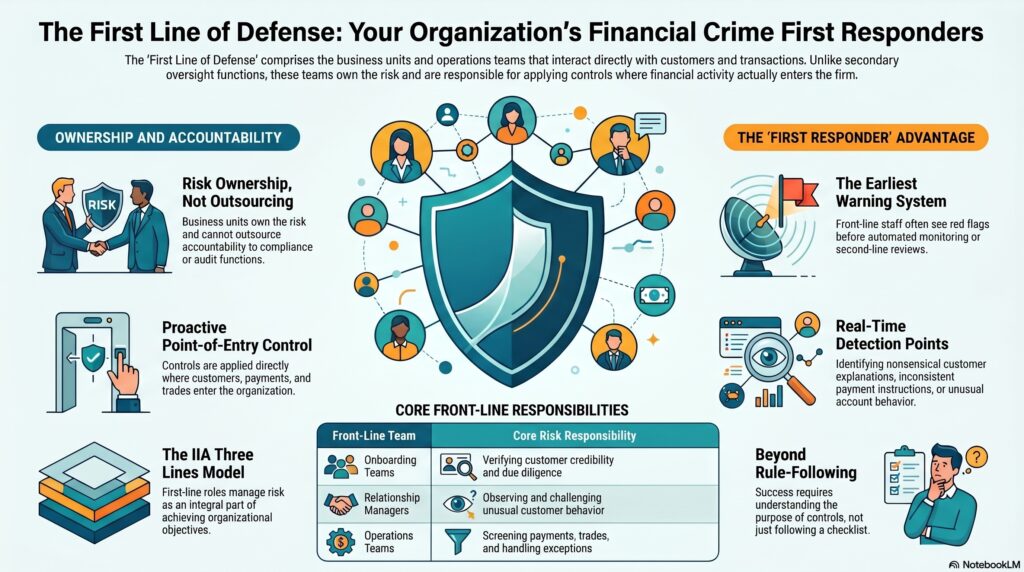
A mature financial crime framework therefore depends on a strong first line of defense. That means staff must understand not only the rules, but also the purpose of the controls they operate. They need clear procedures, adequate training, reliable escalation channels, and enough authority to challenge suspicious activity rather than prioritizing speed, convenience, or short-term commercial interests. If the first line is poorly trained, under-resourced, or incentivized in a way that discourages challenge, the wider financial crime framework weakens materially. This is an inference supported by the IIA’s description of first-line roles as part of risk management and the FCA’s expectation that firms themselves act as an effective line of defence.
The first line of defense also has a strong connection to governance. It should not operate in isolation. Its effectiveness depends on clear handoffs to the second line for policy, oversight, and challenge, and ultimately to the third line for independent assurance. The IIA’s updated Three Lines Model emphasizes coordination, communication, and alignment rather than treating the three lines as a rigid sequential structure. That matters in the financial crime environment because first-line ownership is strongest when responsibilities are clear but connected, with no gaps and no assumption that someone else will catch every issue later.
Ultimately, the first line of defense is fundamental in the financial crime environment because it is where risk is encountered and controlled in real time. It is the business-facing layer that turns policy into action and detects warning signs at the point where customers, payments, transactions, and relationships are actually handled. Without a strong first line, even well-designed compliance and audit functions will struggle to compensate for weak risk ownership where it matters most.


