
Product description
Ekata, now part of Mastercard Identity, is a digital identity verification and fraud prevention solution designed to help organizations assess the legitimacy of customers and transactions across online account opening, login, payments and other digital interactions. The platform is positioned around providing identity insights that reduce friction for legitimate users while helping businesses detect suspicious behavior earlier in the customer journey. Ekata states that its solutions are used by ecommerce and financial services organizations to safeguard against fraud, scams and abuse, onboard legitimate customers and deliver seamless transaction experiences.
Watch on YouTube: Ekata
From a financial-crime perspective, Ekata is best categorized as an identity-risk, fraud prevention and digital trust solution rather than a traditional AML transaction-monitoring or sanctions-screening platform. Its relevance in a fin-crime control environment lies in verifying customer identity attributes, strengthening onboarding controls, improving payment authentication and supporting fraud decisioning for suspicious digital interactions. Ekata’s solution set is described around identity verification, transaction fraud, payment authentication, manual fraud review and promotion abuse prevention, while Mastercard Identity positions the broader capability as helping organizations verify good customers, authorize transactions faster and reduce fraud risk with less friction.
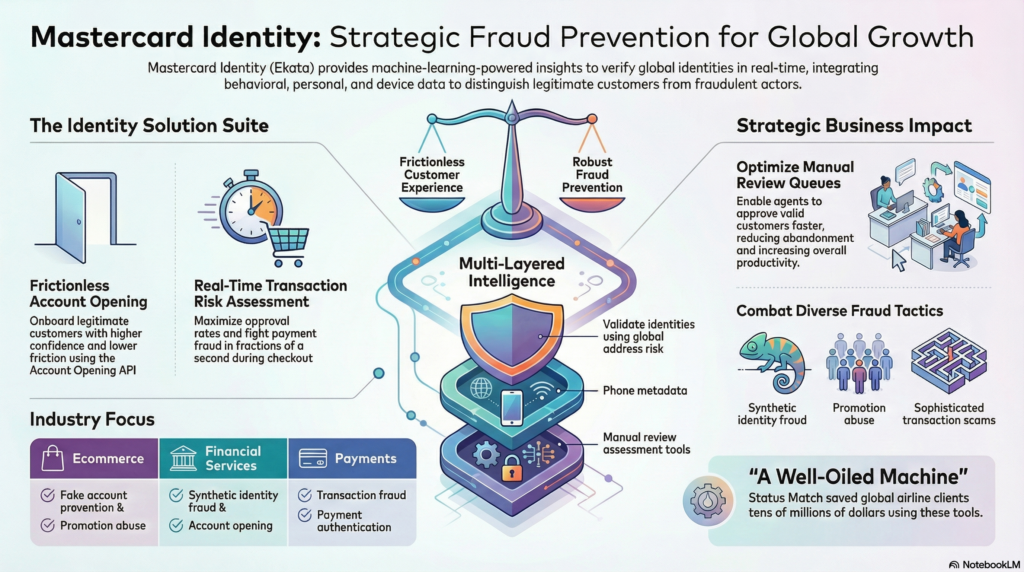
Operationally, Ekata is suited to merchants, payments companies, fintechs and financial institutions that need fast, data-driven trust decisions across digital channels. A core differentiator is its identity-network approach: Ekata says its Identity Network uses data from over 200 million monthly anonymized real-world queries to generate predictive risk signals based on how identity elements are used online. For fraud and financial-crime teams, that makes the platform particularly relevant in onboarding risk, synthetic or manipulated identity detection, account-opening fraud, transaction-risk assessment, manual review optimization and digital fraud prevention in cross-border or high-volume environments.


FinCrime Intelligence –
Overall score: ★★★★☆ (4/5)
Ekata is a strong specialist platform for identity verification, fraud prevention, and digital trust decisioning. Its main strength is its focused use of identity data, device-linked signals, and risk analytics to help businesses assess whether a customer is legitimate during onboarding, account activity, or transactions. It is especially relevant for ecommerce, fintech, payments, and financial services businesses that need to reduce fraud while keeping legitimate users moving through the journey with minimal friction.
Public feedback is broadly positive. Reviews consistently highlight real-time identity insights, a clear dashboard, strong fraud-detection support, and improved efficiency for manual-review teams. Public review summaries also point to simpler investigations and better decision-making when teams need to assess identity risk quickly.
A key advantage is its operational usefulness. Ekata appears particularly strong for organizations that need an identity intelligence layer rather than just basic document verification. Review commentary suggests it helps reduce manual effort, support approvals, and improve fraud investigations by bringing multiple identity signals into a single workflow.
Its main limitation is that the experience is not completely uniform. Some public feedback mentions dashboard speed issues under heavier use, and there are comments that international data coverage can vary depending on market and business type. The public review footprint is also more concentrated around specific products such as Identity Review 360 and Pro Insight rather than a single unified Ekata product view, which makes the market picture slightly fragmented.
Overall, Ekata appears to be a credible and professionally relevant identity-risk and fraud-prevention solution with strong practical value for businesses that need real-time identity intelligence and efficient fraud-review workflows. It looks especially compelling where fraud prevention depends on fast, data-driven trust decisions rather than manual-only review.