A typology is a recognized pattern, method, or modus operandi by which financial crime is committed, attempted, or concealed. FATF has long described its typologies work as the study of the methods and trends associated with money laundering and terrorist financing, and the FCA uses the term in current guidance to refer to the latest financial crime typologies and to typologies relevant to firms’ monitoring and risk assessment.
In the financial crime environment, typologies matter because firms are not trying to detect “crime in the abstract.” They are trying to detect how crime usually happens in practice. A typology translates broad risk categories such as fraud, money laundering, sanctions evasion, or market abuse into operational patterns that can be monitored, tested, and escalated. FATF’s methods-and-trends work exists for exactly this reason: to help authorities and firms understand how criminals adapt their techniques over time.
Watch on YouTube: Typology
From a professional perspective, a typology is not the same as a red flag, although the two are closely related. A typologyis the broader criminal method or pattern. A red flag is a specific indicator that a given customer, transaction, or behavior may fit that typology. For example, trade-based money laundering is a typology; unusual invoice values, mismatched goods, or circular shipping patterns may be red flags within that typology. FATF’s trade-based money laundering materials explicitly discuss methods, techniques, modus operandi, and related red flags.
This is why typologies are central to risk assessment, transaction monitoring, screening, surveillance, and staff training. The FCA’s recent money-laundering-through-markets review says firms use financial crime-related risks and typologies to assess products and services, map red flags, and determine relevance to their business activity. The FCA’s updated Financial Crime Guide also links monitoring rules and system design to relevant typologies.
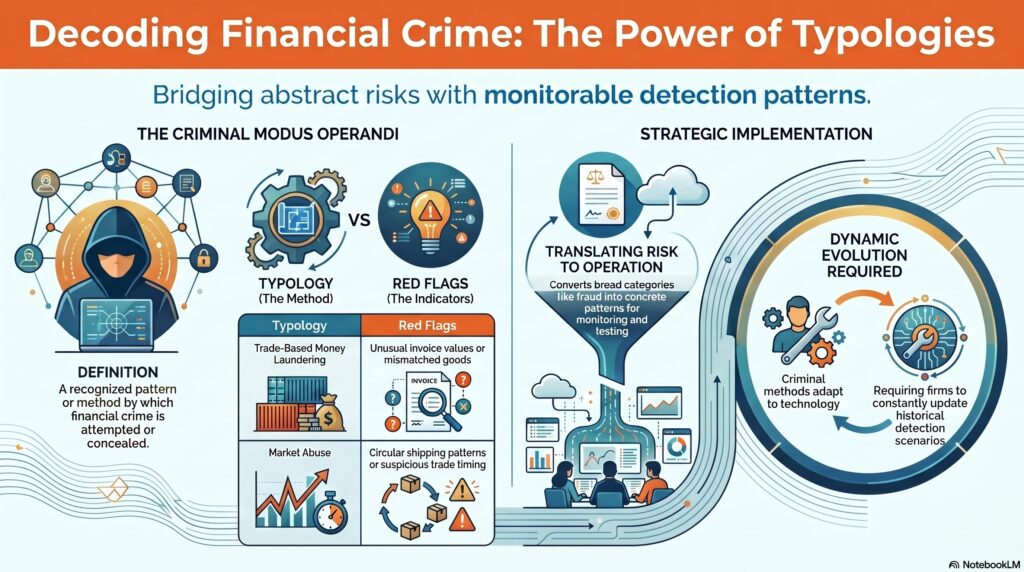
A key professional point is that typologies are dynamic. Criminal methods evolve with technology, products, customer behavior, and market structure. FATF’s current methods-and-trends work continues to publish updated material on changing risks, and the FCA has said that fraud typologies continue to evolve. That means firms cannot rely only on historic scenarios; they need to update their understanding of relevant typologies as threats change.
Ultimately, a typology in the financial crime environment is the practical pattern of offending that helps firms and authorities understand how financial crime is being carried out. It turns broad legal and regulatory risks into concrete, monitorable methods, which is why it is a foundational concept in modern financial crime control.