
Transaction Monitoring and Filtering Programs (TMPs) are the combined control frameworks firms use to monitor transactions after execution for potential BSA/AML issues and to filter transactions before execution for sanctions risks, especially under the New York Department of Financial Services (NYDFS) Part 504 regime. NYDFS says regulated institutions must maintain programs to monitor and filter transactions for potential BSA/AML violations and to prevent transactions with sanctioned entities, and must certify compliance annually. ACAMS’ glossary summarizes Part 504 in the same way.
In the financial crime environment, TMPs matter because they combine two distinct but closely related control functions. Transaction monitoring is generally detective and looks at completed or in-flight activity for patterns that may indicate money laundering or suspicious activity. Filtering is generally preventive and focuses on stopping or escalating transactions involving sanctioned parties or prohibited activity before execution. NYDFS’s original 2016 rule announcement said regulated institutions must ensure their transaction-monitoring and filtering programs are reasonably designed to comply with risk-based safeguards.
From a professional perspective, TMPs are not just software tools. They are a governed systems-and-controls framework. Under the NYDFS Part 504 approach, the issue is not merely whether a firm has a monitoring engine or sanctions filter in place, but whether the program is appropriately designed, risk-based, tested, governed, and supported by annual certification. Enforcement actions and consent orders continue to refer to deficiencies in transaction monitoring and filtering programs as material compliance failures.
Watch on YouTube: Transaction Monitoring and Filtering Programs (TMPs)
A key feature of TMPs is the split between post-transaction AML detection and pre-transaction sanctions interdiction. ACAMS notes that Part 504 requires TMPs reasonably designed to monitor transactions after execution for compliance with BSA/AML laws and regulations and prior to execution for compliance with OFAC requirements. That distinction matters operationally because the two control objectives are related but not identical: one is mainly about identifying suspicious activity for investigation and possible SAR filing, while the other is about blocking or escalating prohibited transactions before value moves.
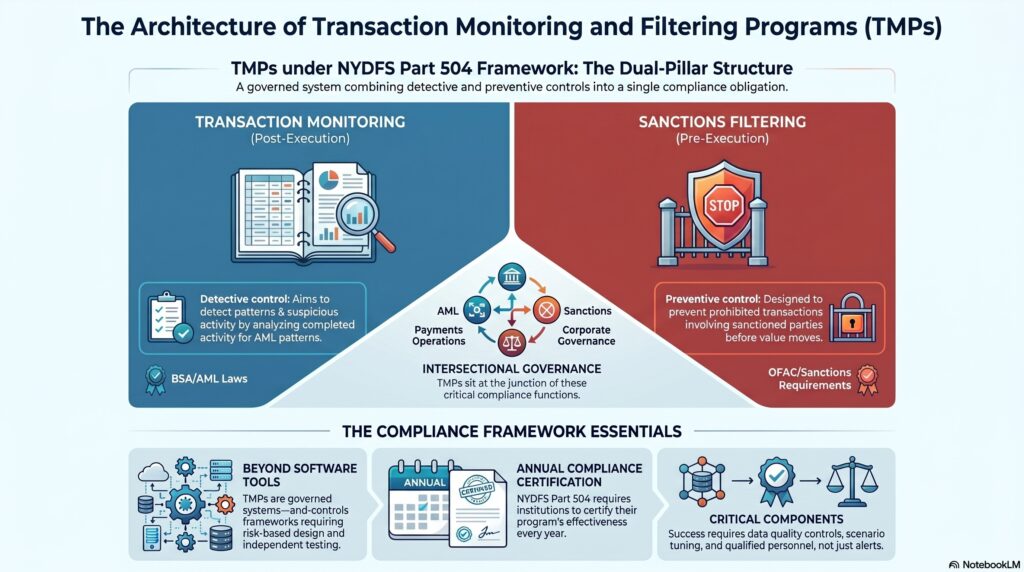
This is why TMPs sit at the intersection of AML, sanctions, payments operations, and governance. A weak monitoring component can miss suspicious patterns, structuring, mule activity, or unusual customer behavior. A weak filtering component can allow transactions involving sanctioned entities or restricted activity to proceed. NYDFS industry guidance and more recent industry letters continue to stress the importance of keeping these programs current, including for global-conflict-related sanctions changes and trade-finance exposure.
A mature TMP framework therefore requires more than alerts. It needs risk assessment, scenario and filter design, tuning, independent testing, qualified personnel, escalation procedures, data quality controls, and management oversight. Recent NYDFS consent orders continue to describe Part 504 as imposing minimum requirements over these programs and cite failures where firms did not remediate recurring weaknesses or incorrectly certified compliance.
Ultimately, TMPs are significant in the financial crime environment because they represent the practical control architecture through which firms try to detect suspicious activity and prevent prohibited transactions. In the most specific regulatory sense, the term is strongly associated with NYDFS Part 504, where transaction monitoring and sanctions filtering are treated as linked, certifiable compliance obligations rather than separate technical functions.