
A shell bank is a bank that has no physical presence in the country in which it is incorporated and licensed and is not affiliated with a regulated financial group subject to effective consolidated supervision. FATF’s glossary uses that definition and adds that “physical presence” means meaningful mind and management located within a country, not merely a local agent or low-level staff. In the U.S. BSA framework, the narrower legal term foreign shell bank is defined in 31 CFR 1010.605(g) as a foreign bank without a physical presence in any country.
Key Takeaways
- Shell Banks Are Banks With No Meaningful Physical Presence
- Shell Banks Are Generally Not Affiliated With a Regulated Financial Group
- Shell Banks Present Elevated Money Laundering and Financial Crime Risk
- Lack of Physical Presence Can Reduce Regulatory Transparency
- Weak or Unclear Supervision Can Increase Shell Bank Risk
- Shell Banks Can Be Used to Obscure the Origin and Destination of Funds
- Correspondent Banking Can Provide Shell Banks With Access to the Wider Financial System
- Nested Relationships Can Conceal Indirect Shell Bank Exposure
- Shell Banks Can Facilitate Cross-Border Movement of Criminal Proceeds
- Sanctions Evasion Can Be Supported Through Opaque Banking Structures
- Beneficial Ownership Opacity Can Increase Shell Bank Risk
- Shell Banks Can Be Used by Organised Crime and Corrupt Actors
- FATF Standards Discourage Financial Institutions From Dealing With Shell Banks
- Correspondent Institutions Should Understand Their Respondents’ Customer Base
- Institutions Should Ensure Respondent Banks Do Not Permit Shell Bank Access
- Shell Bank Risk Extends Beyond Direct Account Relationships
- Ownership, licensing and supervisory status Require Verification
- Seemingly Legitimate Intermediary Banks Can Create Indirect Exposure
- Shell Bank Controls Are a Core Component of Correspondent Banking Due Diligence
- Effective Detection Requires Transparency Across the Full Banking Relationship
In the financial crime environment, shell banks matter because they create extreme transparency and control problems. A bank with no real physical presence and weak or absent supervisory connection can be difficult to assess, difficult to oversee, and easier to misuse for money laundering, sanctions evasion, terrorist financing, or other illicit financial activity. FATF therefore prohibits financial institutions from entering into, or continuing, correspondent banking relationships with shell banks, and also requires institutions to satisfy themselves that respondent banks do not permit their accounts to be used by shell banks.
Watch on YouTube: Shell Bank
From a professional perspective, the concern is not simply that a bank operates internationally or digitally. The issue is the absence of meaningful presence and effective supervision. A legitimate international bank may operate across borders while still having real management, licensing, and consolidated oversight. A shell bank, by contrast, lacks that substance, which makes due diligence and regulatory accountability much weaker. FATF’s definition is built precisely around this distinction between genuine regulated presence and a nominal banking entity with no meaningful location or oversight.
This is why shell banks are especially relevant in correspondent banking. Correspondent relationships allow one bank to access payment and settlement services through another bank’s infrastructure. If shell banks are allowed into that chain, they can gain indirect access to the wider financial system without the level of transparency and supervision expected of regulated institutions. The FFIEC states that banks are prohibited from establishing, maintaining, administering, or managing a correspondent account in the United States for, or on behalf of, a foreign shell bank, unless the foreign shell bank is a regulated affiliate.
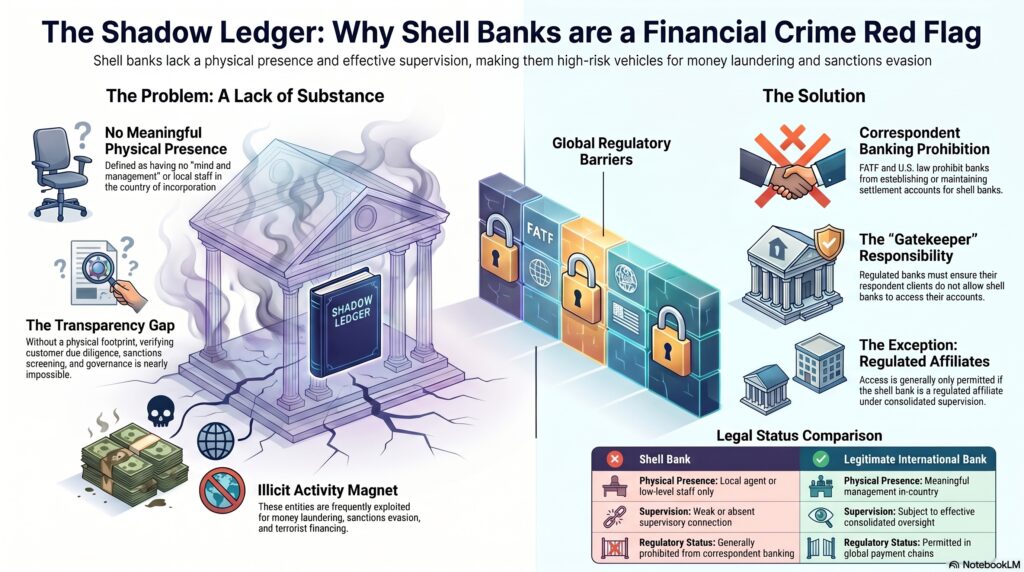
In practical financial crime terms, shell banks are a high-risk concern because they can weaken confidence in who is really behind a payment, account, or institutional relationship. If the institution itself lacks real substance, the quality of its customer due diligence, sanctions screening, transaction monitoring, and governance may also be unreliable or unverifiable. That is why prohibition, rather than mere enhanced monitoring, is the core response in major AML frameworks. This is an inference supported by FATF Recommendation 13 and the U.S. prohibition in 31 CFR 1010.630.
What Financial Institutions Should Consider
- Prohibit Direct Relationships With Shell Banks
- Verify the Physical Presence of Respondent Banks
- Confirm Regulatory Licensing and Supervision
- Assess Whether the Respondent Is Part of a Regulated Financial Group
- Identify Ultimate Beneficial Owners and Controllers
- Review the Respondent Bank’s Ownership Structure
- Understand the Respondent’s Business Model
- Assess the Respondent’s AML and Sanctions Controls
- Determine Whether Nested Relationships Are Permitted
- Identify Downstream Institutions Using Correspondent Access
- Obtain Assurances That Shell Banks Are Not Provided Indirect Access
- Review High-Risk Correspondent Banking Jurisdictions
- Monitor Payment Activity for Unexpected Banking Intermediaries
- Investigate Unexplained Changes in Payment Routing
- Apply Enhanced Due Diligence to Higher-Risk Correspondent Relationships
- Conduct Periodic and Event-Driven Reviews
- Monitor Changes in Licensing or Supervisory Status
- Escalate Unverified or Opaque Banking Relationships
- Maintain Complete Correspondent Due Diligence Records
- Treat Shell Bank Exposure as a Critical Correspondent Banking Risk
Ultimately, a shell bank is significant in the financial crime environment because it represents a banking vehicle without the physical presence and supervisory substance needed to support trust, transparency, and accountability. For that reason, shell banks are treated not as ordinary higher-risk institutions, but as entities that regulated financial institutions are generally prohibited from serving through correspondent relationships.