
Sanctions compliance is the framework through which a firm ensures it does not deal unlawfully with sanctioned persons, entities, vessels, countries, regions, sectors, or prohibited activities. In the U.S., OFAC says sanctions can be comprehensive or selective and may use asset blocking and trade restrictions, while in the UK OFSI says it helps ensure financial sanctions are properly understood, implemented, and enforced.
In the financial crime environment, sanctions compliance is significant because it is not just a screening exercise. It is a legal and operational control framework that determines whether a firm may process a payment, maintain a relationship, provide a service, release funds, or support a transaction at all. A sanctions failure can mean that the firm has made funds or economic resources available to a prohibited party or activity, which creates legal, regulatory, operational, and reputational exposure. OFAC’s guidance and OFSI’s general guidance both make clear that sanctions compliance is a live obligation supported by enforcement powers.
From a professional perspective, sanctions compliance depends on more than list screening. It requires a firm to understand who its customer is, who ultimately owns or controls them, which jurisdictions are involved, what goods or services are being provided, and whether any party or activity falls within a restriction. The FCA’s sanctions chapter says senior management should take clear responsibility for sanctions systems and controls, and that firms should have appropriate governance, screening, escalation, and staff training arrangements.
Watch on YouTube: Sanctions Compliance
A mature sanctions compliance framework is risk-based. OFAC’s Framework for OFAC Compliance Commitments identifies five essential components of a sanctions compliance program: management commitment, risk assessment, internal controls, testing and auditing, and training. That structure is useful well beyond the U.S. context because it shows that sanctions compliance is a governance discipline, not just a technical filter.
In practical terms, sanctions compliance usually includes customer and beneficial ownership screening, payment screening, trade and sector controls, escalation and investigation of potential matches, blocking or freezing where required, reporting to the relevant authority, and periodic testing of system effectiveness. The FCA’s Financial Crime Guide links sanctions directly to firms’ wider systems and controls obligations, while OFSI’s current UK guidance provides detailed operational advice on implementing UK financial sanctions.
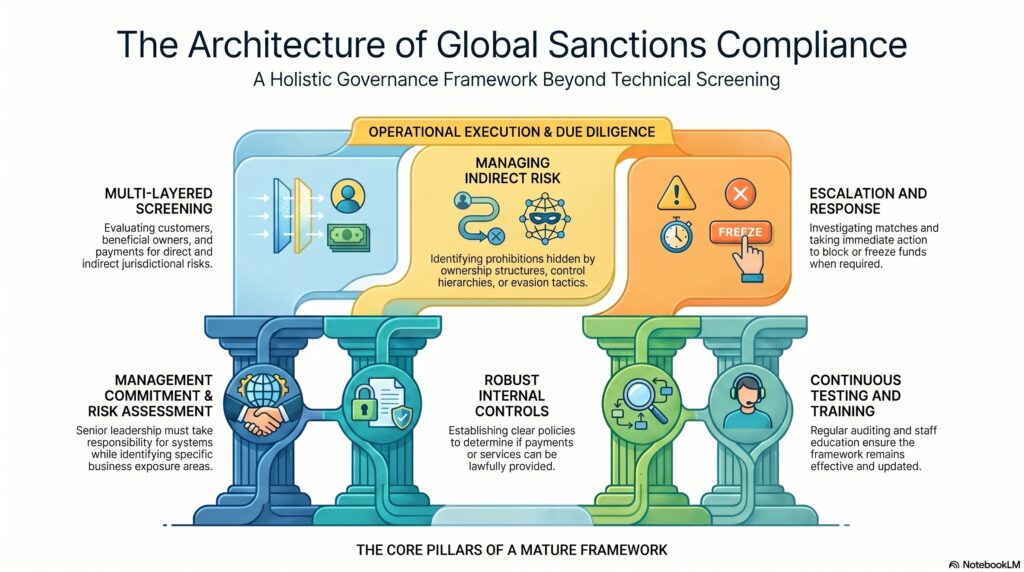
A key challenge is that sanctions risk is often indirect. A transaction may not contain a direct name match and still be prohibited because of ownership, control, geography, sector restrictions, or evasion tactics. That is why firms need strong due diligence and good-quality data, not just good software. OFAC’s framework emphasizes risk assessment and internal controls, and FCA guidance highlights the importance of firms understanding where sanctions exposure can arise in their business.
Sanctions compliance is also dynamic. Programs, lists, FAQs, guidance, and enforcement priorities change regularly. OFSI updated its general UK financial sanctions guidance on January 28, 2026, and its wider UK sanctions guidance collection was updated on March 30, 2026, which shows that firms cannot treat sanctions compliance as static.
Ultimately, sanctions compliance is a core part of the financial crime environment because it governs whether financial and commercial activity can proceed lawfully at all. It requires firms to combine legal interpretation, customer transparency, screening, governance, and operational discipline to prevent prohibited dealings and respond quickly when risk is identified.