
Reputational risk is the risk that negative perceptions about a firm damage trust in the institution and, as a result, harm its business position, resilience, or relationships with customers, counterparties, investors, or regulators. The Basel framework defines reputational risk as risk arising from negative perception on the part of customers, counterparties, shareholders, investors, debt-holders, market analysts, other relevant parties, or regulators that can adversely affect a bank’s ability to maintain existing, or establish new, business relationships and continued access to sources of funding. The OCC’s corporate governance handbook also continues to list reputation as one of its supervisory risk categories.
In the financial crime environment, reputational risk matters because financial crime events do not only create direct legal, operational, or financial loss. They also damage confidence. A sanctions failure, fraud event, weak AML control environment, market abuse case, or major enforcement action can cause customers to lose trust, counterparties to apply more caution, and markets or regulators to question the firm’s control credibility. The FCA has stated that fraud and financial crime damage the reputation of UK markets, and that effective enforcement supports the UK’s reputation as a trusted, clean, and stable place to do business.
From a professional perspective, reputational risk in financial crime is usually a consequence risk rather than a standalone root cause. The underlying problem may be weak customer due diligence, poor sanctions screening, inadequate fraud controls, governance failure, staff misconduct, or a serious operational incident. Reputational damage follows when stakeholders conclude that the firm is unsafe, poorly controlled, or untrustworthy. This is why reputational risk is so closely linked to compliance, operational, conduct, and financial crime risk rather than replacing them. The OCC notes that its supervisory risk categories are not mutually exclusive, and Basel explicitly distinguishes reputational risk from operational risk even though the two can interact.
Watch on YouTube: Reputational Risk
In the financial crime environment, reputational damage can arise in several ways. One is direct association with criminal misuse, such as being used for money laundering, fraud proceeds movement, or sanctions breaches. Another is perceived weakness in systems and controls, even if the firm was not itself the originator of the misconduct. A third is poor response: slow remediation, weak communication, or repeated failures can deepen the perception that the firm lacks control. The FCA’s financial crime guidance is built around the expectation that firms maintain effective systems and controls to reduce the risk of being used for financial crime, which reflects the link between control quality and external confidence.
This is why reputational risk is especially relevant to customer exits, de-risking, and account access decisions. The FCA’s work on payment-account access and closures notes that firms’ approaches to financial crime controls can create difficulties for customers, showing that reputational concerns and financial crime concerns can become intertwined in practice. A firm may fear the consequences of being associated with a higher-risk sector or customer type, but poor handling of that concern can itself create reputational and conduct issues.
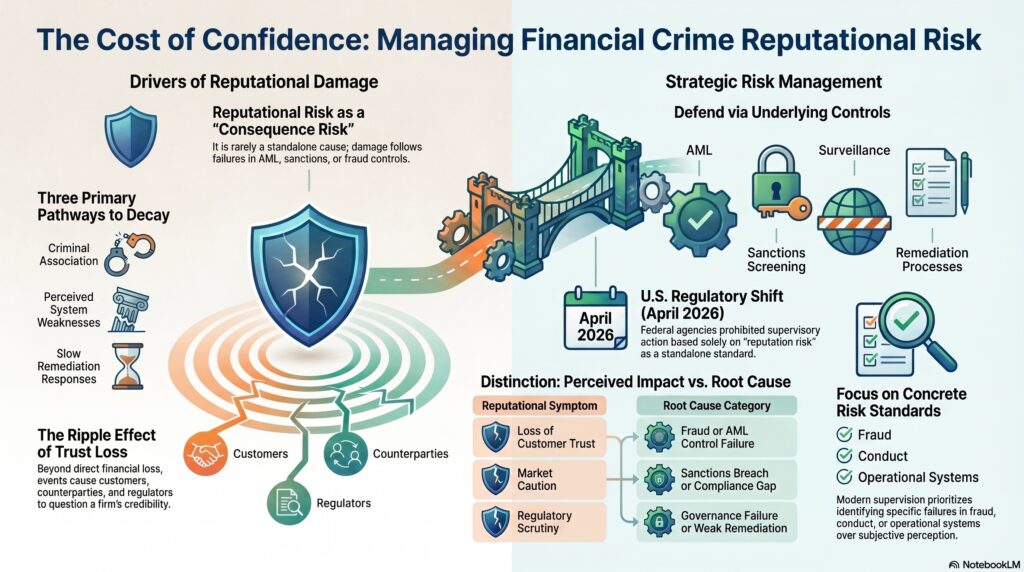
A mature professional view therefore treats reputational risk as something that should be managed mainly through the underlying control framework, not through vague or purely image-based decision-making. Strong AML, fraud, sanctions, surveillance, escalation, and remediation processes are the real protections. That point is especially relevant right now in the U.S., where federal banking agencies have moved to prohibit supervisory criticism or adverse action based solely on “reputation risk” as a basis in itself. The OCC announced this final rule on April 7, 2026, stating that the agencies have removed reputation risk from supervisory frameworks and are codifying that change.
That recent U.S. development is important because it highlights a useful distinction: reputational risk is real as a business consequence, but it can be too subjective if treated as a standalone supervisory standard. In practice, the stronger approach is to identify the concrete underlying risks — fraud, sanctions exposure, AML weakness, conduct failure, operational disruption — and manage those directly. The OCC’s recent materials reflect exactly this shift in supervisory treatment, even while older supervisory handbooks still refer to reputation as a risk category.
Ultimately, reputational risk matters in the financial crime environment because trust is one of the financial system’s core assets. When a firm is associated with financial crime, weak controls, or poor judgment, the damage can extend beyond immediate losses into customer confidence, market standing, and long-term business viability. But the most defensible way to manage reputational risk is to manage the underlying financial crime and control risks that create it.


