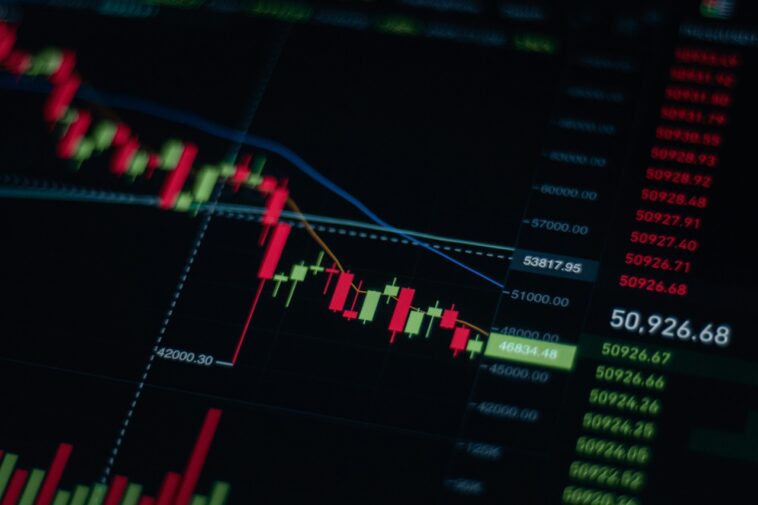
A pump and dump scheme is a form of market manipulation in which fraudsters artificially inflate the price or trading interest of a security or other investment and then sell their own holdings at the inflated level, leaving later investors with losses when the price falls. The FCA’s current investor warning explains that promoters artificially inflate an investment for personal gain and then sell quickly, causing the price to drop, while SEC investor alerts describe pump-and-dump schemes as efforts to manipulate a stock’s price or volume through false or misleading statements.
In the financial crime environment, pump and dump matters because it combines deception, market manipulation, and investor harm in a single scheme. It is not simply aggressive promotion or speculative trading. The core misconduct is that the “pump” is driven by misleading hype, false claims, rumors, or coordinated activity designed to create a buying frenzy that would not exist if the market had accurate information. Once enough demand has been created, the perpetrators “dump” their positions and profit at the expense of others. ESMA’s market-abuse materials describe pump and dump as taking a long position and then undertaking buying activity and/or disseminating misleading positive information to raise the price before selling out at the inflated price.
From a professional perspective, pump and dump is significant because it attacks market integrity directly. Investors rely on prices, volumes, and market commentary as signals of genuine value and interest. A pump-and-dump scheme corrupts those signals. It creates the false appearance of momentum, opportunity, or insider knowledge, which can induce other market participants to trade on a distorted basis. The FCA states that market abuse harms the integrity of UK markets, and its recent materials explicitly identify pump-and-dump manipulation as harmful to investors and the appeal of UK markets.
Watch on YouTube: Pump and Dump
The typology has traditionally been associated with microcap and thinly traded securities, because these are easier to move with relatively modest buying pressure and promotional activity. SEC investor alerts have long warned that pump-and-dump schemes often involve small, thinly traded companies promoted through the internet and social media. But the typology is no longer confined to classic penny-stock cold-calling. The FCA’s current warnings and policy work also refer to pump and dump in digital and online contexts, including cryptoasset markets, which shows the underlying manipulation method remains current even as the channels change.
A key professional point is that the “pump” can take many forms. It may involve false claims about a company’s prospects, fake partnerships, misleading financial narratives, staged hype on online forums, coordinated social media promotion, or fabricated urgency urging investors to buy quickly before the price rises further. SEC investor alerts on social media and rumors emphasize that false and misleading positive rumors are a common mechanism in pump-and-dump activity.
This is why pump and dump is both a communications risk and a trading-surveillance risk. The communications side involves false or misleading promotion. The trading side involves the perpetrator’s positioning, buying, and eventual selling activity. A firm or regulator looking only at market prices might see volatility and turnover but miss the coordinated promotional element. Looking only at communications might miss the fact that the promoter is positioned to profit from the induced price move. Effective control therefore requires linking communications, account positions, trading patterns, and timing. This is an inference supported by the FCA’s market-abuse framework and ESMA’s description of pump and dump as involving both position-taking and dissemination of misleading information.
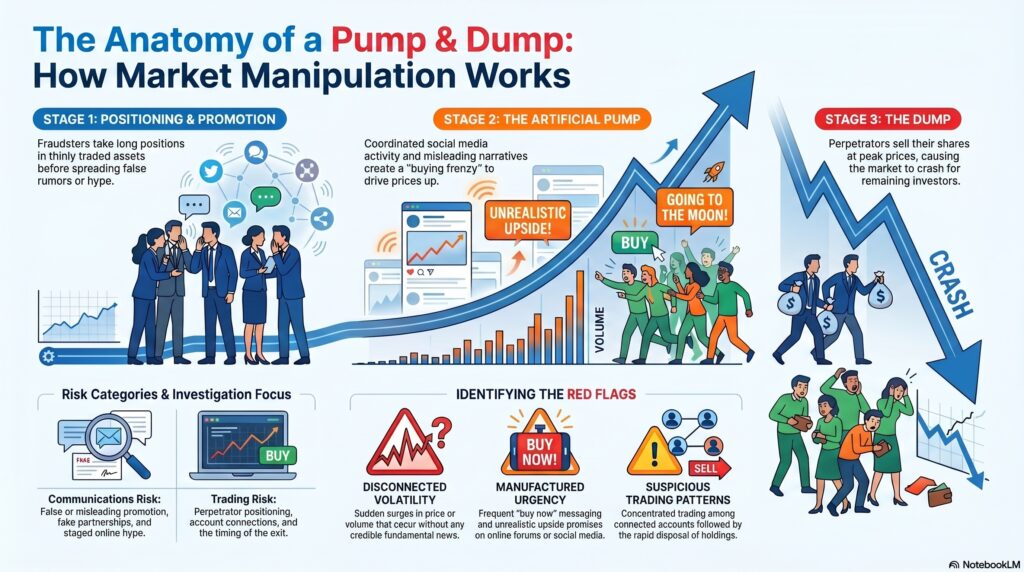
In practical terms, red flags can include sudden surges in price or volume without credible fundamental news, concentrated online hype, repeated urgent “buy now” messaging, suspicious promoter activity, trading concentrated among connected accounts, and rapid disposal of holdings once outside demand appears. FCA materials for consumers warn that pump-and-dump promoters often push urgency and unrealistic upside, while SEC alerts warn investors to be skeptical of unsolicited hype and rumor-driven opportunities.
Pump and dump is also relevant because it can overlap with gatekeeper failures and broader financial crime infrastructure. Promoters may use offshore entities, paid touting, compromised accounts, or opaque beneficial ownership structures. The SEC’s 2025 enforcement results noted continuing pursuit of pump-and-dump and ramp-and-dump schemes involving foreign-based companies and gatekeepers, which shows the typology is still active and often structured through broader enabling networks.
Ultimately, pump and dump is a serious form of market manipulation because it uses false or misleading promotion to manufacture demand, inflate price, and transfer loss from perpetrators to later investors. It undermines fair price formation, damages confidence in markets, and remains relevant across both traditional securities and newer digital-asset environments. For that reason, it should be treated as a core market-abuse risk requiring strong surveillance, communications control, and investor-protection measures.


