
Phishing scams are deceptive messages or communications designed to trick people into revealing sensitive information, clicking malicious links, opening harmful attachments, or authorizing actions that benefit criminals. CISA defines phishing as an attempt to get people to open harmful links, emails, or attachments that may request personal information or infect devices, while the FTC explains that scammers often impersonate trusted organizations such as banks or utilities to steal money or identity information.
In the financial crime environment, phishing is significant because it is often the entry point to wider fraud and illicit fund movement. A phishing email or text may look like a routine customer-service message, a payment alert, a security check, or a rewards notification, but its real purpose is to compromise credentials, harvest personal and financial data, or induce a victim to take an action that enables fraud. The FTC’s current consumer guidance says phishing messages often aim to get people to click links, open attachments, or hand over financial details, while CISA notes that they may also infect devices.
From a professional perspective, phishing is not just a cyber nuisance. It is a financial crime enabler. Stolen credentials can be used for account takeover, unauthorized payments, identity fraud, business email compromise, and wider customer impersonation. Stolen personal information can support application fraud or synthetic identity abuse. Compromised business inboxes can be used to redirect invoices or manipulate payment instructions. FATF’s 2026 paper on cyber-enabled fraud places phishing within a wider digital fraud landscape that is increasingly linked to money laundering and illicit financial flows.
Watch on YouTube: Phishing Scams
This is why phishing scams matter far beyond the initial victim interaction. In many cases, the phishing event is only the first stage. The real financial crime impact comes later, when the compromised information is used to access accounts, move funds, recruit money mules, or facilitate scams against additional victims. FATF’s recent work emphasizes that cyber-enabled fraud has strong links to wider criminal activity and that the proceeds often move quickly through the financial system once the deception succeeds.
A key operational feature of phishing is impersonation of trust. The scam works because the message appears credible enough to bypass skepticism. That may involve spoofing a bank, regulator, payment provider, employer, supplier, or loyalty program. The FCA has warned specifically about fraudsters impersonating the FCA and reported almost 5,000 fake FCA scam reports in the first half of 2025, while also reminding consumers that the FCA would never ask for PINs, passwords, or money transfers.
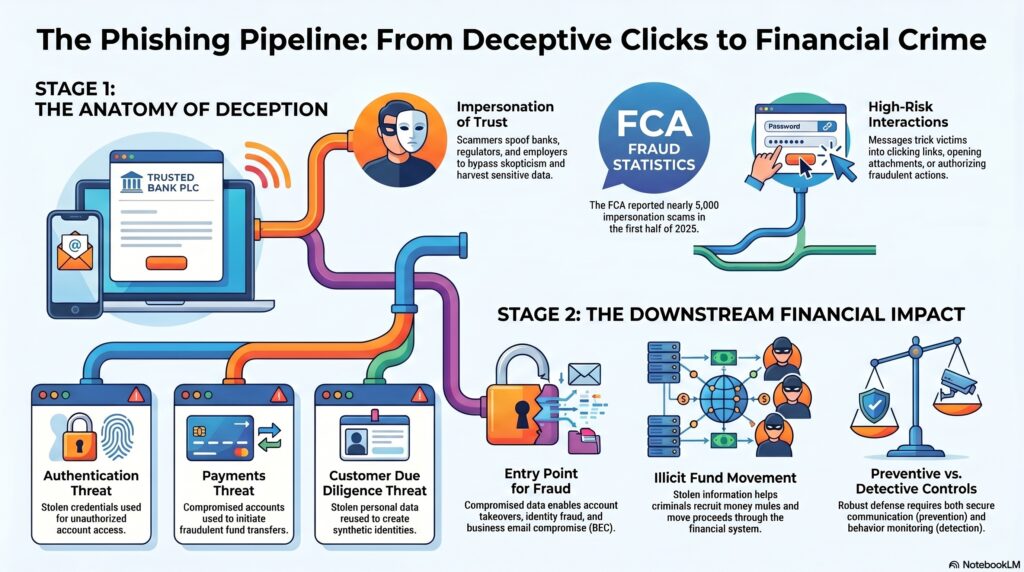
In the financial crime environment, phishing therefore creates risks across several control areas at once. It threatens authentication, because credentials may be stolen. It threatens customer due diligence, because stolen information may be reused to impersonate real people. It threatens payments controls, because compromised accounts or deceived victims may send money to criminals. It also threatens communications integrity, because business and customer interactions can be hijacked or mimicked. This is an inference supported by the FTC’s and CISA’s descriptions of how phishing seeks personal, financial, and access-related information.
A mature fraud and financial crime framework therefore treats phishing as both a preventive and a detective challenge. Prevention includes secure customer and employee communications, strong authentication, phishing-resistant access controls, staff awareness, customer warnings, and clear reporting channels. Detection includes monitoring for unusual account behavior after credential compromise, suspicious payment initiation, login anomalies, email-account compromise indicators, and receiving-account patterns consistent with fraud proceeds. CISA’s guidance focuses on recognizing and reporting phishing quickly, which reflects the importance of early intervention.
Ultimately, phishing scams are a major threat in the financial crime environment because they convert trust in digital communication into access, deception, and financial loss. They are often the first stage in broader fraud, account compromise, identity misuse, and illicit fund movement. For that reason, phishing should be understood not just as a cybersecurity issue, but as a core financial crime typology requiring coordinated controls across fraud, cyber, payments, AML, and customer-protection functions.