
A non-governmental organization (NGO) is generally understood as a non-profit, voluntary citizens’ group organized at local, national, or international level, and independent from government. The United Nations uses that formulation in its civil-society materials. In FATF terminology, the more regulatory term is often non-profit organization (NPO), reflecting entities primarily engaged in raising or disbursing funds for charitable, religious, cultural, educational, social, or similar purposes.
Key Takeaways
- NGOs Serve Legitimate and Often Essential Public-Interest Functions
- NGO Status Alone Does Not Create Elevated Financial Crime Risk
- NGO Risk Depends on Activities, Geographies, Funding and Governance
- Humanitarian Operations Can Create Distinct AML and CFT Challenges
- Cross-Border Donations Can Increase Transaction Complexity
- Conflict-Affected Operations Can Increase Exposure to Terrorist Financing Risk
- Cash-Intensive Field Activity Can Reduce Financial Transparency
- Local Implementing Partners Can Create Additional Third-Party Risk
- Complex Beneficiary Networks Can Increase Oversight Challenges
- Weak Governance Can Increase the Risk of Fund Diversion
- Fraud Can Arise Through False Beneficiaries or Misappropriated Donations
- Sanctions Risk Can Arise in Restricted or High-Risk Operating Environments
- Poor Recordkeeping Can Make Legitimate Activity Difficult to Validate
- Unusual Payment Routing Can Require Additional Investigation
- Activity Inconsistent With the NGO’s Mission Can Be a Relevant Risk Indicator
- FATF Supports Targeted and Proportionate Controls for the NPO Sector
- Blanket De-Risking Can Undermine Legitimate Access to Financial Services
- Financial Institutions Should Distinguish Vulnerability From Suspicion
- NGO Due Diligence Should Focus on Purpose, Governance and Real-World Operations
- Effective NGO Risk Management Requires a Proportionate Risk-Based Approach
In the financial crime environment, NGOs matter because they play a legitimate and often essential role in humanitarian relief, development, advocacy, education, and civil society, including in higher-risk regions and conflict-affected environments. At the same time, some NGOs or NPOs can be vulnerable to abuse for terrorist financing, diversion of funds, sanctions evasion, fraud, or other illicit purposes if governance and controls are weak. FATF’s current work on NPOs emphasizes both sides of this issue: protecting the sector from abuse while also protecting legitimate civil society from disproportionate or misapplied restrictions.
From a professional perspective, the key point is that an NGO is not inherently high risk. The risk depends on the organization’s activities, geographies, funding flows, delivery model, counterparties, governance, and transparency. FATF revised Recommendation 8 in 2023 specifically to reinforce that measures affecting NPOs should be targeted and proportionate, and not used to suppress lawful civil society activity through blanket assumptions.
Watch on YouTube: Non-Governmental Organization (NGO)
This matters because NGOs often operate in conditions that can look higher risk from a financial crime-control standpoint: cross-border donations, cash-intensive field activity, reliance on intermediaries, urgent disbursement needs, work in sanctioned or conflict-affected areas, and complex local partner networks. Those features can create operational and AML/CFT challenges even where the organization is entirely legitimate. FATF’s NPO materials focus on this practical vulnerability to abuse, especially in the terrorist-financing context.
For financial institutions, NGOs therefore require a risk-based approach rather than automatic de-risking. A mature institution will seek to understand the NGO’s mission, legal status, governance, funding sources, geographic footprint, use of partners, expected transaction patterns, and controls over beneficiaries and disbursements. The objective is to determine whether the activity is coherent and well governed, not simply to reject the relationship because the entity is an NGO. FATF’s 2023 revisions were aimed in part at preventing exactly that kind of over-application of controls.
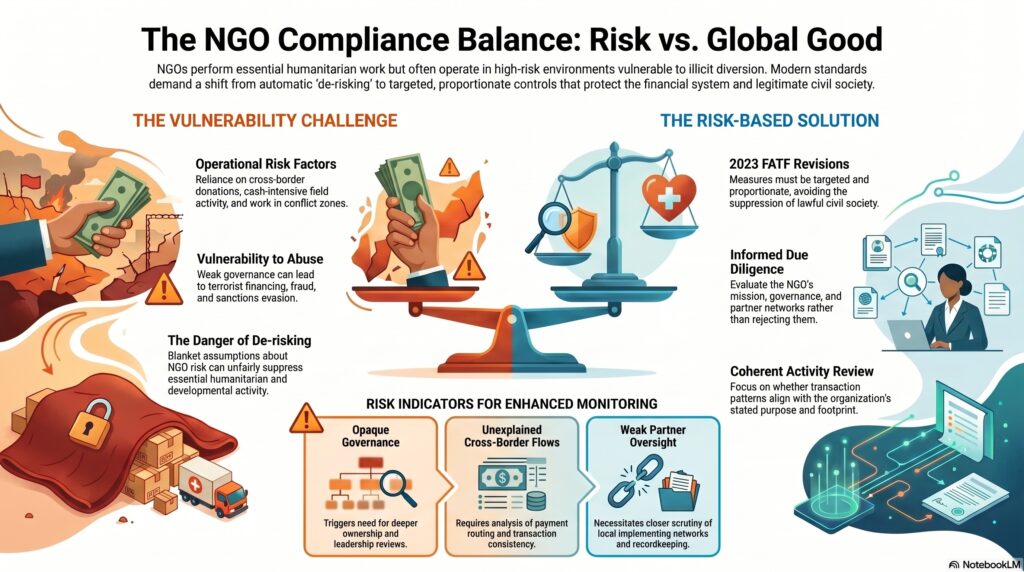
In practical financial crime terms, relevant risk indicators may include opaque ownership or governance, unexplained cross-border flows, activity inconsistent with the stated mission, weak oversight of local implementing partners, poor recordkeeping, unusually complex payment routing, or use of channels that reduce transparency. None of these factors is conclusive on its own, but together they can indicate heightened exposure that justifies enhanced due diligence or closer monitoring. This is an inference supported by FATF’s emphasis on targeted risk-based safeguards for the NPO sector.
There is also an important regulatory and policy dimension. FATF’s current NPO work makes clear that governments and firms should protect the sector from abuse without undermining legitimate access to financial services. In the financial crime environment, that means NGOs should be viewed as entities requiring informed, proportionate control rather than treated as unacceptable by default.
What Financial Institutions Should Consider
- Understand the NGO’s Mission and Core Activities
- Verify Legal and Regulatory Status
- Assess Governance and Management Arrangements
- Understand Sources of Funding
- Review Major Donors and Funding Channels
- Assess Geographic and Conflict-Zone Exposure
- Understand Expected Transaction Patterns
- Review Use of Cash and Alternative Payment Channels
- Assess Local Implementing Partners and Intermediaries
- Understand Beneficiary Selection and Verification Controls
- Review Controls Over Fund Disbursement
- Assess Sanctions Exposure in Operating Jurisdictions
- Apply Enhanced Due Diligence Where Risk Warrants
- Monitor Activity Against the NGO’s Stated Mission
- Investigate Unexplained Cross-Border Transfers
- Review Unusual or Complex Payment Routing
- Monitor Material Changes in Funding or Geographic Activity
- Maintain Proportionate Ongoing Monitoring
- Avoid Automatic De-Risking Based Solely on NGO Status
- Treat NGO Risk Through Behaviour, Governance and Financial Activity Rather Than Sector Labels
Ultimately, an NGO is significant in the financial crime environment because it combines public-interest activity with operating conditions that can create distinct AML/CFT and fraud-control challenges. The right professional response is neither suspicion by default nor naïve acceptance. It is proportionate, well-informed due diligence supported by an understanding of the organization’s purpose, governance, and real-world operating model.