
Natural Language Processing, or NLP, is the branch of artificial intelligence that enables computers to read, interpret, classify, summarize, and extract meaning from human language in text or speech. In the financial crime environment, NLP is important because large parts of financial crime risk appear in unstructured data rather than in neatly formatted transaction fields. FATF’s guidance on new technologies for AML/CFT includes a dedicated section on NLP and notes that it can support analysis where inputs are incomplete, ambiguous, or unstructured.
From a professional perspective, NLP matters because many core financial crime processes still depend on language-heavy material: customer files, onboarding narratives, sanctions and adverse-media content, suspicious transaction reports, transaction references, communications, internal case notes, complaint text, and open-source intelligence. Traditional rules and structured-data models often struggle with these sources because the risk signal is embedded in wording, context, tone, and relationships between terms. FATF’s digital transformation work notes that NLP and text-mining techniques can help operational agencies and FIUs learn from report narratives and identify patterns in suspicious activity reporting.
In practical financial crime terms, NLP is especially useful in several areas. One is communications surveillance, where firms need to identify language linked to insider dealing, market manipulation, off-channel conduct, bribery, or control evasion. Another is transaction and case triage, where payment references, investigator notes, and free-text narratives may contain signals that would otherwise be missed. A third is customer-risk assessment, where NLP can help extract and organize information from corporate records, adverse media, or due-diligence documents. The FCA has publicly said firms are applying technologies including NLP to tackle financial crime, and the FCA itself has explored NLP for triage and market-surveillance use cases.
Watch on YouTube: Natural Language Processing
NLP is also highly relevant to suspicious activity analysis. FATF’s digital-transformation work says NLP can transform free text in suspicious transaction reports into structured information that supports pattern identification and higher-quality analysis by FIUs and operational agencies. That matters because STR and SAR narratives often contain the most useful explanation of why activity is suspicious, but that value is hard to scale without language-processing tools.
A key advantage of NLP in the financial crime environment is that it can improve both speed and coverage. It can classify documents, extract entities, compare narratives, cluster similar cases, summarize large volumes of text, and highlight language that deserves human review. But its real value is not automation for its own sake. Its value is that it helps firms and authorities make use of information they already possess but cannot review efficiently at scale. FATF’s guidance and the FCA’s public statements both support this view of technology as a way to improve effectiveness and reduce noise.
At the same time, NLP has important limitations. Language is contextual, ambiguous, and sometimes deliberately coded. Slang, multilingual content, abbreviations, sarcasm, and domain-specific phrasing can all reduce accuracy. In financial crime settings, a model that misreads context may create large numbers of false positives or miss genuinely risky content. FATF’s technology guidance emphasizes that these tools should be integrated into broader monitoring systems and supported by proper validation and human oversight.
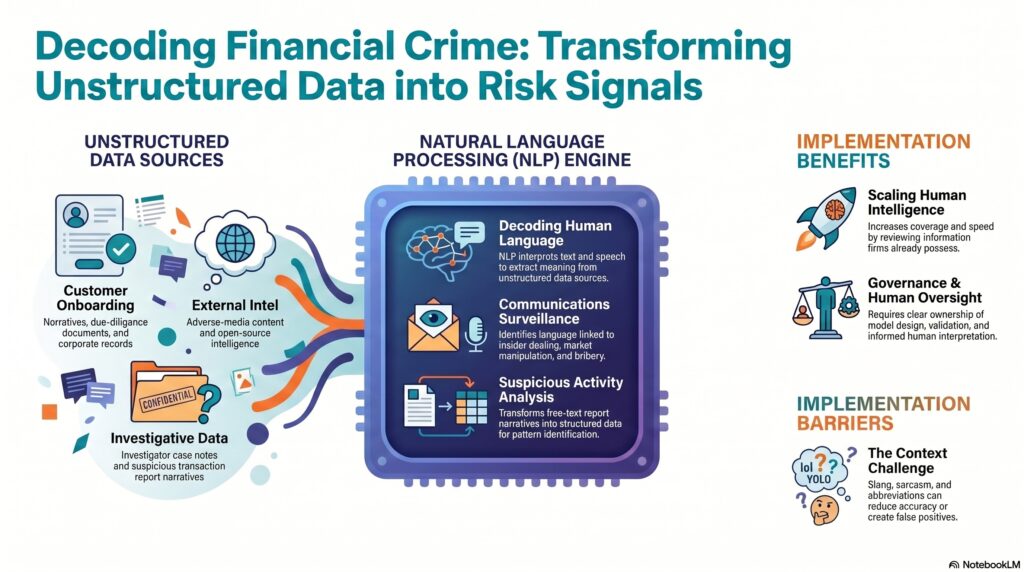
This means governance is central. Firms using NLP need clear ownership over model design, training data, tuning, review workflows, and outcome testing. They also need to understand what the NLP system is being used for: prioritization, extraction, summarization, surveillance, or decision support. The FCA’s broader AI work emphasizes safe and responsible use of AI in financial services, and its AI Lab is specifically designed to support responsible deployment.
There is also a threat-side dimension. NLP and broader AI tools are not only defensive technologies. The FCA’s January 2026 AI review notes that AI may enable more sophisticated forms of financial crime, fraud, and manipulation, and that bad actors will exploit the same advances that support innovation. That means firms need to think about NLP both as a control capability and as part of an evolving threat landscape in which criminals may automate deception, phishing, impersonation, and communications-based fraud.
Ultimately, NLP is significant in the financial crime environment because it allows firms and authorities to turn language-heavy data into usable risk signals. It strengthens communications surveillance, case triage, suspicious activity analysis, and customer-risk review by making unstructured information more searchable, comparable, and actionable. But its value depends on strong data, careful validation, clear governance, and informed human interpretation.