
Market surveillance is the set of monitoring, analytical, investigative, and escalation processes used to identify suspicious behavior, abusive trading patterns, misconduct indicators, and control failures across financial markets. In the financial crime environment, it is a core market-integrity capability because it helps firms, trading venues, self-regulatory bodies, and regulators detect insider dealing, market manipulation, abusive order behavior, misuse of confidential information, and other conduct that can undermine confidence in markets. The FCA states that behavior such as insider dealing and market manipulation can amount to market abuse and that firms must have safeguards in place, while ESMA says the market abuse framework is intended to guarantee the integrity of European financial markets and increase investor confidence.
From a professional perspective, market surveillance is not just post-trade review. It is a broader control framework that can include pre-trade monitoring, real-time alerting, post-trade analytics, communications surveillance, transaction reporting review, control-room information, and escalation into compliance or regulatory reporting. The FCA’s April 2025 speech on its market abuse agenda said its strategy is focused on being predictable, proportionate, and purposeful, and that organized criminal groups are a serious threat to markets. That framing shows market surveillance is treated as an active, risk-led response to evolving market abuse threats rather than a static back-office function.
In the financial crime environment, market surveillance matters because many forms of misconduct are pattern-based. A single order, trade, or communication may appear harmless. Suspicion emerges when events are linked together: unusual trading ahead of announcements, order layering or spoofing patterns, coordinated activity across accounts or venues, misuse of inside information, or communications that align with suspicious market behavior. This is why effective surveillance depends on connecting multiple data sources rather than reviewing isolated events in a vacuum. That is an inference supported by the FCA’s and ESMA’s emphasis on market abuse detection and integrity.
Watch on YouTube: Markets Surveillance
A mature market surveillance framework usually includes several layers. One layer is trade and order surveillance, looking for patterns that may indicate manipulation, abusive order placement, insider dealing, or misleading signals to the market. Another is communications surveillance, because intent and coordination often appear in messages before they are visible in executed trades. A third is reference-data and control information, such as restricted lists, wall-crossings, employee dealing records, and transaction reporting. Taken together, these help the firm or regulator move from anomaly detection to a defensible understanding of what likely happened and why. This is an inference supported by current supervisory approaches and enforcement priorities.
Market surveillance is also closely tied to transaction reporting and transparency infrastructure. The FCA has repeatedly linked transaction reporting to detecting and investigating market abuse and preventing financial crime, and firms with poor reporting quality can weaken the surveillance environment significantly. Recent FCA enforcement data and fines show that transaction-reporting failures remain a live issue in practice, not just a technical concern.
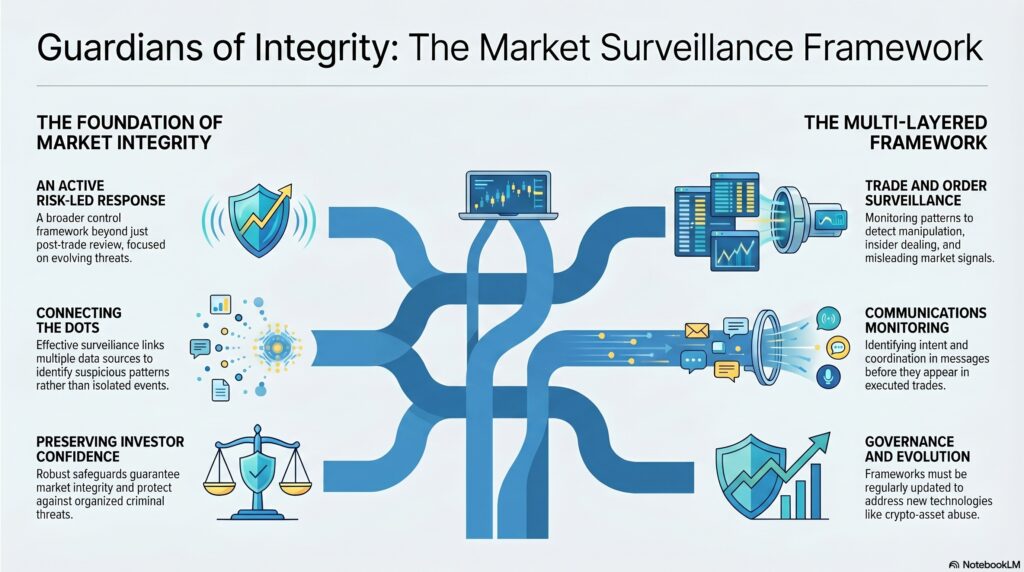
Governance is critical. Surveillance tools alone are not enough if alert ownership is unclear, escalations are weak, skilled investigators are lacking, or management does not understand where the main misconduct risks lie. ESMA’s current market-integrity work and its MiCA market-abuse supervisory guidelines both emphasize supervisory practices, monitoring, and resource adequacy. In practical terms, strong market surveillance depends on clear ownership, calibrated scenarios, good-quality data, effective case review, and a willingness to escalate where suspicion is reasonable.
There is also an important evolutionary aspect. Market surveillance cannot be static because market abuse techniques, communications habits, technology, and product types change over time. ESMA’s February 2026 consultation on simplifying market abuse guidelines and its 2025–2026 work around MiCA show that supervisory expectations continue to evolve, including for crypto-asset market abuse. That means firms need surveillance frameworks that are regularly reviewed, tested, and updated rather than treated as one-time implementations.
Ultimately, market surveillance is one of the central control capabilities in the financial crime environment because it helps protect the fairness, orderliness, and credibility of financial markets. It is the mechanism through which suspicious trading behavior is identified, investigated, and escalated before abusive conduct becomes normalized or systemic. Without effective market surveillance, firms and regulators lose visibility into the patterns that reveal insider dealing, manipulation, and wider market misconduct.