
The layering phase is the middle stage of the classic money laundering cycle, coming after placement and before integration. UNODC describes money laundering as typically following three stages and defines layering as the stage of “disguising the trail to foil pursuit.” FATF materials and national risk assessment guidance also continue to use the three-stage model when analyzing money laundering risk.
In the financial crime environment, the layering phase is significant because this is the point at which criminals try to separate illicit funds from their criminal origin by creating complexity, movement, and distance. If placement is about getting criminal proceeds into the financial system, layering is about making those proceeds harder to trace. UNODC’s educational material describes layering as the most complex stage, often involving the movement of funds internationally and the concealment of the audit trail linking the money to the original crime.
From a professional AML perspective, the main objective of layering is not yet to spend the money openly, but to break the evidential chain. Criminals may transfer funds through multiple accounts, jurisdictions, legal entities, nominees, shell companies, payment instruments, or asset classes so that investigators and firms can no longer easily connect the money to the predicate offence. FATF’s report on professional money laundering notes that, in the layering stage, launderers commonly use account settlement mechanisms and a combination of techniques to make funds more difficult to trace.
Watch on YouTube: Layering Phase (of AML)
This is why layering is so important operationally. It is often the stage at which suspicious funds begin to resemble ordinary financial activity. A single deposit linked to criminal conduct may still look unusual. After several transfers, conversions, counterparties, or jurisdictions, the same funds may appear as a series of routine account movements, settlements, business payments, or investment transactions. That transformation is exactly what layering is designed to achieve. This is an inference supported by UNODC’s and FATF’s descriptions of layering as disguising the trail and making tracing more difficult.
In practice, layering can involve domestic and cross-border transfers, movement through multiple bank accounts, use of intermediaries, trades in securities or other assets, trade-based structures, digital payment channels, and the use of professional or corporate structures that obscure beneficial ownership. FATF’s professional money laundering report emphasizes that different techniques may be combined within one laundering scheme and that the layering stage is often coordinated by individuals or networks responsible for executing financial transactions.
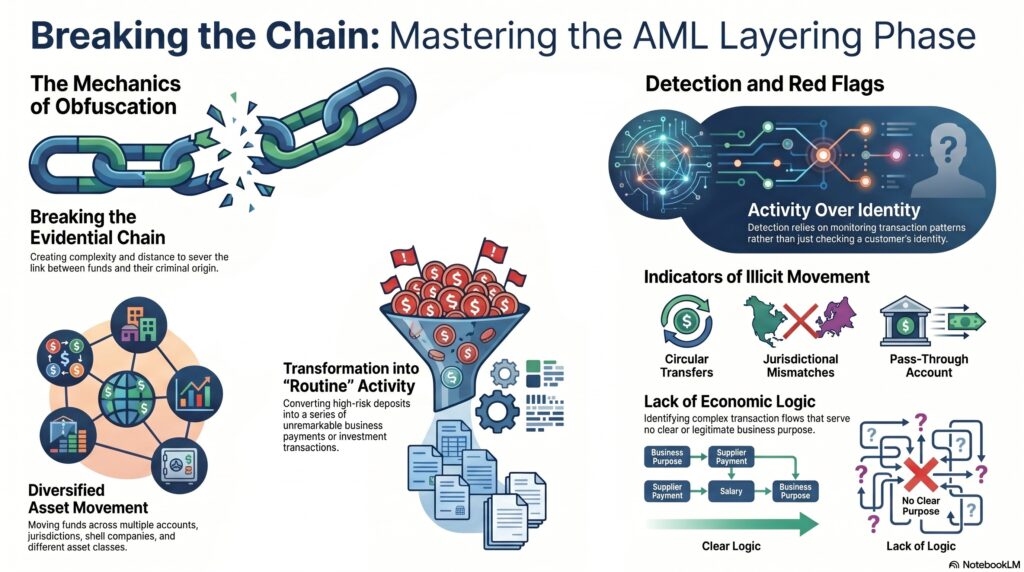
For firms, the control challenge is that layering often presents as activity rather than identity. The customer may already be onboarded, the account may appear legitimate, and the transactions may not look individually remarkable. What raises concern is the pattern: movement that lacks economic logic, rapid pass-through behaviour, unusual counterparties, unnecessary complexity, circular transfers, jurisdictional mismatch, or transaction flows that do not fit the stated purpose of the relationship. This is why effective layering detection depends heavily on transaction monitoring, customer understanding, beneficial ownership analysis, and investigative judgment rather than simple threshold checks. The FCA’s Financial Crime Guide is directed at helping firms maintain systems and controls against money laundering risk in exactly this wider sense.
A professionally mature view also recognizes that the classic three stages are not always cleanly separated in real life. UNODC notes that money laundering typically follows these stages, but in practice they may overlap or occur in blended ways. FATF and UNODC materials both support treating placement, layering, and integration as analytical models rather than rigid chronological rules. That matters because firms should not assume that once funds are moving in complex ways they are no longer connected to placement, or that integration has not already begun in part.
Ultimately, the layering phase matters in the financial crime environment because it is the stage at which criminals try to turn traceable illicit proceeds into hard-to-follow financial movement. It is where audit trails are obscured, ownership becomes less visible, and criminal funds begin to lose their obvious connection to the underlying offence. For AML controls, that makes layering one of the most important points of intervention: if firms can identify unjustified complexity and suspicious movement early enough, they have a better chance of disrupting the laundering process before the funds are fully integrated into the legitimate economy.