
Fraud detection is the set of controls, analytical methods, operational processes, and governance arrangements used to identify behavior that may indicate fraud before losses escalate or criminal proceeds move beyond reach. In the financial crime environment, it goes well beyond spotting obviously unauthorized transactions. It includes the detection of scams, account takeover, application fraud, payment abuse, identity misuse, mule activity, chargeback abuse, and insider-enabled fraud. The FCA states that firms are a vital line of defence against fraud, while the FFIEC treats suspicious-activity monitoring and reporting as critical internal controls.
From a professional perspective, fraud detection is best understood as a capability rather than a single system. A firm may have alert rules, screening tools, transaction monitoring scenarios, behavioural analytics, and case-management platforms, but its true detection capability depends on how well those elements work together. Effective fraud detection means generating meaningful signals, prioritizing them intelligently, investigating them promptly, escalating them consistently, and learning from outcomes over time. The FCA’s Financial Crime Guide frames fraud control in terms of management oversight, risk assessment, and fraud data.
Modern fraud detection is difficult because fraud is often contextual rather than obvious. A transaction may look ordinary in value, yet become suspicious when viewed alongside a password reset, a new-device login, a payee change, or unusual velocity of fund movement. A payment may be customer-authorised and still be fraudulent if the customer was deceived. An application may pass basic identity checks and still be fraudulent in substance. FATF’s work on cyber-enabled fraud highlights how digitalisation is changing fraud typologies and increasing the overlap between fraud prevention and wider AML/CFT controls.
Watch on YouTube: Fraud Detection
That overlap is increasingly important. Many frauds do not end when the victim loses money; they continue through the movement, concealment, and redistribution of proceeds. Mule accounts, rapid onward transfers, and pass-through activity mean fraud detection now sits very close to AML monitoring. FATF explicitly links cyber-enabled fraud to money laundering risk and notes that AML/CFT tools can help prevent fraud proceeds from reaching criminals and support recovery efforts.
In practical terms, strong fraud detection usually combines several layers. One is preventive intelligence, such as onboarding checks, authentication controls, anti-phishing measures, and account-security controls. Another is behavioural and transactional monitoring, which looks for activity inconsistent with customer profile, account purpose, or established patterns. A third is investigative response, where alerts are reviewed in context to determine whether they indicate genuine fraud, customer error, mule activity, or a wider financial crime issue. FFIEC guidance on authentication and access stresses layered security and monitoring rather than reliance on a single factor.
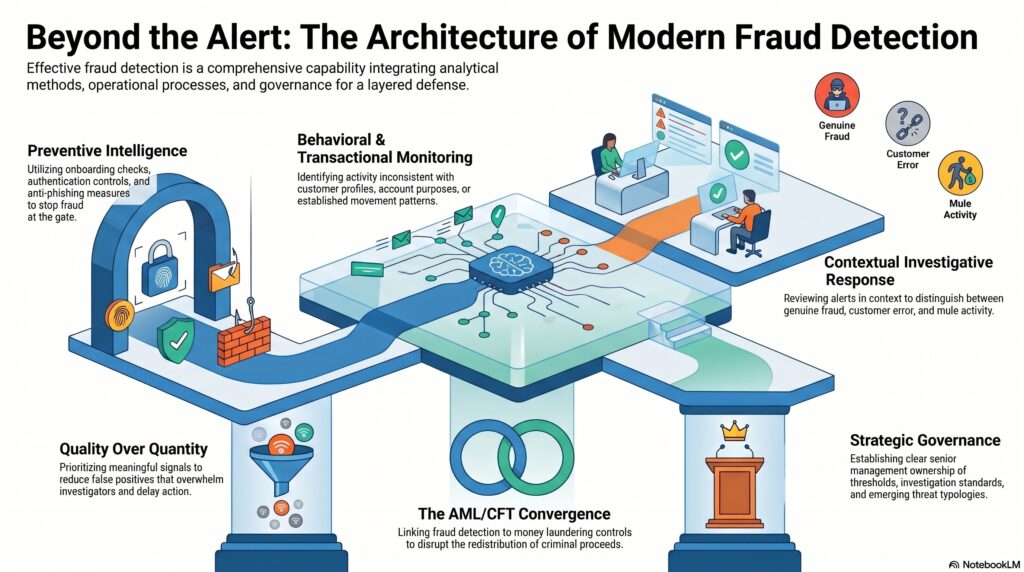
A major issue in fraud detection is alert quality. More alerts do not necessarily mean better protection. Excessive false positives can overwhelm investigators, delay action, and make it harder to identify the cases that matter most. FATF’s technology guidance notes that new technologies can improve efficiency and reduce unnecessary alert noise, while the FCA’s updated financial crime materials focus on implementation quality and control effectiveness rather than raw sensitivity alone.
Governance is therefore central. A mature fraud detection framework needs clear ownership of scenarios, thresholds, alert triage, investigation standards, escalation routes, and remediation. Senior management should understand not just how many alerts are produced, but whether the system is identifying the right risks, whether response times are adequate, and whether emerging fraud typologies are being captured. The FCA’s work on APP fraud controls and complaint handling shows that regulators look closely at how firms design and operate anti-fraud controls in practice.
Ultimately, fraud detection is a core capability in the financial crime environment because it determines whether a firm can identify deceptive behaviour early enough to prevent loss, protect customers, disrupt criminal activity, and escalate suspicious conduct appropriately. It is not simply a matter of software or alerts. It is the practical discipline of turning fragmented signals into timely, defensible decisions in a fast-moving and increasingly adaptive threat environment.


