
The Financial Action Task Force (FATF) is the global standard-setting body for anti-money laundering, counter-terrorist financing, and counter-proliferation financing. FATF states that its mandate is to set standards and promote the effective implementation of legal, regulatory, and operational measures to combat money laundering, terrorist financing, and the financing of proliferation, as well as related threats to the integrity of the international financial system.
In the financial crime environment, FATF is significant because it provides the common international framework that shapes how countries and regulated firms approach financial crime risk. Its 40 Recommendations are the core global standards and are organized across seven broad areas, including AML/CFT policies, money laundering and confiscation, terrorist financing and proliferation financing, preventive measures, transparency and beneficial ownership, powers of competent authorities, and international cooperation. FATF says these Recommendations form a comprehensive framework of measures that countries should implement through systems adapted to their own legal and operational circumstances.
From a professional compliance perspective, FATF matters because it defines the architecture behind many of the controls firms apply in practice. Customer due diligence, beneficial ownership transparency, suspicious transaction reporting, correspondent banking controls, sanctions-adjacent proliferation financing measures, risk-based supervision, and international information-sharing all derive much of their structure and legitimacy from FATF standards. In that sense, FATF is not a regulator of individual firms, but it is one of the most influential bodies in determining what a credible financial crime framework looks like across jurisdictions. This is an inference drawn from the breadth of the FATF Recommendations and their role as internationally endorsed standards.
Watch on YouTube: Financial Action Task Force (FATF)
A defining feature of FATF is its focus on effectiveness, not just technical rule adoption. FATF mutual evaluations are peer reviews that assess both a country’s technical compliance with the Recommendations and the effectiveness of its AML/CFT/CPF system in practice. FATF’s current mutual evaluation materials describe these reports as in-depth assessments of implementation and effectiveness, and the published methodology continues to frame FATF standards as the global AML/CFT benchmark.
That evaluation function is critical in the financial crime environment because FATF’s influence comes not only from publishing standards, but from assessing whether countries actually meet them. FATF’s latest effectiveness and compliance reporting says that 76% of countries have now satisfactorily implemented the 40 Recommendations in terms of laws and regulations, a major improvement from 36% in 2012, and attributes much of that progress to the mutual evaluation and follow-up process. In practical terms, FATF drives change by combining standard-setting with public assessment, peer pressure, and follow-up.
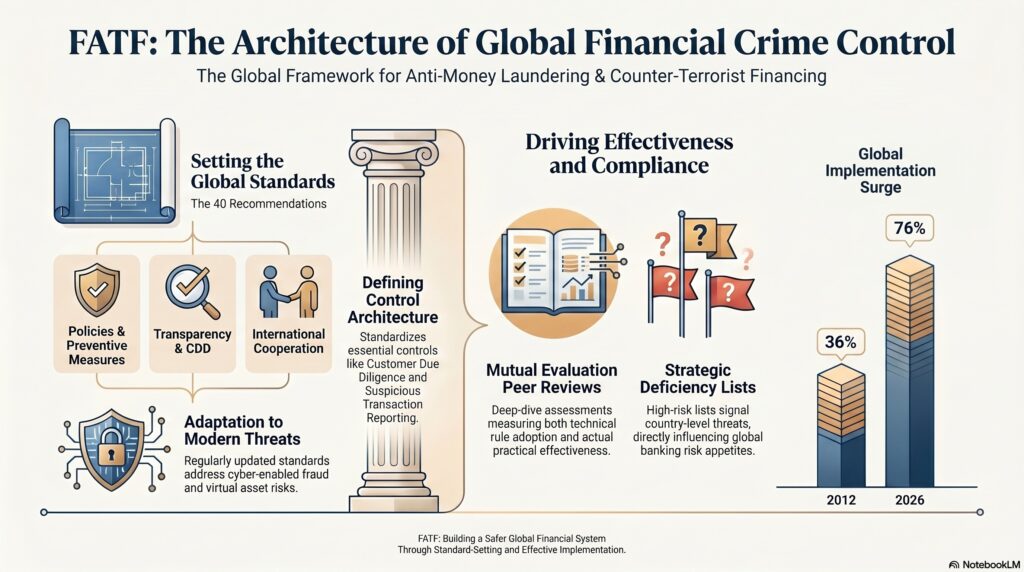
FATF is also highly relevant because it identifies and publicizes jurisdictions with strategic deficiencies. Its lists of jurisdictions under increased monitoring and high-risk jurisdictions subject to a call for action are among the most influential country-risk signals in global compliance. FATF’s February 2026 publications show that this process remains active and that countries are added, reviewed, and assessed based on progress against agreed action plans. For firms, these FATF positions often shape risk appetite, customer due diligence intensity, correspondent banking decisions, and geographic risk assessment.
Another reason FATF matters is that it evolves with the threat environment. The February 2026 plenary outcomes note that FATF approved new publications on cyber-enabled fraud and virtual assets, and the Recommendations themselves were last updated in October 2025. That shows FATF is not a static historical body; it continually adapts its standards and guidance to changing criminal typologies, technologies, and geopolitical risks.
Ultimately, the Financial Action Task Force is central to the financial crime environment because it defines the global standards against which national AML/CFT systems, regulators, and firms are judged. It shapes the design of controls, the assessment of jurisdictions, the expectations placed on institutions, and the international language of financial crime compliance. For that reason, FATF is best understood as the global reference point for building, evaluating, and strengthening modern financial crime frameworks.