
A domestic transfer is a transfer of funds between parties within the same country, typically processed under one national legal and payment-system framework and usually in the domestic currency. In practice, domestic transfers can take several forms depending on the rail used, including account-to-account credit transfers, domestic wire transfers, batched ACH-type payments, and other in-country payment instructions. The Federal Reserve describes ACH as a nationwide network for batched electronic credit and debit transfers in the United States, and FFIEC materials note that Fedwire and CHIPS facilitate U.S. dollar transfers between two domestic endpoints.
In the financial crime environment, domestic transfers matter because they are among the most common and operationally important ways money moves through the financial system. That routine nature is part of their value, but it is also part of their risk. Because domestic transfers are ordinary, high-volume, and often processed quickly, suspicious activity can be concealed within payment flows that appear normal on the surface. A domestic transfer may be entirely legitimate, but it can also be used to move fraud proceeds, pass funds through mule accounts, settle criminal transactions, layer illicit funds, or execute customer-authorised scams. FCA materials on fraudulent payments and payment-fraud reporting make clear that domestic credit transfers are a key channel through which fraud occurs.
From a professional financial crime perspective, the significance of a domestic transfer lies in the fact that it often combines speed, familiarity, and perceived legitimacy. Customers and businesses use domestic transfers for payroll, supplier payments, personal transfers, treasury movements, bill settlement, and internal account management. Because these uses are ordinary, institutions cannot treat domestic transfers as inherently suspicious. The challenge is to determine when a transfer that appears operationally normal is actually inconsistent with the customer’s profile, transaction purpose, or risk context. That is why domestic transfer monitoring depends heavily on behavioral and contextual analysis rather than on the payment type alone. This is an inference supported by the routine use of domestic payment rails and the fraud risks identified by the FCA and FFIEC materials.
Watch on YouTube: Domestic Transfer
Domestic transfers are especially important in the context of authorised push payment fraud and other scam typologies. FCA guidance says APP fraud occurs where a customer is deceived into instructing their provider to send money to an account controlled by a fraudster or for an illegitimate purpose, and the FCA’s risk-based payments guidance was issued specifically to support controls against this kind of fraud. In operational terms, that means a domestic transfer may be technically valid and customer-authorised while still being criminal in substance.
Domestic transfers also matter from an AML perspective because they are frequently used in the movement and layering of funds after the proceeds of crime enter the financial system. A mule account may receive domestic credits and push them onward quickly to other domestic accounts. Fraud proceeds can be fragmented across multiple in-country transfers to reduce visibility. Business accounts can be used to disguise suspicious domestic flows as ordinary commercial payments. The FFIEC’s funds transfer materials explicitly treat funds transfers as an area of money laundering and terrorist financing risk and link them to BSA recordkeeping requirements.
A professionally mature understanding of domestic transfers also requires distinguishing between payment rails. Some domestic transfers are processed in batch form, such as ACH-type payments, while others move through domestic wire systems with final and irrevocable settlement characteristics. The Federal Reserve and OCC describe domestic wire transfers through Fedwire as final and irrevocable when made, while ACH operates in a batched, scheduled-processing environment. These operational differences matter because they affect detection windows, return processes, recovery options, and the type of fraud and AML controls that are realistic.
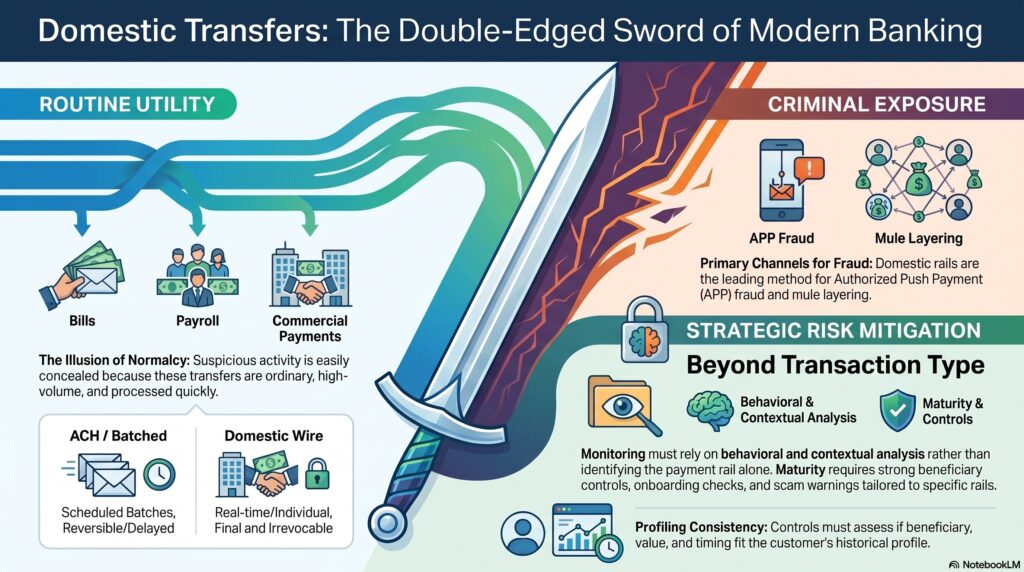
In practical control terms, domestic transfers should be assessed against the customer’s expected behavior. Relevant questions include whether the transfer is consistent with the account purpose, whether the beneficiary is new or unusual, whether the value and timing fit the customer’s historical profile, whether there were recent changes to credentials or contact details, and whether the receiving side shows indicators of mule or fraud activity. FCA payment-fraud reporting categories include issuance or modification of payment orders by fraudsters, which shows that regulators expect firms to distinguish ordinary domestic transfer activity from fraud-linked domestic transfer activity.
Domestic transfers are therefore not just a payment operations concept. They are a financial crime control surface. Institutions need appropriate onboarding controls, beneficiary controls, behavioral analytics, sanctions and screening where relevant, transaction monitoring, scam warnings, and response procedures that match the characteristics of the domestic transfer rail being used. Where those controls are weak, the speed and familiarity of domestic transfers can make them highly attractive for fraud, mule activity, and suspicious movement of funds. This is an inference supported by the cited FCA fraud materials and FFIEC funds transfer guidance.
Ultimately, a domestic transfer is one of the most common ways money moves within a national payment system, but in the financial crime environment it is also one of the most important channels through which fraud and illicit fund movement can occur. Its routine character does not reduce its risk relevance. On the contrary, it is precisely because domestic transfers are ordinary, fast, and trusted that firms need strong controls to distinguish legitimate in-country payments from transfers that support scams, mule networks, and wider financial crime.