
Conduct risk is the risk that a firm’s actions, decisions, incentives, culture, or control environment lead to poor outcomes for customers, markets, counterparties, or the integrity of the financial system. It is closely associated with how people behave inside the organization, how products and services are delivered, how conflicts are managed, and whether business practices align with regulatory expectations and ethical standards. While regulators do not always define conduct risk in a single fixed formula, the FCA’s work on market integrity, financial crime systems and controls, and conduct obligations makes clear that firms are expected to manage behavior and incentives in a way that prevents harm, supports fair treatment, and protects market confidence.
In the financial crime environment, conduct risk is especially important because many financial crime failures are not caused only by weak systems. They are caused by behavior. A firm may have formal AML procedures, sanctions controls, fraud rules, or market abuse policies, but still experience serious failures if staff override controls, tolerate weak challenge, prioritize revenue over integrity, ignore escalation signals, misuse customer information, or accept commercial practices that undermine compliance standards. The FCA’s Financial Crime Guide focuses on effective systems and controls, but the need for those controls exists precisely because culture, incentives, and human judgment can create or amplify financial crime risk when they are poorly managed.
From a professional perspective, conduct risk should not be viewed as separate from financial crime risk. The two are often closely linked. Weak conduct can create the conditions in which money laundering is overlooked, sanctions exposures are tolerated, customers are misled, market abuse is concealed, or fraud is enabled through poor internal behaviour. A sales culture that discourages challenge, for example, may increase onboarding risk. Pressure to retain profitable clients may weaken suspicious activity escalation. Poor communications discipline may heighten market abuse or insider dealing risk. In this way, conduct risk is often the behavioural dimension of financial crime exposure. This is an inference grounded in the FCA’s focus on systems, controls, and market integrity, and ESMA’s emphasis on integrity and investor confidence.
Watch on YouTube: Conduct Risk
One of the defining features of conduct risk is that it is often embedded in ordinary business decisions rather than obvious criminal acts. It may appear in how staff handle vulnerable customers, how exceptions are approved, how warnings are delivered, how conflicts are disclosed, how suspicious behaviour is escalated, or whether commercial objectives are allowed to dominate control considerations. That is why conduct risk is difficult to reduce to a single metric. It arises through decision-making patterns, incentive structures, governance weaknesses, and tolerated behaviours that may not look like fraud or AML failure in isolation, but which create the circumstances in which those failures become more likely.
In the financial crime environment, conduct risk is especially visible in several areas. One is customer onboarding, where poor questioning, inadequate challenge, or commercial pressure can weaken due diligence and beneficial ownership assessment. Another is transaction and alert handling, where staff may close alerts too quickly, avoid escalation, or accept weak explanations to reduce workload or protect relationships. A third is market conduct, where poor communication discipline, conflicts of interest, or aggressive trading culture can create market abuse exposure. ESMA’s market integrity framework is directly relevant here because it is designed to protect fair and orderly markets and support investor confidence.
Conduct risk is also closely linked to governance. A firm’s tone from the top, escalation culture, and accountability structures strongly influence whether staff make prudent and defensible decisions. If senior management signals that commercial outcomes matter more than control quality, conduct risk rises even if formal policies remain unchanged. Likewise, where management information is poor, challenge is weak, and remediation is delayed, small conduct issues can become larger compliance and financial crime problems over time. The FCA’s broader financial crime and risk-assessment work reflects this by focusing on how firms identify, understand, assess, and mitigate risk through governance and controls, not just through policies on paper.
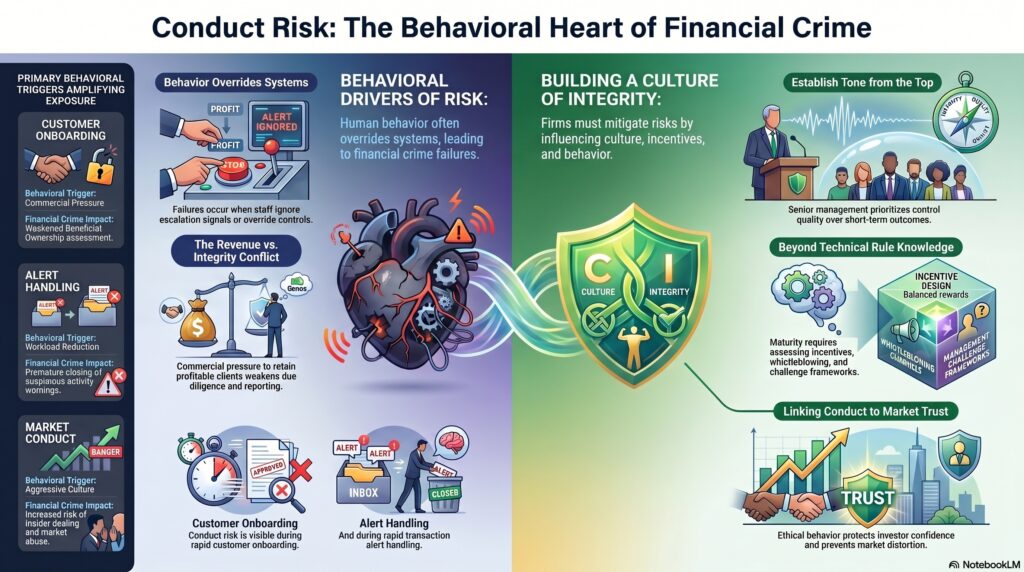
A mature approach to conduct risk therefore requires firms to look beyond whether employees know the rules. It requires firms to assess whether the environment in which decisions are made supports the right outcomes. This includes incentive design, quality assurance, training, management challenge, disciplinary frameworks, whistleblowing channels, and surveillance of high-risk activity. In a financial crime setting, it also includes whether staff understand the purpose of AML, sanctions, fraud, and market abuse controls, and whether they feel able and expected to escalate concerns when those controls are under pressure. The FCA’s conduct and financial crime materials together support this broader view that behavior and governance matter as much as technical rule knowledge.
There is also an important relationship between conduct risk and market confidence. Poor conduct can damage not only individual customers but also the integrity of trading venues, payment systems, and financial institutions. ESMA explicitly links market integrity to investor confidence, and conduct failures in areas such as communication, execution, disclosure, or misuse of inside information can directly undermine that integrity. In that sense, conduct risk is not merely an internal HR or ethics topic. It is a live regulatory and financial crime issue because poor conduct can distort outcomes, conceal misconduct, and weaken public trust in the financial system.
Ultimately, conduct risk is a core concept in the financial crime environment because it captures the danger that behavior, culture, and incentives will undermine legal obligations, customer protection, and market integrity. It sits behind many control failures that later appear as fraud, AML breaches, sanctions issues, or market abuse cases. For that reason, firms should treat conduct risk not as a soft or secondary topic, but as a central part of how financial crime risk is created, amplified, or prevented. Strong controls matter, but the conduct environment in which those controls operate often determines whether they work in practice.