
The Commodity Futures Trading Commission (CFTC) is the independent U.S. federal regulator responsible for overseeing the U.S. derivatives markets, including futures, options on futures, and swaps. The Commission’s market oversight functions are designed to support open, transparent, fair, competitive, and secure derivatives markets, while its enforcement and surveillance functions focus on identifying and addressing fraud, manipulation, abusive practices, and related misconduct. The CFTC’s own organizational materials describe its oversight role in precisely these terms, including the supervision of derivatives markets, trading venues, and market participants.
In the financial crime environment, the CFTC is significant because it sits at the intersection of market integrity, customer protection, and misconduct enforcement in the derivatives sector. Unlike prudential supervisors or retail conduct regulators, the CFTC’s core remit is not general banking supervision. Its importance lies in how it protects derivatives markets from fraud, manipulation, false reporting, misappropriation, disruptive trading practices, illegal off-exchange activity, and related violations that can undermine confidence in commodity and financial markets. The CFTC’s Division of Enforcement explicitly lists these types of violations among the matters it investigates.
From a professional financial crime perspective, the CFTC should be understood as a market-integrity regulator with direct relevance to financial crime controls. Its work is especially important where misconduct in derivatives markets overlaps with broader criminal or abusive conduct, such as fraudulent schemes, market manipulation, false statements, recordkeeping failures, supervisory failures, or abusive trading practices. The Commission also maintains public-facing fraud education functions through its Office of Customer Education and Outreach, which it says helps the public spot, avoid, and report fraud involving commodities or derivatives trading.
Watch on YouTube: Commodity Futures Trading Commission
A key element of the CFTC’s role in the financial crime environment is market surveillance. The Commission states that its Market Surveillance Branch is focused on protecting market users and the public from fraud, manipulation, and abusive practices prohibited by the Commodity Exchange Act, and that it monitors trading activity to detect and prevent manipulation and abusive conduct. This makes the CFTC especially relevant in areas where suspicious market behavior may not present as conventional AML risk, but still constitutes serious financial misconduct with broader integrity implications.
The CFTC is also relevant to AML through its oversight of certain registered market participants. The Commission’s anti-money laundering materials explain that the Bank Secrecy Act and related regulations require futures commission merchants (FCMs) and introducing brokers (IBs) to establish AML programs, report suspicious activity, verify customer identity, and apply enhanced due diligence in certain higher-risk contexts. The CFTC also notes that other registrant categories may in future be subject to additional AML requirements.
This is important because it shows that the CFTC’s role is not limited to market abuse in the narrow sense. In the derivatives environment, firms subject to the Commission’s regime may also face BSA/AML obligations that require them to maintain written AML programs, suspicious activity reporting processes, and customer verification controls. In practice, that means the CFTC sits adjacent to both market-conduct regulation and anti-money laundering enforcement, particularly for registrants operating in the futures and commodities space.
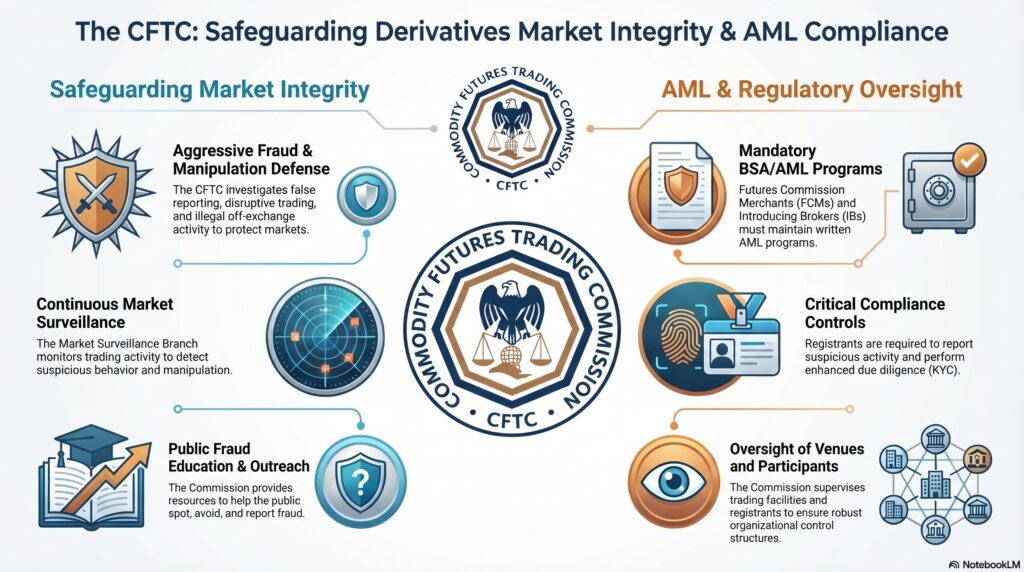
Another major feature of the CFTC’s role is its oversight of registrants and trading venues. The Commission’s Market Participants Division says its mission is to conduct smart, effective, and practical oversight of CFTC registrants, while the Division of Market Oversight says it supervises the health and market structure of derivatives markets and the exchanges and facilities on which those derivatives trade. In the financial crime environment, this matters because control failures at firms or venues can create conditions in which fraud, manipulation, and broader misconduct are harder to detect or deter.
There is also an important boundary issue. The CFTC’s authority is strongest in derivatives markets, not across all financial markets or all digital asset activity. In public remarks, the agency has noted that for digital asset commodities in the spot market, its authority is limited primarily to prosecuting fraud and manipulation rather than broad ongoing regulatory supervision. That distinction matters because it explains both the reach and the limits of the Commission’s financial crime role.
Ultimately, the Commodity Futures Trading Commission is important in the financial crime environment because it helps preserve the integrity of U.S. derivatives markets through surveillance, registrant oversight, enforcement, customer education, and certain AML-related obligations. Its role is especially significant where fraud, manipulation, false reporting, abusive trading, and supervisory failures threaten confidence in futures, options, and swaps markets. For firms operating in or around those markets, the CFTC should be understood as a core regulator of market integrity and misconduct risk, with direct relevance to both compliance controls and broader financial crime governance.


