 FinCrime Intelligence

The prosecution of former OpenSea product manager Nathaniel Chastain was initially presented as the first criminal conviction for insider trading involving non-fungible tokens. That description captured the enforcement ambition of the case, but it no longer reflects its final legal outcome.
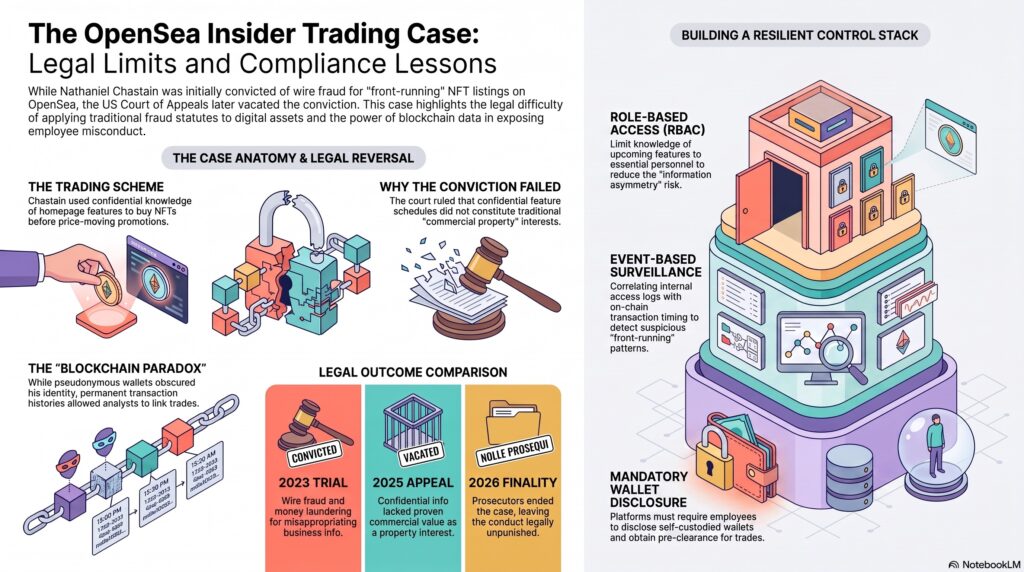
A Manhattan jury convicted Chastain in May 2023 of wire fraud and money laundering after prosecutors alleged that he used confidential knowledge of NFTs scheduled for promotion on OpenSea’s homepage to buy them before publication and sell them after the resulting increase in attention and price.
He was sentenced in August 2023 to three months in prison, three months of home confinement, three years of supervised release, a US$50,000 fine and forfeiture of Ethereum obtained through the trades.
In July 2025, however, the United States Court of Appeals for the Second Circuit vacated both convictions. The majority held that the jury instructions could have permitted conviction for unethical workplace behaviour without requiring proof that Chastain had misappropriated a traditional property interest belonging to OpenSea.
After the case returned to the district court, prosecutors entered a deferred-prosecution resolution and filed a nolle prosequi in February 2026, ending the prosecution.
The case is therefore more significant than a simple conviction story. It demonstrates both the power of blockchain data to expose employee misconduct and the limits of using broad federal fraud statutes to police market abuse where the traded assets may not fall within conventional securities rules.
Key Takeaways
- Insider Trading Risk Extends Beyond Traditional Securities Markets
- Confidential Platform Information Can Create Material Trading Advantages
- NFTs Can Be Used in Fraud and Money Laundering Schemes
- Digital Asset Misconduct Can Be Prosecuted Under Existing Fraud Laws
- Employee Access to Sensitive Marketplace Data Creates Conduct Risk
- Crypto Market Abuse Does Not Depend on an Asset Being a Security
- Anonymous Wallets Do Not Guarantee Anonymity
- Blockchain Transparency Can Support Investigations
- Novel Technology Does Not Eliminate Traditional Financial Crime Principles
- Digital Asset Platforms Require Strong Information-Barrier Controls
- Employee Trading Activity Can Create Significant Reputational Risk
- NFT Marketplaces Require Market Surveillance Capabilities
- Insider Threat Monitoring Is Relevant to Digital Asset Businesses
- The OpenSea Case Expanded Enforcement Attention to Crypto Market Conduct
Listen the podcast
Watch the video
Why the OpenSea case matters now
Digital-asset markets create many of the information asymmetries found in traditional finance. Exchange listings, homepage features, token launches, partnership announcements and protocol changes can move prices before the wider market can assess their significance.
Employees, advisers, contractors and connected third parties may know about those events before users do. A person with privileged access can trade before an announcement or tip someone who trades on their behalf.
The legal framework is less straightforward. Traditional United States insider-trading law is primarily associated with securities and generally depends on a duty of trust or confidence and the deceptive use or disclosure of material non-public information.
The Chastain prosecution did not require the government to prove that the NFTs were securities. Prosecutors used wire fraud, alleging the misappropriation of OpenSea’s confidential business information, and money laundering, based on transactions intended to conceal the alleged proceeds.
That approach reached conduct in an emerging market without resolving the regulatory status of each NFT. It also created the property-law issue that ultimately undermined the conviction.
How the trading scheme operated
Chastain was OpenSea’s first head of product and selected NFTs to appear in a featured section of the marketplace’s homepage.
A feature could direct substantial attention towards a collection, and the appellate record indicated that promoted NFTs typically increased in price.
According to prosecutors, Chastain bought NFTs before they appeared on the homepage and sold them afterwards, earning approximately US$57,000. He often used accounts and digital wallets not publicly associated with his name, moving cryptocurrency from a personal wallet to an intermediary wallet, executing trades and later returning proceeds.
The wallet separation was presented as evidence of concealment and supported the money-laundering charge, which depended on wire fraud as its predicate offence.
The conduct became public because market participants analysed blockchain transactions. They linked purchases made before homepage features with wallets associated with Chastain and raised the pattern publicly in September 2021.
OpenSea asked him to resign and introduced policies preventing employees from trading collections while the platform was featuring or promoting them and from using confidential information to trade NFTs.
The episode exposed a central blockchain paradox: pseudonymous wallets can obscure identity, but the underlying transaction history may remain permanently available for investigation.
Blockchain records show wallet addresses, token movements and timestamps, but not automatically the person controlling an address. Attribution depends on links to exchange accounts, known wallets, platform records and off-chain evidence. In this case, transaction timing and wallet flows could be compared with employment records, communications and access logs to establish knowledge, control and intent.
What “insider trading” meant legally
The label described the economic behaviour, not the criminal offence charged.
Chastain was prosecuted under the federal wire-fraud and money-laundering statutes rather than the principal securities-fraud provisions.
Wire fraud requires a scheme to obtain money or property through false or fraudulent pretences using interstate wires. The government argued that OpenSea’s confidential selection information was property and that Chastain misappropriated it for personal gain.
The theory drew on the Supreme Court’s decision in Carpenter, which recognised a newspaper’s confidential prepublication information as property. The newspaper had an economic interest in controlling information forming part of its commercial product.
OpenSea’s feature decisions were different. The marketplace did not sell the information, charge creators to be featured or trade promoted NFTs itself. Its economic interest in keeping the selections confidential therefore became a disputed issue.
The case tested how far confidential business information can be treated as property under a criminal fraud statute.
Why the Second Circuit vacated the convictions
The trial judge instructed the jury that confidential information could be property even if it had no commercial value to OpenSea. Jurors were also told that a scheme to defraud could involve conduct departing from traditional notions of honesty and fair play.
The Second Circuit majority held that those instructions were erroneous under Supreme Court decisions limiting federal fraud statutes to traditional property interests.
The court concluded that not every item of confidential information is property for wire-fraud purposes. The information must have commercial value to its holder through exclusive use, confidentiality or another recognised economic interest.
The trial evidence supported competing interpretations. OpenSea treated the feature decisions as confidential and could suffer reputational harm if users believed employees exploited them. Other evidence suggested the information was tangential to the marketplace’s business and was not itself commercialised.
A jury note suggested that jurors may have believed OpenSea did not genuinely regard the information as confidential while still considering Chastain’s conduct unethical.
Because the instructions allowed conviction on that basis, the appellate court could not treat the error as harmless. It vacated the wire-fraud conviction and, because that offence was the predicate for the laundering count, vacated the money-laundering conviction as well.
The dissent and the unresolved boundary
The appellate decision was divided.
The dissent argued that the majority had created an unnecessary commercial-value requirement inconsistent with Carpenter. In that view, a company’s right to the exclusive use of confidential business information was sufficient to establish property even where the information was not separately sold or monetised.
The disagreement reaches beyond NFTs. Companies hold non-public listing decisions, rankings and algorithm changes that may influence markets without being sold as products. Exploiting that information may breach employment or fiduciary duties, while criminal property fraud still depends on the company’s economic interest and the statutory elements proved.
The Second Circuit did not hold that confidential information can never be property. It required a more precise connection between the information and a traditional commercial property interest.
What the ruling did not decide
The decision did not declare Chastain’s trading acceptable or prevent employers from prohibiting employee dealing and pursuing disciplinary or civil action.
It did not determine that every NFT lies outside securities, commodities, consumer-protection or market-abuse law. Classification remains fact-specific and depends on the rights, structure, marketing and economic reality of the asset.
Nor did it exempt blockchain markets from fraud law. Deception involving money, tokens or commercially valuable information may still fall within federal or state offences where the statutory elements are established.
The judgment warned against converting a broad ethical expectation into a criminal property offence without identifying the property obtained. Market integrity and criminal liability overlap, but they are not identical.
Why platforms cannot wait for legal classification
A platform should not need a final judicial ruling on whether every listed asset is a security before controlling employee conflicts.
Users reasonably expect promotional features, listing decisions and rankings to be administered without undisclosed self-dealing by the people controlling them.
Digital-asset businesses should identify information capable of affecting price or user behaviour. Access should be role-based, logged and reviewed. Employees with advance knowledge should be subject to trading blackouts covering the relevant assets, linked collections and economically connected tokens.
Personal-account dealing rules must address self-custodied wallets rather than only regulated brokerage accounts. Employees in sensitive roles may need to disclose relevant wallet addresses and obtain pre-clearance for transactions.
A prohibition without surveillance has limited value. Platforms should compare employee and connected-party wallets with announcement calendars, feature schedules and transaction activity. Controls should also cover tipping to relatives, friends, investors or creators.
Detecting digital-asset information abuse
Effective detection combines event, access, market and identity data.
Event data establishes when a collection was selected, when the decision became final and when the feature became public. Access records identify employees who viewed or changed the restricted information. Market data shows purchases, sales and price movements, while identity data links wallets through funding sources, exchange accounts, devices and relationships.
Each signal may be innocent in isolation. Risk increases where the same wallet repeatedly buys assets soon after a particular employee accesses restricted information and sells immediately after publication. Investigators should preserve platform logs, messages and account data before shorter retention periods expire.
What a resilient control stack looks like
A resilient control stack combines information classification, least-privilege access, personal-dealing rules and event-based surveillance. It should cover employees, contractors, close associates and disclosed wallets, while blockchain analytics clusters addresses, traces funding and identifies links to known insiders.
Platforms also need conflict controls for creators, investors and commercial partners seeking promotion, together with independent investigation and documented escalation. Seniority or commercial importance should not protect an employee from scrutiny.
The institution should define when trading activity triggers an internal investigation, account restriction, regulatory notification or suspicious-activity report. Investigators also need authority to combine human-resources information, system access logs and on-chain data while respecting privacy and employment law.
Controls must extend beyond direct trading. An insider may provide information to a relative, friend, investment fund, creator or external wallet operator. Network analysis should therefore identify common funding sources, coordinated transaction timing and proceeds moving between apparently unrelated wallets.
Governance should also determine how long restricted information remains sensitive. The risk may begin before a formal decision is made and continue until the market has had a reasonable opportunity to absorb the public announcement.
The international regulatory direction
The European Union’s Markets in Crypto-Assets Regulation contains a market-abuse regime for crypto-assets within its scope, prohibiting insider dealing, unlawful disclosure of inside information and market manipulation.
Genuinely unique and non-fungible crypto-assets are generally excluded. Fractionalised assets, large collections and tokens that are non-fungible in name but interchangeable in substance may be treated differently under the regulation’s substance-over-form approach.
This means that calling an asset an NFT does not determine its regulatory treatment. Authorities must examine whether the token and the rights it represents are genuinely unique, whether units are issued in a large series and whether market participants treat them as interchangeable.
ESMA’s supervisory guidance also recognises crypto-specific risks, including social-media influence, token-supply manipulation and transaction-ordering strategies. Market surveillance must adapt traditional principles to the technology rather than assuming that transparent blockchains eliminate abuse.
What this means for financial crime leaders
The OpenSea case should no longer be described simply as the first successful NFT insider-trading prosecution. The conviction was vacated, and the prosecution ultimately ended.
Its compliance lessons remain powerful. Market participants detected the conduct by analysing public transactions, demonstrating that wallet separation does not guarantee anonymity and that event-based blockchain surveillance can expose patterns missed by conventional monitoring.
The case also demonstrates the need for legal precision. A breach of trust, conflict of interest or unethical trade does not automatically satisfy wire fraud. Prosecutors must identify money or traditional property obtained through the required deception.
For digital-asset platforms, that limitation is not a reason to weaken controls. Market confidence depends on preventing employees and connected parties from exploiting advance access to platform decisions.
The strongest institutions will combine restricted-information governance, employee-trading controls, blockchain analytics and independent escalation with a realistic understanding of the applicable law.
Digital markets may change the asset, execution venue and evidence trail. They do not remove the underlying risk created when confidential information, discretionary platform power and personal trading converge.
What Financial Institutions Should Consider
- Extend Insider Trading Controls to Digital Assets
- Establish Clear Employee Digital Asset Trading Policies
- Restrict Access to Market-Sensitive Platform Information
- Monitor Employee and Personal Wallet Activity Where Legally Permitted
- Strengthen Information Barriers and Access Controls
- Maintain Audit Trails for Confidential Data Access
- Monitor Trading Around Listings and Promotional Events
- Apply Blockchain Analytics to Suspicious Wallet Activity
- Identify Connected Wallets and Transaction Patterns
- Integrate Market Surveillance With Financial Crime Monitoring
- Conduct Conflict-of-Interest Risk Assessments
- Strengthen Employee Conduct and Ethics Training
- Establish Pre-Clearance Requirements for Higher-Risk Trading
- Investigate Unusual Trading Linked to Internal Events
- Conduct Retrospective Reviews Following Suspected Information Misuse
- Incorporate Digital Assets Into Market Abuse Risk Assessments
- Coordinate Compliance, AML, Cyber and Market Surveillance Teams
- Treat Digital Asset Insider Misconduct as Both Conduct and FinCrime Risk
Download the briefing
NFT Insider Trading After OpenSea: Market Abuse, Blockchain Evidence, and the Limits of Wire Fraud



The OpenSea case remains a landmark in digital-asset compliance, not because it produced a lasting criminal conviction, but because it exposed the legal and operational difficulty of policing information abuse in markets that sit outside traditional regulatory categories.
The conduct alleged by prosecutors reflected a familiar market-integrity problem: an employee used advance knowledge of a platform decision to trade before the wider market could react. Blockchain records, wallet analysis and platform data made that activity visible. Yet the eventual reversal of the convictions showed that unethical conduct, breach of trust and criminal wire fraud are not interchangeable concepts.
For prosecutors, the lesson is precision. A successful fraud case must identify the money or traditional property obtained and prove that the defendant’s deception satisfied the statutory elements. Broad appeals to fairness or workplace dishonesty cannot substitute for a clearly recognised property interest.
For digital-asset businesses, the legal outcome is not a reason to weaken employee-dealing controls. Platforms should classify price-sensitive information, restrict access, monitor personal and connected wallets, impose trading blackouts and investigate suspicious activity independently of an asset’s formal regulatory status.
Ultimately, digital markets do not eliminate insider risk; they change the evidence trail. Organisations that combine blockchain analytics, access logs, personal-dealing rules and legally grounded escalation will be better positioned to prevent employees from converting privileged platform access into private financial advantage.