
Wash trading is the practice of entering into transactions that create the appearance of genuine trading activity without a real change in beneficial ownership or market risk. ESMA’s market-abuse materials define wash trades as arrangements for the sale or purchase of a financial instrument where there is no change in beneficial interests or market risk, or where any transfer is only between parties acting in concert or collusion. In U.S. commodities regulation, the CFTC glossary describes wash trading as a scheme that gives the appearance of trading when no bona fide, competitive tradehas actually occurred.
In the financial crime environment, wash trading matters because it is a form of false market activity. It creates the impression of liquidity, volume, price interest, or market participation that is not economically genuine. That can mislead other market participants, distort price formation, support manipulation, and undermine confidence in the fairness of markets. The FCA states that the UK Market Abuse Regulation aims to increase market integrity and investor protection, which is the broader framework within which wash trading is treated as problematic.
From a professional perspective, the key issue is economic reality. A legitimate trade normally transfers ownership or risk between parties with genuinely different economic interests. A wash trade does not do that in substance. The trade may appear valid in form, but it lacks real market purpose because the same beneficial owner, or coordinated parties with aligned interests, end up on both sides in a way that neutralizes genuine market exposure. ESMA’s definition is explicit that the problem is the absence of meaningful change in beneficial interest or market risk.
Watch on YouTube: Wash Trading
This is why wash trading is closely associated with market manipulation. A trader or group may use wash trades to inflate reported volume, create the illusion of demand, support a desired price level, or give credibility to a security, contract, or market that would otherwise appear inactive. In some environments, wash trading can also be used to support wider schemes such as pump-and-dump activity, misleading valuation, or fee/rebate abuse. This is an inference supported by ESMA’s classification of wash trades under false or misleading transactions and by the CFTC’s treatment of wash trading as fictitious trading.
Wash trading is especially important in electronic and fragmented markets, where large numbers of transactions can occur quickly and apparent volume can influence investor perception or trading algorithms. The underlying misconduct is not limited to traditional securities markets. U.S. derivatives enforcement remains active, with the CFTC issuing wash-sale enforcement actions in 2024 and 2025 involving non-competitive transactions and wash sales. That shows the typology remains current, not historical.
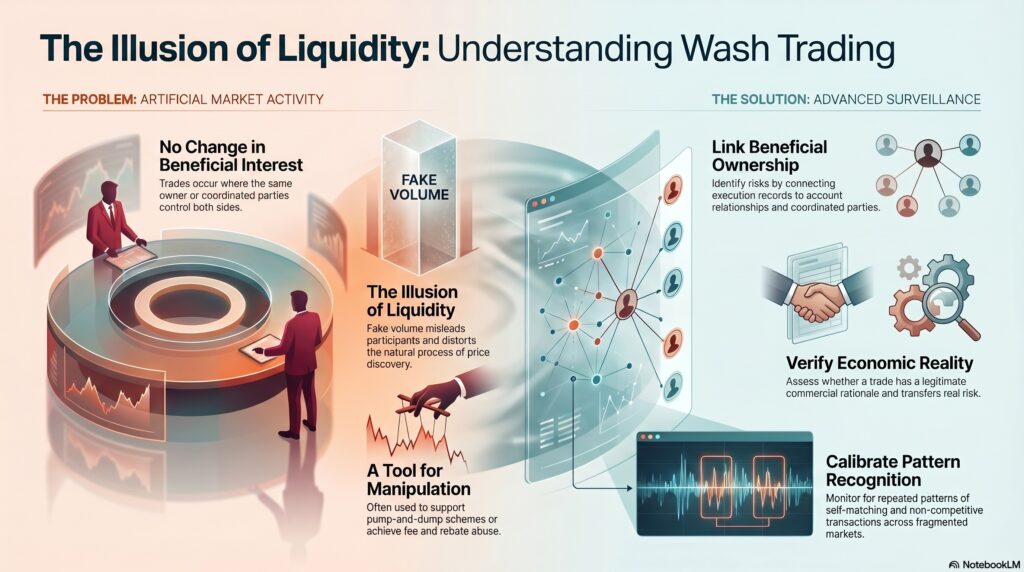
For firms, the control challenge is that a wash trade may not always be obvious from a single execution record. Detection often depends on linking counterparties, beneficial ownership, account relationships, timing, pricing, and repeated patterns of self-matching or coordinated trading. Where the same person controls both sides, or related parties repeatedly transact without real economic change, the risk becomes much more significant. This is an inference supported by the regulatory definitions focusing on beneficial ownership, market risk, and non-bona fide trading.
A mature surveillance framework therefore needs to look beyond superficial execution data. It should assess whether the trade had a legitimate commercial rationale, whether risk truly changed hands, whether the counterparties were genuinely independent, and whether the activity formed part of a wider manipulative pattern. Trade surveillance, beneficial ownership understanding, and escalation into market-abuse reporting processes are all relevant here. ESMA’s broader market-abuse reporting work highlights the importance of typologies and suspicious transaction and order reporting in this area.
Ultimately, wash trading matters in the financial crime environment because it creates fake market activity. It undermines market integrity by making trading interest, volume, or price action look real when it is not. For that reason, it should be treated as a serious market-abuse and surveillance risk requiring strong data linkage, ownership transparency, and well-calibrated trade monitoring.