
Voice-to-text solutions are computer-based tools that convert spoken language into text. NICE Actimize’s glossary defines them as a process that recognizes spoken language and translates it into text.
In the financial crime environment, voice-to-text solutions matter because a large share of potentially risky conduct can occur in recorded voice communications, not only in email or chat. Once voice is transcribed into searchable text, firms can apply lexicons, surveillance rules, analytics, and investigation workflows more consistently across channels. NICE Actimize says voice communications can be converted to text to facilitate analysis and compliance monitoring, and its trader voice transcription materials describe transcription as reducing manual effort and accelerating compliance investigations.
From a professional perspective, voice-to-text solutions are mainly relevant to communications surveillance, conduct monitoring, and market-abuse detection. The FCA’s August 2025 off-channel communications review says robust recordkeeping and monitoring of communications is essential for firms to detect and investigate misconduct. FINRA’s AI-in-securities-industry materials likewise note that firms use AI to capture and surveil structured and unstructured data in forms including speech and voice to identify patterns and anomalies.
Watch on YouTube: Voice-To-Text Solutions
This means voice-to-text is not just a productivity tool. It is a control-enabling technology. Without transcription, recorded calls are much harder to review at scale, especially where firms need to detect misconduct indicators, off-channel references, market-abuse language, complaint signals, or other suspicious content. Global Relay’s 2024 compliance note says audio transcription is critical to robust voice surveillance to meet recordkeeping and monitoring obligations.
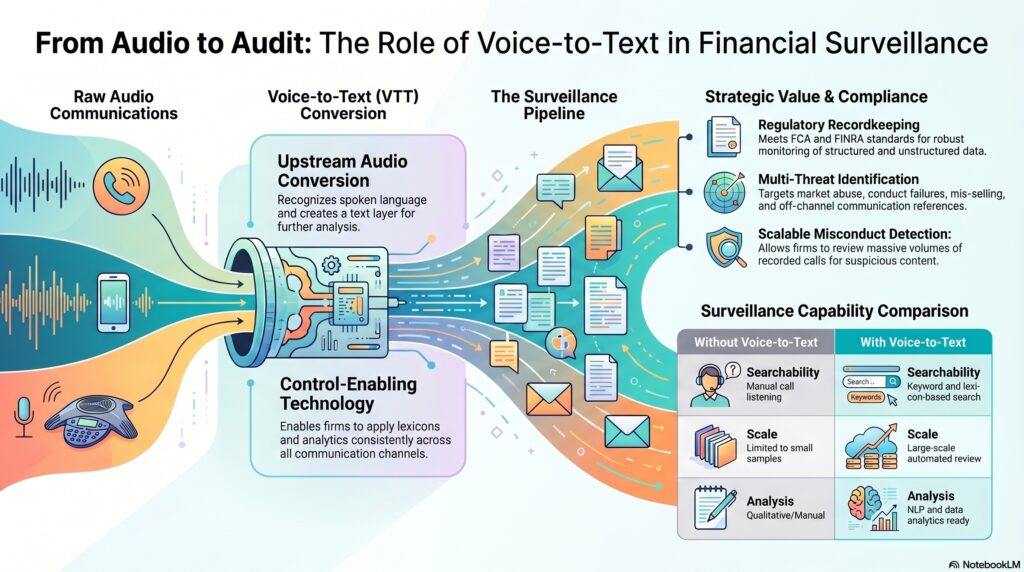
A key professional point is that voice-to-text solutions usually sit upstream of other surveillance methods. The transcription itself does not determine misconduct; it creates a text layer that can then be searched, scored, or reviewed using lexicon-based models, NLP, or manual investigation. NICE Actimize’s communications-surveillance materials and white paper both describe this broader workflow, where transcription supports later analysis and better detection accuracy.
In practical financial crime terms, voice-to-text solutions are valuable where firms need to monitor trader calls, sales calls, client interactions, or internal voice communications for signs of market abuse, conduct failures, mis-selling, or policy breaches. But the effectiveness of these tools depends on transcription quality, language coverage, governance, escalation standards, and integration with wider surveillance and recordkeeping controls. This is an inference supported by the FCA’s emphasis on communications monitoring and by vendor descriptions of transcription as part of compliance workflows.
Ultimately, voice-to-text solutions matter in the financial crime environment because they turn spoken communications into analyzable records, making voice surveillance more scalable, searchable, and useful for detecting misconduct and supporting investigations.