Suspicious activity is behavior, transactions, patterns, or circumstances that indicate a possible connection to money laundering, terrorist financing, fraud, sanctions evasion, market abuse, or other illicit conduct and therefore justify further review or reporting. The FFIEC states that suspicious activity monitoring and reporting are critical internal controls and that appropriate policies, procedures, and processes should be in place to monitor and identify unusual activity. In the UK, the FCA says that if a firm knows or suspects that someone is involved in, or attempting, money laundering, it must submit a Suspicious Activity Report to the National Crime Agency.
In the financial crime environment, suspicious activity matters because it is the point at which ordinary financial behavior stops looking commercially or behaviorally coherent and begins to suggest possible criminal misuse. The concept is broader than “illegal activity proved.” A transaction or customer pattern may be suspicious long before the firm can prove a predicate offence, identify the full scheme, or know exactly which law may have been broken. FinCEN’s SAR materials and FAQs make clear that the suspicious activity reporting regime is designed to capture concerns at the point where suspicion arises, not only after certainty exists.
From a professional perspective, suspicious activity is not the same as unusual activity, but the two are closely related. Unusual activity is simply activity that falls outside the expected pattern. Suspicious activity is activity that, after considering context, appears potentially linked to illicit conduct or lacks a credible lawful explanation. The FFIEC notes that many legitimate transactions may be unusual because they are inconsistent with normal account activity, but that monitoring and reporting are essential to identifying activity that may expose the bank to financial loss or illicit use.
Watch on YouTube: Suspicious Activity
This distinction is important because firms should not confuse every anomaly with criminality. A large payment, an unfamiliar counterparty, or a sudden change in account behavior may have a valid explanation. What makes the activity suspicious is the combination of indicators, lack of coherent rationale, inconsistency with the customer profile, or signs of evasion, deception, or concealment. FATF’s red-flag guidance makes the same point: a single indicator is not proof of criminal activity, but multiple indicators with no logical business explanation may require further examination and reporting.
In practical terms, suspicious activity can appear in many forms. It may involve unexplained movement of funds, structuring around reporting thresholds, rapid pass-through activity, unusual use of mule accounts, inconsistent source-of-funds explanations, sanctions-sensitive routing, suspicious market activity, or patterns linked to fraud and cyber-enabled abuse. The FFIEC’s red-flag appendix provides examples across money laundering and terrorist financing typologies, and the FCA’s wider financial crime materials treat suspicious activity as part of firms’ frontline responsibility to identify and escalate financial crime concerns.
This is why suspicious activity sits at the heart of the SAR/SAR-equivalent reporting framework. In the U.S., the FFIEC notes that banks are required to file a SAR whenever they detect a known or suspected criminal violation of federal law or a suspicious transaction related to money laundering or a violation of the BSA. FinCEN’s FAQ materials also restate the filing framework and timing expectations, including the general 30-day filing timeline from initial detection, extended to 60 days where no suspect is identified.
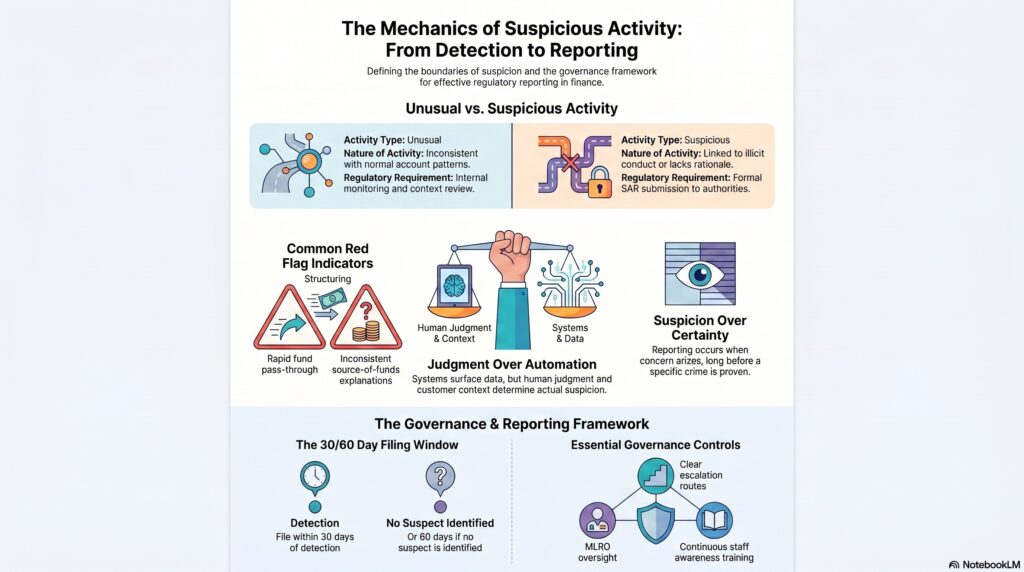
A key professional point is that suspicious activity is ultimately a judgment concept supported by controls, not a purely automated one. Monitoring systems, red-flag scenarios, rules, and models help surface activity that may warrant concern, but the determination of suspicion often depends on context, investigation, and the quality of customer understanding. The FFIEC’s examination procedures focus not only on whether monitoring systems exist, but on the process used to monitor, identify, research, and report suspicious activity.
Governance is therefore essential. A mature suspicious-activity framework requires clear escalation routes, trained investigators, an effective nominated officer or MLRO structure where applicable, good-quality customer and transaction data, and enough management oversight to ensure concerns are neither ignored nor over-escalated without basis. FCA guidance on AML governance and suspicious activity reporting reinforces that firms need staff awareness and escalation discipline, not just written rules.
Ultimately, suspicious activity is one of the most important practical concepts in the financial crime environment because it is the threshold at which concern becomes action. It is how firms translate unusual patterns, warning signs, and contextual inconsistencies into investigation, escalation, and, where appropriate, formal reporting to authorities. Without an effective suspicious-activity framework, the wider AML, fraud, and sanctions control environment loses one of its main mechanisms for identifying and disrupting illicit finance.


