
A Memorandum of Understanding (MOU) is a formal cooperation arrangement that sets out how two or more authorities or organizations intend to coordinate, consult, and exchange information. In the financial crime environment, an MOU is not usually the source of the substantive legal obligation itself. Instead, it provides the operational framework for how institutions or regulators will work together on supervision, oversight, information-sharing, and risk management. SEC materials explain that MOUs are generally used to facilitate consultation and cooperation with foreign counterparts and to set out the terms and conditions for sharing and protecting nonpublic information.
From a professional perspective, the importance of an MOU lies in structured cooperation. Financial crime, market abuse, sanctions evasion, and wider supervisory risk often cross institutional and national boundaries. One authority may supervise the firm, another the market infrastructure, another the banking group, and another the overseas branch or trading venue. Without a clear framework for who shares what, when, and on what confidentiality basis, important information can be delayed, duplicated, or missed. FCA and Bank of England MOUs explicitly describe themselves as high-level frameworks for cooperation and coordination in supervision and market infrastructure oversight.
In the financial crime environment, MOUs are especially relevant because many risks are cross-border and multi-agency by nature. Fraud proceeds move across jurisdictions, correspondent relationships span countries, market misconduct can involve participants supervised by different authorities, and critical third parties may sit outside the primary regulator’s perimeter. FATF’s 2025 report on international cooperation for money laundering detection, investigation, and prosecution notes that memoranda of understanding are part of the cooperation landscape and emphasizes the importance of relevant information-sharing across authorities.
Watch on YouTube: Memorandum of Understanding (MOU)
A key feature of an MOU is that it often clarifies scope, confidentiality, and use of information. SEC materials state that MOUs establish clear mechanisms for information exchange, including the terms and conditions for sharing and protecting nonpublic information. This matters because regulators and institutions may each hold sensitive supervisory, investigative, or customer-related information that cannot simply be exchanged informally without regard to legal and confidentiality constraints. In practical terms, an MOU helps create a defensible basis for cooperation while respecting those constraints.
MOUs are also important because they reduce ambiguity in crises and live risk events. If a cyberattack affects a critical third party, if a cross-border supervised entity deteriorates, or if a market abuse issue spans jurisdictions, authorities need to know how to coordinate quickly. The FCA’s January 2026 statement on the UK-EU regulators’ MOU for critical third parties says the arrangement establishes a framework for coordinating and sharing information on oversight, including during incidents such as power outages or cyber-attacks, and aims to strengthen international cooperation while managing risks to financial stability and market confidence.
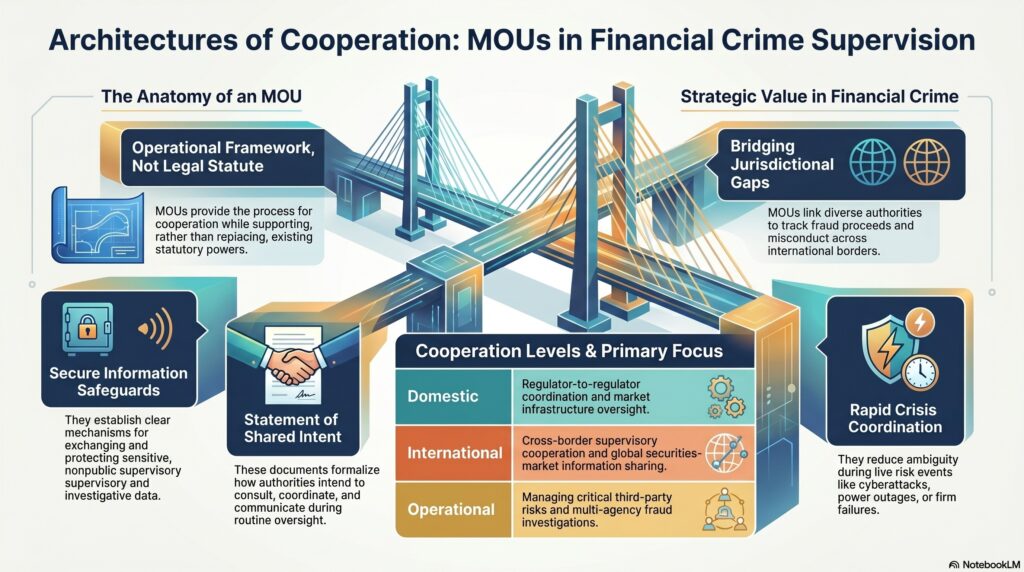
A professionally mature understanding also recognizes that an MOU is often a statement of intent and process, not a standalone enforcement statute. SEC bilateral MOUs commonly describe themselves as statements of intent to consult, cooperate, and exchange information in connection with supervision and oversight. That means an MOU usually supports the exercise of existing statutory powers rather than replacing them. In the financial crime environment, its value is operational: it helps authorities and institutions act coherently across legal and supervisory boundaries.
In practical terms, MOUs appear across many parts of the financial crime and supervision landscape: domestic regulator-to-regulator coordination, cross-border supervisory cooperation, oversight of financial market infrastructure, cooperation on critical third-party risk, and securities-market information-sharing. FCA MOUs with the Bank of England, the PRA, and other authorities show how central these arrangements are to supervisory coordination in the UK framework.
Ultimately, a Memorandum of Understanding matters in the financial crime environment because it helps turn fragmented authority into coordinated action. It supports information-sharing, clarifies expectations, protects confidentiality, and improves the ability of regulators and institutions to respond to cross-border, cross-sector, and multi-agency risks. For that reason, an MOU should be understood as a key cooperation instrument within the wider architecture of financial crime supervision and market oversight.


